Here in Quebec, we have perhaps the highest tax burden in North America, and it appears we are using a lot of that money to line the pockets of all too many of our elected leaders. Tax and development experts have long argued that if you could only get the masses paying taxes, they will demand their governments be accountable to them for how those taxes are used (this has been the argument for salient taxes like the VAT, which everyone feels the pain of daily). This shameful abuse of taxpayers ought to get people into the streets banging pots.
On fiscal policy, politics, society, philosophy, and culture. Follow on twitter: @profchristians
Tuesday, October 16, 2012
Canada's decision on Glaxo coming soon!
Prepare yourselves--the Supreme Court will soon release its decision in the Glaxo SmithKline case. The case record is here. But as a quick reminder, here are the basics of the dispute:
My own view is the Gabco reasonable business person test was wrongly applied, and the license and supply agreement must be viewed separately under any coherent transfer pricing assessment, otherwise the taxpayer is free to create any pool of agreements they want to and tie them all together to justify any price--in other words, there would never be any comparables and you might as well not have a transfer pricing regime at all. But the case deals with repealed s. 69(2) and not the current standard (ITA 247), so even if the SCC rules against the government here and delivers Glaxo a big win by letting it hide royalty payments in its supply agreement, there is likely still a chance that Canada could have a coherent arms' length rule under current law.
Keep in mind that Glaxo settled a similar transfer pricing dispute in the US for $3.4 billion back in 2006 pending a trial that was to begin in 2007; the bulk of the issues in that dispute involved Zantac, but the issue was the deductibility of royalties connected to marketing intangibles rather than the price paid for ranitidine. The IRS said that GSK conceded over 60% of the total amount at issue in that case.
- Glaxo Group and Glaxo Canada entered into a License Agreement giving Glaxo Canada the right to market Zantac, the active ingredient of which is ranitidine
- The agreement required Glaxo Canada to buy its ranitidine from a member of the Glaxo Group, Adechsa, a nonresident company.
- Under that supply agreement, Glaxo Canada paid about five times as much per kilo for its ranitidine supply as its generic brand competitors paid for theirs (Glaxo Canada paid between $1,512 and $1,652 per kilo, while two generic brand competitors paid non arms' length suppliers between $194 and $304 per kilo).
- Even at the inflated price, Glaxo Canada stood to earn a 40% profit margin on the sales of Zantac.
- The Minister deemed Glaxo Canada's purchase price to be greater than that which "would have been reasonable in the circumstances if ... [Adechsa] and ... [Glaxo Canada] had been dealing at arm's length," and therefore reallocated Glaxo Canada's profits under ITA s. 69(2) using $300 as the appropriate price for ranitidine.
- Glaxo Canada argued that any reasonable business person would enter into the supply agreement with Adechsa in order to obtain the benefit of the license agreement with the Glaxo Group.
- The trial judge assessed the license agreement and the supply agreement separately, and upheld the Minister's assessment but allowed an adjustment of $25 per kilogram to reflect the price of processing the ranitidine, therefore setting the arm's length price at $325 per kilo.
- The Federal Court of Appeal decided that the license and supply agreements should have been assessed together and determined that Glaxo Canada’s business circumstances were not comparable with the generic brand competitors because the question at issue was “whether that arm’s length purchaser would be able to sell his Ranitidine under the Zantac trademark." The FCA therefore found that the Tax Court erred in not considering the license agreement as a circumstance, and sent the matter back to trial court to decide whether the price was reasonable under the circumstances (following Gabco).
- On appeal, the SCC is to determine (1) whether the Federal Court of Appeal erred by applying the reasonable business person test to the interpretation of subsection 69(2) of the Income Tax Act; and (2) whether the Federal Court of Appeal erred in interpreting subsection 69(2) by failing to apply the arm’s-length principle on a transaction-by-transaction basis and on the basis that members of the multinational group are operating as separate entities.
My own view is the Gabco reasonable business person test was wrongly applied, and the license and supply agreement must be viewed separately under any coherent transfer pricing assessment, otherwise the taxpayer is free to create any pool of agreements they want to and tie them all together to justify any price--in other words, there would never be any comparables and you might as well not have a transfer pricing regime at all. But the case deals with repealed s. 69(2) and not the current standard (ITA 247), so even if the SCC rules against the government here and delivers Glaxo a big win by letting it hide royalty payments in its supply agreement, there is likely still a chance that Canada could have a coherent arms' length rule under current law.
Keep in mind that Glaxo settled a similar transfer pricing dispute in the US for $3.4 billion back in 2006 pending a trial that was to begin in 2007; the bulk of the issues in that dispute involved Zantac, but the issue was the deductibility of royalties connected to marketing intangibles rather than the price paid for ranitidine. The IRS said that GSK conceded over 60% of the total amount at issue in that case.
Friday, October 12, 2012
Walmart workers rejecting Walmart's vision of the social contract
Walmart workers in California walked out last week to protest unfair labor practices, and now a nationwide strike is under works. The company, of course, has no unions. So how do they strike? Cautiously, and under justified fears of retaliation:
Stoller concludes:

More from Stoller on just how deeply Walmart influences manufacturing practices, retail prices, and wages here, and for an international perspective, take a look at this. It was the first-ever employee walk-out in the company’s 50 year history, said Dawn Le, a spokeswoman for Making Change at Walmart, a coalition whose mission is to change the way Walmart conducts business.
“Everyone else has a union,” said Le. “Workers in every other country — Japan, the U.K., Nicaragua, South Africa, Brazil, Argentina — have been able to form a union, except the U.S. and Canada. We just don’t understand the double standard Walmart has. How come those in other countries get to have a voice, yet not in the U.S., its home country?”Walmart's answer is that the workers don't want to unionize here:
Walmart spokesman Dan Fogleman disputed Le’s charges, claiming that most employees have “repeatedly rejected unionization. “They seem to recognize that Walmart has some of the best jobs in the retail industry — good pay, affordable benefits and the chance for advancement,” he said in a telephone interview with ABC News.If Joe Biden was there, perhaps he would have laughed at the absurdity and wished that Fogleman "would just tell — be a little more candid." Matt Stoller reports on the high stakes, not just for Walmart's workforce but for society in America and globally:
Workers at Walmart stores across the country, as Josh Eidelson reports, are threatening to walk out on Black Friday, the biggest shopping day of the year. These labor actions are coming on top of earlier labor actions at Walmart's warehouse contractors linked to "non-payment of overtime, non-payment for all hours worked, and even pay less than the minimum wage."
...Walmart is massive – the company is the largest private employer in the US, with more than 2 million employees. The average American household spends $3500 at Walmart, and in 2006, the company alone represented 2.3% of the American GDP. The company is so powerful that when a Walmart Supercenter comes into your community, the entire community's obesity rate increases. It is also, as New America scholar Barry Lynn has argued in End of the Line, a force that has reshaped the American corporate world.
According to St. Louis Federal Reserve President William Poole... "About 20 percent of their associates are part time and that they are going to be increasing that share to 40 percent so they can staff at peak times and get more productivity out of their workforce."But the threat of strike could impact this strategy:
Just two months later, Poole offered some very different and shocking news, "My Wal-Mart contact also said that "Wal-Mart is in the process of raising starting wages in about 700 stores. This is the first time in eight years of talking with him that I've heard any comment like that. He said that some of the raises are part of the Wal-Mart, I'll call it "Social/political" agenda because of all the controversy about Wal-Mart."
... The company, not surprisingly, is ... known for brutal tactics against workers. It is known for retaliating against employers who attempt to organize. Walmart employees often rely on food stamps and Medicaid, because of insufficient wages and lack of adequate health care. In 2005 ... Walmart "observed among their own employees a reduction in health care utilization – that is, fewer doctors' visits – but an increase in emergency room visits. Apparently employees are struggling some to make the co-payments and that kind of thing, again emphasizing the stress that exists in many lower-income households."That's as it should be, if you're into Romney's current plan for the health of the 47%.
Stoller concludes:
In the 1950s, the so-called "Treaty of Detroit", an agreement between government, business, and labor for ever increasing wages at automakers, set the tone for the next twenty years of political economy. From the 1970s onward, the new social contract was increasingly set, not just by companies like Walmart, but by Walmart itself. As a new social contract, let's call it the "Treaty of Walmart", emerged as a deal cut between the US government, the Chinese government, and global trading corporations, American society began to reflect a race to the bottom. This strike is thus worth watching – if Walmart loses some pricing pressure because of tactics that impact the company's supply chain or ability to sell, we'll be in uncharted territory.
Cheaters, sponsored by dodgers, and sanctioned by government.
So wrong! Cheating F1 team wins the right to deduct its fines from its taxes. Notice the prominent vodafone logo? Yes, that Vodafone. Also, Mobil.
Next Monday: Art Cockfield on FATCA
Professor Arthur Cockfield will be at McGill next Monday, where he will present his paper on FATCA as part of our Tax Policy Colloquium Series. It promises to be a lively discussion, as the issues here are many and difficult. Here is the title and abstract:
The Limits of the International Tax Regime as a Commitment Projector
The paper examines how transaction cost approaches (as developed by North and Williamson) can inform international tax law and policy discussions. The international tax regime evolved institutions and institutional arrangements to address transaction costs such as the risk that two countries might doubly tax the same cross-border business profits. It mainly sought to reduce this risk by serving as a ‘commitment projector’ that enables governments to make credible political promises to taxpayers, other members of the public and other governments that they will not overtax these cross-border profits. As a result of these political commitments, taxpayers do not need to incur transaction costs they would otherwise have to sustain to identify and protect their global tax liabilities. In other areas, however, the international tax regime does not facilitate credible commitments. The talk will focus on one such challenge to the regime, namely the 2010 U.S. proposal to create a global tax reporting system via the Foreign Account Tax Compliance Act or FATCA. By eschewing traditional bilateral and multilateral cooperation when it introduced FATCA, the United States subverted its ability to offer credible commitments and raised transaction costs for economic participants. The talk will review the impact of FATCA on U.S. expatriates (and others) in Canada as well as potential options available to the Canadian government to resist FATCA.
Anyone following FATCA in Canada knows that Prof. Cockfield has been tough on the regime, and I look forward to hearing him flesh out his position in person. The Colloquium is open to all. If you will be in Montreal on Monday, I invite you to join us at 11:35am at the McGill Law Faculty, Chancellor Day Hall Room 202, 3644 Peel Street.
Tax decisions by Canada's newest SC Justice
Richard Wagner, a Montreal native and a graduate of uOttawa Law, was sworn in today as Canada's newest Supreme Court Justice,* and I asked one of my student to find me his tax decisions. It's a very short list, of just eight cases (out of a total of 508 decisions (150 rendered at the Superior Court of Quebec and 508 at the Court of Appeal, though the latter were signed, not always authored, by the Justice):
* I note a bit of an oddity here with respect to the swearing in. I've got a SCC press release in my inbox that says the following: "OTTAWA, October 12, 2012 – The Honourable Mr. Justice Richard Wagner was sworn-in as a judge of the Supreme Court of Canada before The Right Honourable Beverley McLachlin, Chief Justice of Canada, and the judges of the Court in a private ceremony on October 11, 2012. A formal welcome ceremony will take place on a date to be announced." Nowhere on the web can I find any information at all about this swearing in ceremony or the formal ceremony to come, indeed I cannot even find the press release itself on the SCC website or on the Canada News Centre press release site, where they ostensibly post all government press releases as they emerge. So now I am curious, why is there a private swearing in, and a "formal welcome ceremony"? And is it really not news that a new SCC Justice has just been sworn in? Canadian court & media watchers, please advise of this custom.
Productions Merveilles inc c Montréal (Ville), 2006 QCCS 213
Municipal Taxation; Real estate transfer tax
A common-law couple (Productions Merveilles), both lawyers, tried to avoid a transfer tax that is usually incurred when selling immovable property (i.e., real estate). Each party owned a company with an independent active business. Property was transferred between the two companies. The couple argued that due to their personal relationship, identical corporate infrastructure (e.g., same business address), and shared benefit, they share the same patrimony and therefore these transactions should meet the standard of “closely linked entities” (defined as having control of at least 90% of shares) and be exempt from the transfer tax. Judge Wagner rejected the shared patrimony argument and found they had a joint venture, decision in favor of the City of Montreal.
Peintres Filmar inc c Lapointe, 2007 QCCS 1491
CRA search and seizure
Filmar claimed false business expenses to evade taxes. The CRA proposed amnesty if the fraudulent invoices were surrendered. Filamr complied, but only partially. After realizing that disclosure was only partial, the CRA further extended its amnesty in an effort to gain Flimar’s full cooperation. When Filmar refused to comply, the CRA obtained a search warrant and seized documents. Filmar claimed his Charter rights were abused (section 7: “right to life, liberty and security”; section 8: “unreasonable search and seizure”; and, section 24(2): “exclusion of evidence that would bring the administration of justice into disrepute”). Justice Wagner disagreed: the seizure was valid, the CRA’s actions were in compliance of the applicable laws, Filmar’s non-compliance invalidated any limitations on seizures, and furthermore the CRA was reasonable, and even generous, in its dealings with Filmar.
Bromont (Ville) c Québec (Cour du Québec), 2011 QCCA 482
Rejection for leave to appeal
IBM sought to exclude certain assets from its municipal base (tax expenditures for industrial use of a facility). The city of Bromont disputed IBM’s assessment. The Quebec Administrative Tribunal ruled in Bromont’s favour. The Court of Quebec reversed. The Superior Court found that part, but not all of IBM’s exclusions should be allowed. Appeal denied: the Superior court’s decision was reasonable; there is neither an issue of interest, nor one that creates controversy.
Re Garippo, 2011 QCCA 1143 (with Justices Hilton and Morissette)
Rejection, without reasons, for leave to appeal
Construction Louisbourg ltée c Québec (Juge de la Cour du Québec), 2011 QCCA 1636 (with Justices Doyon and Dufresne)
Affirmation of Superior Court’s decision to allow the search and seizure of commercial documents in a criminal tax investigation, citing public interest as the reason for upholding the lower court’s judgement.
Banque Nationale du Canada c Agence du revenu du Québec, 2011 QCCA 1943 (reasons by Justice Dalphond; signed by Justices Wagner and Bouchard)
Banque Nationale managed a bankrupt company’s assets, during which money allocated for taxes was not paid. Held: Banque has a fiduciary relationship, through a constructive trust, with Revenue Quebec and must pay part of the unpaid amount.
Cantley (Municipalité) c Jinlili International Trading Ltd, 2012 QCCA 1151 (with Justices Hilton and Kasirer)
Short joint decision concerning how fees wrongly incurred by the municipality should be refunded.
Pellan c Québec (Sous-ministre du Revenu), 2012 QCCA 1632 (reasons by Justice Biche; signed by Justices Wagner and Bouchard)Nothing too earth-shattering here, though the government or agency prevailed in most cases. It's a very small sampling size, so I am not sure we can read too much into that. Interestingly enough, among his many accomplishments, Justice Wagner was President of the Quebec Bar's Construction Law Section. We've got lots of problems with the construction industry here in Quebec. Too bad we haven't had an Al Capone moment. Maybe we still will.
Jurisdictional matters
A group of soldiers filed a class action, claiming that they were wrongly assessed by Revenue Quebec for income earned while serving overseas. The Superior Court declined jurisdiction and said the action should have gone through the Court of Quebec (provincial court). Appeal Allowed: the Superior Court was a valid vehicle for the claim.
* I note a bit of an oddity here with respect to the swearing in. I've got a SCC press release in my inbox that says the following: "OTTAWA, October 12, 2012 – The Honourable Mr. Justice Richard Wagner was sworn-in as a judge of the Supreme Court of Canada before The Right Honourable Beverley McLachlin, Chief Justice of Canada, and the judges of the Court in a private ceremony on October 11, 2012. A formal welcome ceremony will take place on a date to be announced." Nowhere on the web can I find any information at all about this swearing in ceremony or the formal ceremony to come, indeed I cannot even find the press release itself on the SCC website or on the Canada News Centre press release site, where they ostensibly post all government press releases as they emerge. So now I am curious, why is there a private swearing in, and a "formal welcome ceremony"? And is it really not news that a new SCC Justice has just been sworn in? Canadian court & media watchers, please advise of this custom.
Thursday, October 11, 2012
RIP Prince Roy, Sealand's Head of State
This is a special shout out to tax policy at UW, fall 2011-slash-international tax spring 2012, you know who you are. I am sorry to inform you that one of our favorite personalities has just died. I have not yet found any information on succession: Sealand's wikipedia page has only "the Bates family" listed in the leadership category. So please do inform me if you have any info about who now reigns over our beloved quasi-sovereign territory. For other readers, if you don't know about Sealand and why it explains everything you need to know about international tax policy, you really must watch this video:
After which you should remind yourself of the importance of flags in establishing sovereignty:
Goodbye Prince Roy, I am very sorry I never got to meet you.
After which you should remind yourself of the importance of flags in establishing sovereignty:
Goodbye Prince Roy, I am very sorry I never got to meet you.
So much for the end of men
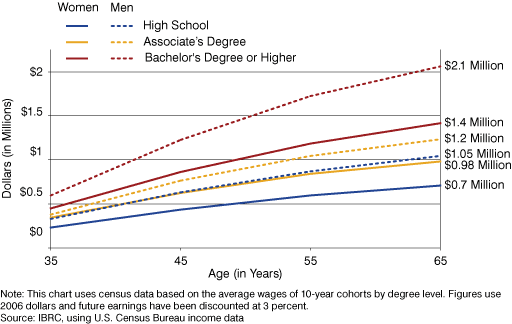
NPR has a story on the college payoff, showing that while students pay much more for a college education in the U.S. than they do in most other countries, they also get a bigger return on their investment. But for me the big story is the enormous gender difference in that payoff. Wow! There continues to be a huge premium for maleness across the globe, but it is striking indeed how much more being male in America gets you:
And what explains why college costs more for women in the U.S., Germany, and Canada? It can't be a base price differential along gender lines, I would think (lawsuit, anyone?), so is it that men are given more scholarships?
The story points us to this study from Indiana University with more detail on the gender gap, including this chart showing that women must obtain associate's degrees to match the salary levels of men with high school degrees:
Wednesday, October 10, 2012
If you're entitled, you probably don't deserve it.
What does it mean to be entitled to something? It used to mean you earned it, and are owed it, and it would be unfair not to give it to you. Now it means you are demanding something that you have not earned, are not owed, and cannot in fairness be given. I view this rhetorical shift as a subtle but very destructive development for spending programs that are tied to revenue sources, e.g., social security in America. Roosevelt famously insisted on tying the benefit to the tax that funded it:
“We put those payroll contributions there so as to give the contributors a legal, moral, and political right to collect their pensions and their unemployment benefits,” he reportedly responded. “With those taxes in there, no damn politician can ever scrap my social security program.”But if it becomes rhetorically acceptable to use entitlement to mean the opposite of entitlement, this creates a license for the damn politicians to scrap these programs after all. This is so even if, like social security, such programs are not actually in fiscal straits. Rhetoric matters, maybe far too much, in politics. It is all too easy to convince people that entitlements are not deserved, therefore anything called an entitlement can and should be eliminated. Worse, so long as you use another term to describe other benefits doled out by government, you get a pass from this scrutiny and judgment. "Tax incentives" is a ready candidate to fil that rhetorical space, as we have seen in this campaign.
Elites call for higher taxes in France, stamp feet when their wish is actually granted
Its fascinating to me that elites will only accept high marginal tax rates for purposes of destruction, namely, war. When it comes to building something, a marginal 75% tax rate on top incomes is seen as outrageous and out of the question-no sane person could support it. Tax resistance is really anti-social in that way.
Friday, October 5, 2012
Evidence: it's ok to tax millionaires
Richard Murphy points to this story that argues, contrary to conventional wisdom, millionaires do not necessarily flee high tax jurisdictions in search of tax havens:

From the article:
Murphy concludes from this report that "It's fairly easy to move in the US. But people don't." He therefore suggests we lay the mobility myth to rest since it would be comparatively much more difficult to move across national borders. If people don't do it when it's easy, what will make them do it when it's hard?
I think and hope this is generally true--that people have cultural/social ties to places that prevent purely fiscal decision-making, so we don't need to coddle the rich out of fear of a Randian exodus, but can ask them to contribute more to the societies in which they live. But the high profile cases we see in the news suggest that when it comes to the super-rich things might not be so clear. Maybe they stay put but nothing stops them from engaging in the standard game playing that puts money out of sight to governments while doing so. It could even be worse for society if they physically hang around but play all kinds of games rather than paying their taxes; in that case, it might be preferable if they pull a Saverin.

From the article:
This newspaper's review of tax return data for 2010, the most recent year for which data is available, found no link between the state income tax rate and the number of people who reported adjusted gross income of at least $1 million.
Consider:
- The states with the most and fewest rich people per capita are Connecticut and West Virginia, respectively. In Connecticut, one of 190 taxpayers earns at least $1 million in adjusted gross income. In West Virginia, just one out of every 1,400 filers make that much. Yet both states tax rich people about the same.
- Our neighbors: Nevada is income-tax free; Oregon has one of the nation's highest income taxes on the rich; and Arizona is about average. Yet all three have a below-average number of rich people per capita.
- In the Midwest: Illinois and Ohio charge about the same income-tax rates and have similar populations. Yet Illinois has 233 millionaires per 100,000 taxpayers, while Ohio has 107 per 100,000 taxpayers.
- In the Northeast: Massachusetts has more than double the millionaires per capita than neighboring New Hampshire, which is income-tax free.
Murphy concludes from this report that "It's fairly easy to move in the US. But people don't." He therefore suggests we lay the mobility myth to rest since it would be comparatively much more difficult to move across national borders. If people don't do it when it's easy, what will make them do it when it's hard?
I think and hope this is generally true--that people have cultural/social ties to places that prevent purely fiscal decision-making, so we don't need to coddle the rich out of fear of a Randian exodus, but can ask them to contribute more to the societies in which they live. But the high profile cases we see in the news suggest that when it comes to the super-rich things might not be so clear. Maybe they stay put but nothing stops them from engaging in the standard game playing that puts money out of sight to governments while doing so. It could even be worse for society if they physically hang around but play all kinds of games rather than paying their taxes; in that case, it might be preferable if they pull a Saverin.
Students in their Classrooms
A fascinating set of photos from Visual News:
![julian-germain-classroom-5[3]](https://lh3.googleusercontent.com/blogger_img_proxy/AEn0k_u3JSeGm-lIZ6eBIkG_I-vtyhVwlQ1Klsvg4NsTTfYGBh7Ev-rU0s6RbP4goHkglcJzNe6cl4vSsytXE4PNPCNRgBbg22OUfieHPF9oaNjGf3Bw_QyNHCqK7OV1cpFX6ydza1r-JayXQyEILJk7Cd4HIwv0_FalH5rWO3bmLTbq=s0-d)
England, Washington, Year 7 (first day), Registration
![julian-germain-classroom-6[3]](https://lh3.googleusercontent.com/blogger_img_proxy/AEn0k_vAvPqCiNvI-196f3LIiWm_ap59RwhsnxuiQKZW_J5DnqupD021sV-OWn32Ih6KOsZTRgLEF9g4IFm5YZP5wSC6sNjfKY_-kPSD-P9lBdhh6QGAv2aJ7cVFzNLzzoicWGKRfPnINGA5ShO0g8F6Ugn8T3IIHOkePyGkaA96hjt2=s0-d)
England, Erith, Year 10, English
![julian-germain-classroom-7[3]](https://lh3.googleusercontent.com/blogger_img_proxy/AEn0k_v8eXQA9sPXvslDza-3iYk0LyOz6Mya3BzzAB2kqzN-qWuZpjWCDbMPweDpd-uaJTbuVNwmckqhfKiCzJwIUh2gVBpQaa7lh9D_7fuAHTTgRZ2nXp6KW6VhtgC0cWhof2tXFXqnQYGjgzhieOeyEg9vL58hIZSBrnMWFlrzdNc=s0-d)
England, Wolsingham, Year 12, English
![julian-germain-classroom-18[3]](https://lh3.googleusercontent.com/blogger_img_proxy/AEn0k_tpX3P-_MAR6yRalPi2fJXQ-xCoXkMlgn57615Rtqr8zw2CV6lVyK2QpE5kFkoekate_jUJr1io_QqmynigM122uMYDCk7iUQA5MO3cEkzdZhfA99oo060zwSDZcBmcdQxq7LoRXJrcqrUaJejeKZoOQCniNETCFVIjBFs0rdajaA=s0-d)
Argentina, Buenos Aires, Grade 4, Natural Science
![julian-germain-classroom-10[3]](https://lh3.googleusercontent.com/blogger_img_proxy/AEn0k_uotTAaneWaPCs9aJ--JNFKknu1U-I7wbx9qaGxA1PcSIvkpVbNpLGFWR3cycQFORf37oPdqPlLljfBQAFgsBwX2NB0i7XAvo86oX7WrPy1NzmWoQoDr0Ku6xw-LbYbPzQ5Uu1p0_pj2B3gLTgDb2Diqha0rW4xcPhaKWHrdXM0UQ=s0-d)
Saudi Arabia, Dammam, Kindergarden, Activities
![julian-germain-classroom-11[3]](https://lh3.googleusercontent.com/blogger_img_proxy/AEn0k_uq8PbIk0m1kZP9Fi26LNti1WY32N0mALj2j99wOdZgK8i9CDbDbFpNF-Pr5JvRaxyQ2Fcymn0XaR3gu8-q1XaTdvk03Izi0Py8jSu4KPBPGaGw8pZszI5Xmx2zL0v6JFPHaiAIsP-ZLC8iaruv5NXZImsHzxX-lZefAFWYZvlk=s0-d)
Yemen, Manakha, Primary Year 2, Science Revision
![julian-germain-classroom-13[3]](https://lh3.googleusercontent.com/blogger_img_proxy/AEn0k_uXvmxpNi9WrrQT5oIseP9tXg-mt_FHWVKKn1xbU7M3L7xe0yQVPJvAkTB2mgW6cPj7a43otRdru8tcGQRMwGLjaUKLOWPjsbGQB_v01q-CIRtitJxv0Km5XPpJ1TrDC1b-jZzYJT6v8k_VYo9ljoLMK31ZPLSFVuZIXjB12g169g=s0-d)
Qatar, Grade 8, English
![julian-germain-classroom-15[3]](https://lh3.googleusercontent.com/blogger_img_proxy/AEn0k_tLR8shoUcU4RMKdRixK3WWqicE5-As1q2Y4wj1zDTdPMCguEGu2oIRmvS_oeYQRuUYebBW2LqKrbnKqyjZrurmHFdfIHXdIMcc2bd4p2lP5zloGXvLdw7X6_R9gYbUP0rDhh8-lKF3JV4opn3eOE9mneJFyzRF2f5IfOSMHy1afg=s0-d)
Bahrain, Saar, Grade 11, Islamic
![julian-germain-classroom-16[3]](https://lh3.googleusercontent.com/blogger_img_proxy/AEn0k_ujqmnZQzAh07-z4Wq796SNaaB-T01zbIecCxQOwqXH367Ygbx7UtcTG_f0VqZzzIe_FAiPXxMpShdgs0fdS1pTs0TEUK1HdrUmZhQq0Pzpf6dSzAmBUqRvaapKCeh4zLA0JW7EBm8r-zFXawbgmmApOxcdDcDXUqAe2sWwGN6_=s0-d)
Brazil, Cipó, Series 4, Geography
![julian-germain-classroom-17[3]](https://lh3.googleusercontent.com/blogger_img_proxy/AEn0k_uXLGL4snij-HIvwIKLPCQD6kvLjjfe4ULZoFA7ny9VjRTwufgQbWdfvxRTjZlg-x0xXiunxELk9mxIIILSXH1UahDYkfUpLebOhkHTbqSFBxhnRPBFhI_SzNyUHE0fV2-y4nDDM4BiqU7Rc_bsTClAW_w-zKovHtqzHRPc4sAFQw=s0-d)
Brazil, Belo Horizonte, Series 6, Mathematics
![julian-germain-classroom-19[3]](https://lh3.googleusercontent.com/blogger_img_proxy/AEn0k_vtccVV8tuXFf3ubvOKKwWoDzPAdsMNyH1FCWu8G_UI5VrhP-T68U7mapfdTN1TPBxXSRjYXapsCuyPqTTkAaWcYZRbwgrBZ9XG9luX_Am-nBqQ064QNQLuWr_PYz6ibAouUlOGx4H16YGMn_lWnQafMe7HxpK4ac8wIlpQ67hS=s0-d)
Peru, Cusco, Primary Grade 4, Mathematics
![julian-germain-classroom-21[3]](https://lh3.googleusercontent.com/blogger_img_proxy/AEn0k_t_dMRoSByN3PdADmGyI6jhtGNT4CraKOOSZ-y-QfojBHGiLhTnMlEM_q03A_un1X_2qEQG-DLVNPBY3tl6F7jrlh_rMmbnJf_X7qZkq0__Js4RPqJI8H1HnTzOqQ_w7S502tD-W06JgU7s0GhfHgNamySefftV6IDO3IyRV_cV=s0-d)
USA, Oklahoma, Avant, Grade 4 & 5 Social Sciences
![julian-germain-classroom-22[3]](https://lh3.googleusercontent.com/blogger_img_proxy/AEn0k_ugHkDymrSMp8bOoJUSQfgfAR-IBzFk8heYnr1hcd-JIAeIj8HuzcGJ3T7yUgXS2IkqNC6ipCQfNU6vcX4d2UuFchzbLEptGF0ewx-63ctozzqxl-Scte0rPXHUM2Y4QU1gn4n1mYEmAVKsqlcVn0m6VkUVwV0-MkJ65bNy_DNJrA=s0-d)
USA, St Louis, Grade 4 & 5, Geography
![julian-germain-classroom-23[3]](https://lh3.googleusercontent.com/blogger_img_proxy/AEn0k_uU7AS4ZbJmCBud79Fz1QTrPVs-X53n81E0XNr4IQpsgMYOKjtxtYeicJlSHC4m78Rk2vwbICDinT-AIyiYdNNGUZiOuqEOeUaXoLuhl72cgLlH9aghOgiHCiZZYl1wnb3zdLTprS3zrG6r9X4lapq0owXWC8WC73gIiYbp-Tz9Qg=s0-d)
USA, Oklahoma, Barnsdall, Grade 4 & 5, Science
![julian-germain-classroom-24[3]](https://lh3.googleusercontent.com/blogger_img_proxy/AEn0k_uuG0D8w6x-_vzKIymFRAmZ_OENZ5A_2DxWDEsolNYZ1Jpd-ouUw8UZe2xjtHOyBAigV3bmSKcDVNF5RFXH6ZhhUtF8Jp5_tX9tDH5tgAtfllFu-VExswPbe6cBHIBmGCqYwDVVV2yOdRofngzknkvoqEcba9jD6sRJRyxuL_WXkw=s0-d)
Nigeria, Kano, Ooron Dutse, Senior Islamic Secondary Level 2, Social Studies
![julian-germain-classroom-25[3]](https://lh3.googleusercontent.com/blogger_img_proxy/AEn0k_uB26cBoVVtMooQHhS-oz-jb3a3lpUH8miT47AgWqj8bXIX3N9j05TSrr5ys0o1iAvlpupGXBiESuxbOJR38unPlHM4XThHGmED1DJxQrYsP8KWSz5uZndUPjnJhqDG8YosgR20zTiV9BzvJxMlh2OMtArais_LKhZ4neRkaG1yYQ=s0-d)
Tokyo, Japan, Grade 5, Classical Japanese
![julian-germain-classroom-27[3]](https://lh3.googleusercontent.com/blogger_img_proxy/AEn0k_tzAaS9oIkrKkHBN0T81LOe2wbabcBMrJ7utm7Ogds5zGy5B-5aRLd_HhX1x4HymWTehAhCSMyVQVyxxytCQczjBz-a7bnLvtDlGidEUkilDFwVo7u0fRxYwD-X2QHD8i1lyVFpKNUUQUoP1xS7GZLzvTegIBqF8w2VkwCQBjajoQ=s0-d)
Argentina, Buenos Aires, San Fernando, Year 3 Secondary
![julian-germain-classroom-26[3]](https://lh3.googleusercontent.com/blogger_img_proxy/AEn0k_u1JL97AsK36woa4eae5mPtZgu22xQhhwbQ9Qz1oTCxwdIdKzD2Ug26U4wfsl7NFQGm-Is2W_l7yqiaCKy2ZWrHb5yETmGQJIHLvarKNtV2pRu4d_Lz3MGsTjwgU_zkv1sNElLufR-5qipoi-FxkH_9U6iofhWgEU6dZNFSRADL9A=s0-d)
Taiwan, Ruei Fang Township, Kindergarten, Art
![julian-germain-classroom-28[3]](https://lh3.googleusercontent.com/blogger_img_proxy/AEn0k_ti-XaFwRlrV62h5PIR4v1Q45O2SR1FISnlU7AMzOozvDYE8sOqB1V3SFYCDJm0tpluGiRK5Mq7lLcUAMXBEMzV-Oio9Lxf0xhVBAY8SplYxjCofKK03LsE-VjXIgp65dau5NJBcqNX6wZtAM81NUnNlipFHJuhfm9Gx1dObXxB=s0-d)
Cuba, Havana, Playa, Year 9, national television screening of film 'Can Gamba' (about Cuban participation in Angolan Revolution)
![julian-germain-classroom-30[3]](https://lh3.googleusercontent.com/blogger_img_proxy/AEn0k_tHxEjUpfgafFkh9fIG2gZCXglzz5rZJ1YIBrlJX9KE29fL3VYflm-OnQVDWDg1Uits9UXVBQ6-6jirIDdIrHvGARw3f-aKcKS8oIOAHyWzdBDYt1uTeQcO07lshmaGBoLzcQTeR3N52JEMUBR9ZpdjWncP2bEAQMyIbN1qmzTB=s0-d)
Germany, Düsseldorf, Year 7, English
England, Washington, Year 7 (first day), Registration
England, Erith, Year 10, English
England, Wolsingham, Year 12, English
Argentina, Buenos Aires, Grade 4, Natural Science
Saudi Arabia, Dammam, Kindergarden, Activities
Yemen, Manakha, Primary Year 2, Science Revision
Qatar, Grade 8, English
Bahrain, Saar, Grade 11, Islamic
Brazil, Cipó, Series 4, Geography
Brazil, Belo Horizonte, Series 6, Mathematics
Peru, Cusco, Primary Grade 4, Mathematics
USA, Oklahoma, Avant, Grade 4 & 5 Social Sciences
USA, St Louis, Grade 4 & 5, Geography
USA, Oklahoma, Barnsdall, Grade 4 & 5, Science
Nigeria, Kano, Ooron Dutse, Senior Islamic Secondary Level 2, Social Studies
Tokyo, Japan, Grade 5, Classical Japanese
Argentina, Buenos Aires, San Fernando, Year 3 Secondary
Taiwan, Ruei Fang Township, Kindergarten, Art
Cuba, Havana, Playa, Year 9, national television screening of film 'Can Gamba' (about Cuban participation in Angolan Revolution)
Germany, Düsseldorf, Year 7, English
MRU lectures on development
From Marginal Revolution:

At MRUniversity we just released over 30 new videos on leading thinkers on development. We cover Amartya Sen (who gets three), Bela Belassa, Karl Polanyi, Adam Smith, Paul Romer, William EasterlyI'm glad to see Polanyi on the list, and right beside Adam Smith, precisely correct (though in their full listing the two are separated by Schumpeter and Gerschenkron, fair enough. As to Easterly I am not as enthusiastic but I will watch it anyway. Also on the list: Krugman, Stiglitz, Ostrom, Rodrik, Acemoglu, Banerjee, Collier, more. Yes, the list is almost wholly male--only Ostrom, Anne Kreuger and Esther Duflo are included and all three are American (ok, Duflo is also French). Nevertheless it looks like a fascinating series.
Thursday, October 4, 2012
Tax games? Glencore's self-insurance plan
From the Guardian: Glencore accused of slashing tax bill by using complex insurance deals; Commodity trader's UK profits are being depressed, but company says contracts are not designed to avoid tax.
A leading tax expert has accused Glencore of cutting its UK tax bill by tens of millions of pounds after profits at the commodity trader's London arm were depressed by complex insurance contracts taken out with its own parent.
...The derivative instruments being employed by Glencore are widely used by companies to insure – or hedge – financial risks. They theoretically guarantee a certain return.
Last year, Glencore UK's derivative trading with other parts of the group totalled $383bn (£267bn), more than twice the yearly budget of the National Health Service. The practice resulted in a $122.8m loss for the London-based business, effectively docking that amount from UK profits and transferring it to the main group based in the low-tax Swiss canton of Zug.
Richard Murphy, of Tax Research UK, said: "Glencore is insuring itself with itself. If I insure my house for fire with myself and it burns down, I've got to pay myself for the house which has burnt down. That's what Glencore is doing, and the consequences are that the risk is never leaving Glencore; it's still inside the group. That's $383bn worth of trades that, on the face of it, make no sense whatsoever. We don't know, but it is highly likely that the motivation is not genuine insurance and it looks like a significant amount of tax planning takes place within this trading function."
Murphy said ..."This is totally legal but what we are seeing is a significant change in the way in which multinational corporations are now looking to move their profits around the world.
"All the evidence is that throughout the extractive industries – the mining industry, the oil industry, the gas industry and so on – the way in which people are shifting profits now are derivative financial products."
Glencore UK's accounts show that its massive turnover of $59.8bn in 2011 resulted in a pre-tax profit of $99.1m, a margin of less than 1%. A tax credit, the result of unrelated employee share awards, took total profits for the year to $115.7m. Had the $122.8m derivatives loss remained in the UK and been added to those profits, it would have attracted taxes of about $32m.
Glencore insisted that lowering its tax bill was not the purpose of the derivative trades.
Glencore's Baar-based spokesman said: "The derivative contracts Glencore Energy uses in London with its parent company in Switzerland are effectively tools to help it manage risk.
"They enable risk to be concentrated at the centre, where it can be absorbed due to the size of its capital base. These are standard contracts used by many companies across many industries. This is about managing risk and nothing to do with avoiding tax. Like all major global corporations, we work closely with local tax authorities to ensure that we pay the correct and appropriate amount of tax."
In 2010, Glencore UK made a profit $186.5m on insuring itself with its parent, although those winnings were virtually all cancelled out by losses on external derivative contracts. ...Richard Murphy carries the story and responds:
I note what Glencore say but cannot agree. There [sic] argument appears to be London cannot bear the risks of these trades so they have to be moved on but a simple guarantee (or more capital) would overcome that issue and save the enormous cost of $383 billion of trading. However, those trades do take place which means there must be an economic justification for the cost of doing them, and tax is the only one I can see.
Call for Papers: Tax and Inequality
And here's another call for papers, from TJN:
Call for papers for a Research Workshop on
TAX AND INEQUALITY
The 2013 research workshop co-organised by the Association for Accountancy & Business Affairs,i City University,ii and the Tax Justice Network,iii will explore connections between tax justice and inequality. This opens up possibilities for papers on a wide variety of themes, including taxation of wealth, case studies of innovative tax measures to reduce inequality, how tax expenditures favour particular groups, tax and access to housing, tax and inter-generational wealth distribution.Other related themes are likely to emerge as the workshop programme develops.Offers of papers are especially welcome and early submission of an abstract of no longer than 300 words is encouraged. All submissions will be considered by the organising committeewhich comprises:
- John Christensen (Tax Justice Network)
- Jo Marie Griesgraber (New Rules for Global Finance, Washington)
- Richard Murphy (Tax Research LLP)
- Ronen Palan (City University, London)
- Sol Picciotto (Lancaster University)
This workshop will bring together researchers, academics, journalists, policy staff of civil society organisations, consultants and professionals, elected politicians and/or their researchers, and government or international organisation officials. The purpose of the workshop is to facilitate research through open-minded debate and discussion, and to generate ideas and proposals to inform and shape the political initiatives and campaigns already under way.
- Prem Sikka (Essex University)
There will be a small charge for attendance at the Workshop. Participants are usually expected to finance their own travel although applications from students and others with limited means for bursary support will be considered.More information about this workshop is available from: John Christensen, Tax Justice Network, john@taxjustice.net
Call for Papers: Philosophy of International Law
Interesting call for papers, maybe tough for a typical international tax scholar/armchair philosopher to pass peer review, on the other hand I think international tax scholars are increasingly confronting the kinds of questions outlined here. Details:

HT Jacob Katz Cogan.
The Journal of Philosophy of International Law (JPIL) is a peer-reviewed (and currently an open source Journal) published by ElectronicPublications.Org Ltd—a publisher with no institutional affiliation. The JPIL’s sister publications are the Manchester Journal of International Economic Law and the Journal of Islamic State Practices in International Law. The JPIL is being re-launched and will be published twice a year (May and November). The Journal has a distinguished Advisory Board and its aim is to provide an established scholarly platform for the philosophy of international law.The aims of the JPIL are to promote:
- Critical examination of and legal reflection on the foundations of International Law.
- Philosophical analysis and critique of the nature of the international legal order or any aspect thereof.
The areas that might be covered by these aims include, but are not confined to the following:
- Historical enquiry into International Law for philosophical purposes, or intellectual history as related to the foundations and development of International Law.
- Ethical issues in International Law or the uses of International Law for ethical debate.
- Ontological questions of the existence of International Law and the nature of the reality it attempts to regulate, such as states, humanity and world society.
- Epistemological questions of an interdisciplinary nature and enquiry into the limits of disciplinary approaches such as positivism in International Law.
Guidelines for Authors:The Journal welcomes submissions of articles and reviews for consideration with a view to publication. The normal word length for article contributions is between 4000-8000 words. The normal word length for reviews/commentaries should be 1000 to 1500 words. Submissions (except reviews/commentaries) should include a short abstract of not more than 60 words. The style guide for references is Oxford University Standard for Citation of Legal Authorities (OSCOLA).Editorial correspondence, including submissions to the Journal, should be made electronically to the Editor-in-Chief: at JPIL-submissions@mail.com, JPIL@electronicpublications.org
Trickle down government...wha??
I'm still scratching my head over this. So...is trickle down nonsense now? Or is it affirmed as solid doctrine, but bad if it involves government? Is it an argument that government should inure to the benefit of the top, whose contributions to society will have the effect of trickling government largesse down to the 47%? Or is it to say that government programs aimed at the top are no good because they will (or will not?) trickle down? I'm stumped.
Wednesday, October 3, 2012
Expensive to be poor: dental edition
From Propublica, a look at dental treatment for the poor. First, medicaid pays so little that many dentists won't accept medicaid patients at all; second, when they do accept these patients, they exploit them ruthlessly to extract every possible dollar, either from medicaid or the patients themselves or both. For those without access to dentists, the Romney plan (emergency room care for all) doesn't appear quite workable:
Not that many dentists actually accept Medicaid. There are some states where the reimbursement rates are so low that even the chains don't go there. Like in Florida, for example, the Medicaid rates are so low there that chains don't really even bother. So children end up going to the emergency room because they have a toothache and there's nothing else they can do. They end up in hospitals to treat a tooth.
There was a famous case in Maryland where a 10-year-old boy had a toothache and it was abscessed and he ended up dying because he didn't have a dentist.But for those lucky enough to find a dentist who will take them on, the situation seems only marginally better: instead of dying, you get this:
We looked at two of the larger [dental] chains, and found evidence that these companies were putting pressure on their dentists to produce at certain revenue targets, thus encouraging them to do procedures that may have been unnecessary.
... One of the chains focused on kids on Medicaid, and the reimbursement rates for Medicaid are pretty low. So in order to get a lot of revenue from these patients they were doing things like taking x-rays that were not needed, or putting stainless steel crowns instead of fillings on their teeth. They could make twice as much money from Medicaid on these crowns versus just putting a filling on a tooth. Kids were getting treatments that they really didn't need.
...We had one example of an 87-year-old woman who had already been to the dentist and she went in to have two teeth pulled, thinking it would be cheaper at [New York-based] Aspen Dental. Instead they looked at her mouth and they came up with a treatment plan that was going to cost $8,000. They convinced her though hard-sell tactics to borrow that money through a credit card, and something like $2,000 of that was just to clean her teeth. (Aspen Dental's response is here.)How do these dentists sleep at night? Well, they have big loans to pay off, you see:
These days, when dentists get out of dental school, they often owe anywhere between $200,000 and $300,000 dollars. Dental school is actually more expensive than medical school. So they come out with these huge debts, in a lot of cases they can't really afford to start their own practice.
These dental chains hire people, a lot of the time right out of dental school, and they pay fairly decent salaries and they have a bonus system where the more work you do on a patient the more you get paid. That's true for a private dentist as well, but the difference is that these companies are owned by private equity firms, and they're managed in a different way. You have people who are not dentists coming up with a business plan that's based on metrics. They try to get new patients in who haven't been to the dentist in a while, and they've already calculated how much revenue the average new patient should generate.
If you happen to go in and you don't really have anything wrong with your mouth and you're a new patient you're not fitting the model. That creates pressure for the dentists to find things that are 'wrong.'The report goes on to show that the problems are mostly undetected because there is insufficient oversight. A scholar who works on corruption in governance once told me that the recipe for corruption is greed plus opportunity. You can't stop greed, he said--that's human nature. But society has got to find ways to curb opportunity. That's after all one of the main reasons to form a society at all--namely, to curb the human animal's propensity to exploit and destroy one another for personal gain. For more on this issue, you can watch "Dollars and Dentists" at PBS.
Tuesday, October 2, 2012
"IRS Rules" is Wrong!
One of my, if not my biggest, pet peeves with popular press reporting on taxes is when reporters blame "IRS Rules" for some perceived tax abuse. For example, today's New York Times (also linked on TaxProf) claims that the difference in tax treatment between a partnership interest and a fee from a corporation is one such rule.
I thought the Internal Revenue Code provided for a separate tax on corporations and for partnerships to be treated as flow-through entities, which is why carried interest is taxed differently than fees paid by a corporation. Or maybe the Supreme Court? Or the Circuit Courts? Even Treasury Regulations don't come directly out of the IRS. The IRS does an incredible amount of work administering the tax laws of the largest economy in the world, and there really are rules published by the IRS that can have substantive effect , but the IRS does not (and cannot) make these more fundamental structural legal choices.
Why care so much? Because the use of "IRS rules" gives the impression that somehow there is a shadowy underworld of bureaucrats conspiring with shifty practitioners and taxpayers to avoid or undermine obviously correct tax consequences, rather than face the difficult policy choices inherent in constructing a tax law which involve real and difficult trade-offs. As someone who struggles with these issues, this concerns me. How is the country supposed to engage in a real policy debate without directly confronting these difficult policy choices? Perhaps not all is lost, though - the Times editorial board seems to be able to get it right.
More personally, however, I suppose I am just tired of explaining to people that the IRS had nothing to do with why Bain can form entities in the Cayman Islands and defer paying taxes. Oh well.
I thought the Internal Revenue Code provided for a separate tax on corporations and for partnerships to be treated as flow-through entities, which is why carried interest is taxed differently than fees paid by a corporation. Or maybe the Supreme Court? Or the Circuit Courts? Even Treasury Regulations don't come directly out of the IRS. The IRS does an incredible amount of work administering the tax laws of the largest economy in the world, and there really are rules published by the IRS that can have substantive effect , but the IRS does not (and cannot) make these more fundamental structural legal choices.
Why care so much? Because the use of "IRS rules" gives the impression that somehow there is a shadowy underworld of bureaucrats conspiring with shifty practitioners and taxpayers to avoid or undermine obviously correct tax consequences, rather than face the difficult policy choices inherent in constructing a tax law which involve real and difficult trade-offs. As someone who struggles with these issues, this concerns me. How is the country supposed to engage in a real policy debate without directly confronting these difficult policy choices? Perhaps not all is lost, though - the Times editorial board seems to be able to get it right.
More personally, however, I suppose I am just tired of explaining to people that the IRS had nothing to do with why Bain can form entities in the Cayman Islands and defer paying taxes. Oh well.
Subscribe to:
Posts (Atom)