Showing posts with label information. Show all posts

Monday, April 15, 2019

What Kinds of Corporate Entities Evade Tax? The Human Factor in Third Party Info Reporting

Under what circumstances should we expect corporate entities to evade tax? The following guest post by Gaute Solheim of the Norwegian Tax Administration posits that it is most likely when they are small, owner-operator gigs, and much less likely when they are giant multinationals. The rationale, drawn from insights about why third party reporting is vital in a self-reporting system, is that the bigger the company, the more people have to work cooperatively to engage in fraud, many of whom will be employees with no direct economic upside. Of course there must be exceptions--Enron comes to mind. But Solheim's observation is that the human self-interest that makes third party reporting an effective compliance tool also minimizes the frequency and scope of Enron-type evasion. Cross posted from the Surly Subgroup.
Gaute Solheim, Senior Tax Advisor, Norwegian Tax Administration
(Mr. Solheim writes in his individual capacity and does not purport to represent the views of the Norwegian Tax Administration.)
I happened to reread a paper by Wei Cui from 2017 on Third Party Information Reporting (TPIR) some weeks ago. Based on my own practical experience working for the Norwegian Tax Administration, I found it hard to agree with him on uselessness of TPIR. In this post, I will explain why I expect good quality in TPIR filing. I plan to write a later post on why TPIR is useful.
I will start with crediting Cui for outlining very well what I will call “the story of the corporate tax revenue collection machine.” He does a good job describing how the government has outsourced the bulk of the revenue collection to corporations. I would love to see papers adding empirical numbers to this description. My Norwegian perspective is a world of VAT, corporations withholding taxes on wages and delivering massive amounts of data used to prepopulate the personal tax filings. The way Cui describe the role of the corporations in the “tax revenue collection machine” is probably even more spot on for me than for a reader with a US perspective.
As I read Cui, he expect legal entities to cooperate sufficiently to ensure fairly good quality TPIR. He does some reasoning on why this is to be expected, but I did not find his arguments very convincing. This may be because for some years I have had a different line of reasoning ending with the same conclusion. What follows is based on material I used in a talk some ten years ago for my colleagues at the Large Taxpayer Office in Norway. The theme of that talk was why we found less evasion in our segment of taxpayers than what other tax auditors found when auditing smaller entities. I called the talk “The Human Factor in Tax Filing”. I believe the reasoning I used there also may explain high quality TPIR.
To make it clear: This is about tax evasion (or deliberately misreporting). Tax avoidance is a different beast.
I started out by observing that legal entities cannot write, and hence are unable to fill out their own tax returns. They need human beings to help them. My next observation was that you can split these “helpers” into two groups. Group one is humans with direct economic upside from evasion, typically the owner(s) of the entities. Group two is humans with no direct economic upside from evasion, typically employees without an owner interest. My third observation was that the influence these two groups had on the filings was strongly linked to the size of the entities. In the smallest one-person owner/manager entities, people with direct personal economic upside from evasion (group one) have a large influence on the numbers filed. In the largest multinational corporations, people with no personal direct economic upside from cheating (group two) do most of the work.
Based on these unsystematic observations of reality, I made the following diagram of my estimate of how the influence of people with economic upside from misreporting (red line) and those without (blue line) varies as a function of entity size. The vertical axis goes from zero control to a hundred percent. On the horizontal axis, each entity is counted as one.Capture1st.PNGI do not have empirical studies to back up any claim that the balance of influence between the two groups shift at a specific gross income or similar figure. If forced to make a guesstimate, I would, for Norway, say somewhere around USD 5 million, with big variations among business segments. I will, for the sake of simplicity, use USD 5 million as the crossing point.
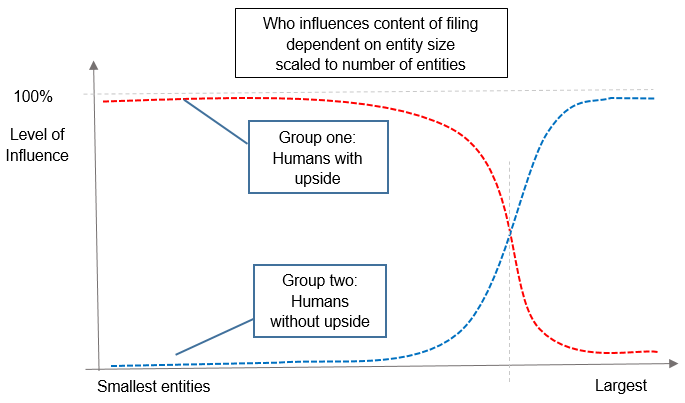
Corporations with less than USD 5 million in revenue are by far the main bulk of the population. Based on this perspective, we would logically start wondering why all these entities represented by humans with incentives to cheat average to a compliance rate of 90% or better. This is the perspective I understand Cui is debating in the last half of his paper, and he formulated some explanations that did not fully convince me.
As a longtime tax auditor, the number of entities to me is an administrative problem. I’ve always measured my own work in money saved: How much of the tax gap did I manage to plug? To get this perspective on reality, I must change the unit of measurement on the horizontal axis from entities to dollars. Each entity claims a space equal to the share of the total government revenue collected or paid by that entity.Capture2nd.PNGSomething very interesting happens to the perspective when we change from entities to dollars: The main bulk of government revenue is collected, reported and paid by the small group of big entities where the people with no upside is in full control over the numbers reported.
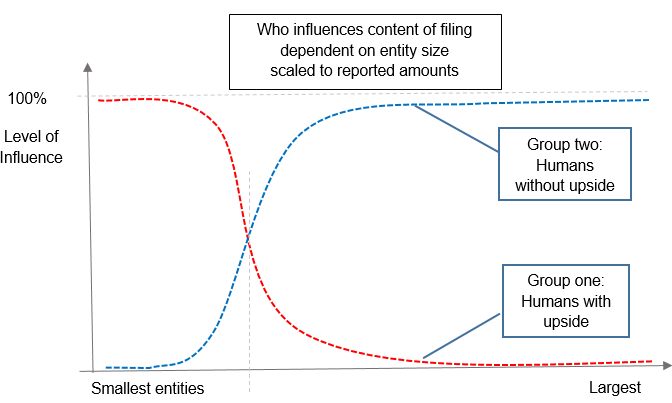
I only have hard numbers for corporate income tax (CIT) in Norway to back up this perspective, but I am confident that it holds true in general. Sixty-five percent of all CIT in Norway is paid by entities with revenue higher than approximately USD 150 million. The corporations with billions in revenue and thousands of employees are few, but they represent the bulk of what matters. When we use this perspective—money—we see that individuals with no personal gain from non-compliance handle the main share of input to the revenue collection machine and TPIR. This is true whether the reports are on wages and taxes withheld from them, VAT, or the entities’ own corporate income tax.
There is another important human factor, the down side. I have observed legal entities with feelings only when someone employed by the entity has made a mistake and the mistake has become public. The public relation department will issue a statement telling the public “The entity is very sorry that a trusted person have failed to live up to the high ethical standards of the entity as explicitly laid out in internal memos, rules, etc.” Then they throw that someone under the bus. Everybody knows this.
Since everybody knows this, it would be strange if that knowledge did not shape the behavior of the people engaged in taking care of compliance tasks on behalf of the huge impersonal corporation. They have no personal gain and they know who the scapegoat will be.
Based on this rather simple analysis of the human factors involved, I am convinced that compliance and quality TPIR is what I in general should expect from large corporations. I do know from experience that in some particular settings this will not hold true, but the big picture is to expect compliance. I will now shift to the smaller entities.
Cui gives a few examples illustrating how the employer and the employee have a win-win scenario in misreporting (cheating). He leaves out some elements that I find very practical in real life. I must confess that a few times in my life it has happened that I was guilty of doing something qualifying at least for a fine. But I’ve never been tempted to do something that relied on recruiting a partner in crime. Somehow human nature realises without thinking too hard about it that conspiracy is on a different scale than a moment of weak ethics. If you do not figure it out on your own, the penal code makes that very clear.
The win-win situation described by Cui differs a lot from an owner/manager deciding to keep some income off the books. While you may do that alone as owner/manager, the Cui win-win may only be established by recruiting someone to take part in the scheme. In addition, the owner knows that employers and employees from time to time end up with conflicting interests. Lay-offs are but one example. From my limited knowledge of the US penal system and tax legislation, I have the impression that an employee deciding to inform the IRS about the misdeeds of a corporation may get much more lenient treatment than the corporation and the owner/manager of that corporation. As a hypothetical owner/manager, I would at least think twice.
This is not saying that this kind of collusion does not happen. It does, but the human factor and a simple risk analysis informs me that it should be more the exception than the rule. Undeclared income is a much more likely scenario in the small corporations than manipulated TPIR. This result is not produced by the integrity of the corporation, which I believe has none, but is what you expect from human beings when acting based on the incentives present in the situation. The sum of these very human choices is what we may call a compliant corporation, sending the tax authorities high-quality TPIR.
As Cui correctly observes, even high-quality TPIR is pointless if it does not contribute to something useful. Tax authorities are collectors of revenue, not of data points. Why I do not agree when Cui concludes that TPIR is not useful will be the theme for a later blog post.
And again: This was about evasion, not avoidance.

Tuesday, January 17, 2017

Cockfield on Information Exchange

Arthur Cockfield has posted a paper of interest, entitled How Countries Should Share Tax Information. Here is the abstract:
There are increasing policy concerns that aggressive international tax avoidance and offshore tax evasion significantly reduce government revenues. In particular, for some low income countries the amount of capital flight (where elites move and hide monies offshore in tax havens) exceeds foreign aid. Governments struggle to enforce their tax laws to constrain these actions, but are inhibited by a lack of information concerning international capital flows. The main international policy response to these developments has been to promote global financial transparency through heightened cross-border exchanges of tax information. The paper discusses elements of optimal cross-border tax information exchange laws and policies by focusing on three key challenges: information quality, taxpayer privacy, and enforcement. Relatedly, the paper discusses how the exchange of automatic ‘big tax data’ combined with data analytics can help address the challenges.
Cockfield seeks to find a solution that balances the need of the state for extensive information in order to protect the integrity of the income tax system against the need of the individual for protection from abuse by the state. That is no easy balance to strike. From the paper:
All of [the recent information gathering and exchange] efforts seek to provide governments with more and better tax information, and reduce costs through agreement on underlying EOI rules and principles. The reforms, however, largely do not address how financial secrecy laws subvert global financial transparency initiatives. Nor do they address legal technical complexity that raises transaction costs, and makes it even harder for low and middle income countries to implement and enforce EOI. While the EOI reforms are positive steps, given an environment of high transaction costs it may be difficult to make progress in addressing key policy challenges.... 
Data availability, usefulness and verifiability are three components of high quality information that can help governments pursue their cross-border investigations and audits. In particular, transferred information should be relatable to domestic tax identification measures, and checked against third party reporting, and withholding tax disclosures. Once this is done, governments can conduct analysis to determine audit risk by focusing on issues such as taxpayer segmentation, dealings between the taxpayer and offshore service providers, and cross-indexing tax and financial information against non-tax data (e.g., insurance policy disclosures). 
Against this desire for high quality tax information stands (shrugs?) taxpayer privacy concerns. The apprehensions arise from the varied levels of domestic legal protection afforded to privacy rights, along with the risk of abuse or misuse of transferred information. Accordingly, broader multilateral agreement on privacy protections is likely a prerequisite to effective EOI. This hoped-for cooperation is hindered by the fact that many countries refuse to abolish their financial secrecy laws, which stands as one of the main barriers to optimal reform.
My view is that maintaining the integrity of the income tax system appears to require building the panopticon, and much more besides. The steady decline of support for coherent corporate income taxation makes greater and greater individual surveillance necessary, while also making personal income taxation harder. I am not sure where the point lies at which the costs and risks attendant to building the necessary compliance and enforcement infrastructure exceed the benefits of maintaining personal taxes based on income.

Wednesday, November 11, 2015

Senate Foreign Relations Committee Approves 8 Tax Treaties

Senator Rand Paul has been holding up tax treaties for several years but he apparently stepped away from the Foreign Relations Committee yesterday and eight slipped through. They will be considered by the full Senate which I assume will give consent to their ratification, since as far as I know Sen. Paul was the only opponent. From Reuters:
The U.S. Senate Foreign Relations Committee on Tuesday approved eight long-delayed international tax treaties, which had been held up for years because of one Republican senator's objections, despite support from companies that want consistency in rules for how to do international business. 
The treaties are with Switzerland, Luxembourg, Hungary, Chile, Spain, Poland and Japan and the international convention on mutual assistance on tax matters. 
U.S. Senator Rand Paul objected to the agreements for privacy reasons, saying they would allow more inter-governmental sharing of financial information on citizens, which U.S. officials deny. Although the Republican is a member of the committee, he was not at the meeting where the pacts were approved by unanimous voice vote. 
It was not yet certain when the treaties would be considered by the 100-member U.S. Senate, where they need a two-thirds vote to be ratified.


Please Give: Passionate Plea for IRS Funding from Former IRS Commissioners

The IRS faces constant funding pressure from Congress, despite becoming a victim of constant mission creep thanks to Congressional mandates (ACA and FATCA in particular). Over the years many have pled with Congress to stop underfunding the agency. The latest comes from seven former commissioners, who note that not least among the reasons to fund the IRS is the need to spend money on cyber security as the IRS fends off one million hacking attempts each week.

That's a lot of hacking because of course the payload is enormous. FATCA has surely expanded the payload significantly by developing an enormous database of personal information attached to bank account numbers and detailed account activity on a global scale. Even a small breach of security with respect to that vault will be disastrous for the taxpayers involved.

The commissioners also suggest that the IRS workload is going to increase due to BEPS. BEPS is expected to result in more treaty-based conflicts among jurisdictions, so I expect more competent authority hours will be needed. But it's likely also the case that country-by-country reporting requirements will add another enormous treasure trove of information to the database, further increasing the payload.

At minimum, Congress has simply got to fund security for this massively expanding taxpayer information database.
November 9, 2015

The Honorable Thad Cochran
Chairman
Committee on Appropriations
United States Senate
113 Dirksen Senate Office Building
Washington, D.C. 20510

The Honorable Harold Rogers
Chairman
U.S. House Committee on Appropriations
U.S. House of Representatives
2406 Rayburn House Office Building
Washington D.C. 20515

The Honorable Barbara A. Mikulski
Vice Chairwoman
Committee on Appropriations
United States Senate
503 Hart Senate Office Building
Washington, D.C. 20510

The Honorable Nita M. Lowey
Ranking Member
U.S. House Committee on Appropriations
U.S. House of Representatives
2365 Rayburn House Office Building
Washington, D.C. 20515 
Subject: IRS Appropriations for Fiscal Year 2016
Dear Chairman Cochran, Vice Chairwoman Mikulski, Chairman Rogers and Ranking Member Lowey: 
We are all former Commissioners of the Internal Revenue Service. Over the last fifty years we served during the administrations of Presidents John F. Kennedy, Lyndon B. Johnson, Ronald Reagan, George H.W. Bush, William J. Clinton, and George W. Bush.

We are writing to express our great concern about the proposed reductions by the House and Senate in appropriations for the Internal Revenue Service for the current fiscal year that will end on September 30, 2016. We understand that the Appropriations Committees in the House and Senate have proposed to reduce the FY 2015 IRS appropriation of $10.9 billion by $838 million and $470 million, respectively, for the current fiscal year. If Congress were to reduce the IRS appropriation for the current year, it would represent yet another reduction in the IRS appropriation. The appropriations reductions for the IRS over the last five years total $1.2 billion, more than a 17% cut from the IRS appropriation for 2010. None of us ever experienced, nor are we aware of, any IRS appropriations reductions of this magnitude over such a prolonged period of time. The impact on the IRS of these reductions is that the IRS has lost approximately 15,000 full-time employees through attrition over the last five years, with more losses likely in the current fiscal year unless Congress reverses the funding trend. These staffing reductions come at a time when the IRS workforce is aging, with nearly 52% of IRS employees now over the age of 50 and 24% already eligible to retire. Three years from now, 38% of IRS employees will be eligible to retire. This loss of IRS knowledge and experience is alarming, particularly in light of the fact that, out of a present workforce of about 85,000 employees, the IRS has only about 3,400 employees under the age of 30 and only 384 employees under the age of 25 due to hiring freezes for budgetary reasons at the IRS since 2010 and periodically from 2005 to 2010. Over the last fifty years, none of us has ever witnessed anything like what has happened to the IRS appropriations over the last five years and the impact these appropriations reductions are having on our tax system.

These reductions in IRS appropriations are difficult to understand in light of the fact that, at the same time these reductions have occurred, the Congress repeatedly has passed major tax legislation to substantially increase the IRS workload. Most recently the Congress passed the Foreign Account Tax Compliance Act and the Patient Protection and Affordable Care Act, two major new programs, each of which significantly expands the IRS' tax administration burdens. The IRS personnel reductions come at a time when the IRS is stretched to the breaking point to cope with tax enforcement challenges attributable to global and domestic changes that are impacting our tax system. Increasingly, the United States is facing tax challenges as the result of efforts that are taking place in the international tax arena to deal with the tax non-compliance that is accompanying the continued globalization of business and investment activities. The most recent tax changes to address international tax non-compliance are proposed in the Organization for Economic Cooperation and Development's (OECD) Base Erosion and Profit Shifting Report. Regardless of one's view of these proposed changes, it is clear that the IRS will be substantially impacted by changes and challenges of other countries who adopt them.

Additionally, increasing incidents of identity theft and refund fraud are being perpetrated against our tax system by large, sophisticated organized crime syndicates around the world. These criminals seek to file false returns and claim fraudulent refunds using personal taxpayer data obtained from sources outside the IRS. At the same time, many unlicensed, unregulated return preparers are preparing and filing fraudulent tax refund returns. Every time there is an information technology hacking event in the public or private sectors in which Social Security numbers are stolen, the likelihood exists for additional identity theft and refund fraud. The growing refund fraud challenge to our tax system is especially alarming to us because of the need, which is fundamental to our tax system, for the IRS to be able to assure taxpayers who are paying their fair share of taxes that other taxpayers are doing the same thing. To emphasize the seriousness of refund fraud, the Government Accountability Office earlier this year placed identity theft and refund fraud on its list of "high risk areas" in the federal government, a sure sign to each of us that the IRS should have more, not fewer, enforcement resources to deal with this threat to the integrity of our tax system,

To place the impact on our tax system of the Congressional IRS appropriations reductions over the last five years in its proper context, Congress almost annually over the last 25 years has passed legislation that has imposed additional burdens on IRS tax collection and administration under our revenue laws. During this time, the Congress also repeatedly added more and more socio-economic incentives to the tax code and called upon the IRS to administer these new socio-economic programs, including healthcare, retirement, social welfare, education, energy, housing, and economic stimulus programs, none of which is related to the principal job of the IRS to collect revenue. At the same time, Congress passed even more legislation to pay for these tax spending programs. The result is that almost 30 years after the 1986 Tax Reform Act, our tax laws are a mess. Our tax laws have become so difficult for taxpayers to understand that 80% of all individual taxpayers now use paid consultants or software to prepare their income tax returns. Because of insufficient IRS resources in FY 2015, an average of more than 60 percent of the taxpayers who called the IRS for assistance in preparing their returns during the last filing season were unable to reach an IRS assistor, even after many taxpayers had remained on the telephone for more than 30 minutes before they were automatically cut off because of the volume of calls, which the reduced numbers of IRS assistors were unable to handle. Equally serious are the cybersecurity threats illustrated by the problem that occurred earlier this year involving unauthorized attempts to access taxpayer information using the IRS' Get Transcript online application. Separately, the IRS continues to experience about one million attempts each week to hack into its main information technology systems. Although the IRS has so far successfully thwarted these attacks and its main systems remain secure, all of this astonishes us and emphasizes to each of us that the IRS taxpayer assistance and IRS information technology resources are severely underfunded, especially when compared to the increasing cybersecurity budgets of private sector companies.

It is clear to each of us that the IRS appropriations reductions over the last five years materially and adversely affect the ability of the IRS to assist taxpayers who are trying to comply with their tax obligations, as well as the ability of the IRS to detect and deter taxpayers who have not complied with their tax obligations. Recently, we understand that the IRS estimated a direct annual revenue loss to the Federal government in tax enforcement at $6 billion last year and $8 billion this year, due to such appropriations reductions. Historically, for every dollar invested in IRS tax enforcement, the United States received $4 or more in return, and we understand that continues to be true today.

The Congressional Budget Office in its June 2015 Long-Term Budget Outlook projected future fiscal challenges to the United States because of the large and increasing size of our national debt and rising future operating deficits attributable to an aging U.S. population and rising healthcare costs. It, therefore, is imperative that our tax system in the future operate at an optimal level in order to maximize the revenues the IRS collects. For that to happen, the IRS must be able to assist taxpayers who are trying to comply with their tax obligations, and at the same time be able to enforce the tax laws against those taxpayers who have not complied with their tax obligations. In short, because of our country's fiscal and other challenges, our tax system must work and work well to collect the taxes that are owed.

Some have argued that the IRS can solve these problems by simply becoming more efficient. This argument ignores the reality that the IRS is already, by far, the most efficient tax collection agency among large countries in the world. The OECD recently released its bi-annual analysis of tax administration across the developed world and reported, based on 2013 statistics which don't reflect the most recent IRS budget cuts, that the amount the IRS spends to collect a dollar in taxes is approximately half the average amount spent by all OECD countries. Germany, France, England, Canada and Australia all spend as much as two to three times the amount the IRS does to collect a dollar of revenue.

In light of the foregoing, we fail to understand how it makes any logical sense to continue to reduce, rather than increase, the IRS budget for FY 2016 in order to optimize the IRS' ability to provide taxpayer service and to enforce the tax laws to increase revenue collections. To put it succinctly, we do not understand why anyone with present and projected debts and annual losses as large as those of the United States would refuse to pay for telephone assistance to people trying to fulfill their tax obligations, would turn their back on $8 billion annually in additional revenue, or would fail to make an investment that offers a return equal to at least four times the amount invested. For these reasons, we respectfully call upon each of you to support and work to accomplish the passage of an IRS appropriations request for FY 2016 that is substantially in excess of the appropriation for the IRS in FY 2015.

Mortimer M. Caplin (1961-64)

Sheldon S. Cohen (1965-69)

Lawrence B. Gibbs (1986-89)

Fred T. Goldberg, Jr. (1989-92)

Shirley D. Peterson (1992-93)

Margaret M. Richardson (1993-97)

Charles O. Rossotti (1997-2002)

Wednesday, October 14, 2015

Cockfield: Big Data and Tax Haven Secrecy

Art Cockfield has posted a new paper on SSRN, Big Data and Tax Haven Secrecy, forthcoming Florida Tax Review. The article sets out research he did with the International Consortium of Investigative Journalists (ICIJ) and is of interest. Here is the abstract:
While there is now a significant literature in law, politics, economics, and other disciplines that examines tax havens, there is little information on what tax haven intermediaries — so-called offshore service providers — actually do to facilitate offshore evasion, international money laundering and the financing of global terrorism. To provide insight into this secret world of tax havens, this Article relies on the author’s study of big data derived from the financial data leak obtained by the International Consortium for Investigative Journalists (ICIJ). A hypothetical involving Breaking Bad’s Walter White is used to explain how offshore service providers facilitate global financial crimes. The Article deploys a transaction cost perspective to assist in understanding the information and incentive problems revealed by the ICIJ data leak, including how tax haven secrecy enables elites in non-democratic countries to transfer their monies for ultimate investment in stable democratic countries. The approach also emphasizes how, even in a world of perfect information, political incentives persist that thwart cooperative efforts to inhibit global financial crimes.

Thursday, May 28, 2015

Updated: Gotcha! Yet another obscure asset reporting form for US persons

UPDATE: as of sometime this afternoon (depending on your time zone), the BEA has updated its website to extend the filing deadline to June 30 for all new filers. Moreover, it appears that the BEA definition of US Persons is generally limited to persons resident in the United States (with specific exceptions, see comment from Andrew below). As I mention in the comments, I am a bit wary about drawing conclusions of law from instructions to forms but I do think that the instructions at least form the basis for reliance that most physically non-resident US citizens should not be required to fill out the BE-10.  The sudden deadline extension nevertheless suggests that a number of people have been caught by surprise by the new reporting obligation, so that my main point about educating one's regulatory target is still apposite. I have revised this post accordingly.

It seems that in the United States, the asset reporting forms and non-filing penalties just keep on coming, and yet the will to inform individuals about their obligations--especially those who live outside of the United States and do not receive client alerts from big US law firms or big 4 accounting firms--remains curiously absent.  The Bureau of Economic Analysis does a survey of "US Direct Investment Abroad" every five years. In past years, if you were required to file, the BEA contacted you.

Not any more; now you are just supposed to know that the BEA exists and has its own reporting requirements, and that if you are a US person (which includes individuals), you are supposed to go and file a report to them, separate and distinct from all of of your other tax and financial asset reporting requirements. I do not know what the definition of US Person is for BEA purposes, and whether it includes US citizens and other persons, regardless of their residence--looking into that now. The definition of US Person for BEA purposes appears to diverge from that for tax purposes, such that in most cases reporting is required by those physically resident in the United States.

BEA reporting is subject to a civil penalty of $2,500 to $25,000 for nonfiling, plus $10,000, or a year in jail, or both, if the nonfiling was wilful. I am not sure who is responsible for collecting this fine but if it is the IRS (as is the case for FBAR), then I wonder why the Service doesn't bother to tell taxpayers about the form and its deadline anywhere at all on the IRS website.

A BE-10 form must be filed by any US Person that directly or indirectly held 10% or more of the voting securities ("US Reporter") of any non-U.S. business enterprise (a “Foreign Affiliate”). There are no de minimis exceptions: no matter how small your nonUS corporation might be (or have been-you must file for the year even if the corporation ceases to exist), you must report or face the penalty. US Reporters must file Form BE-10A for themselves and may have to file additional BE-10 forms for their corporations.

The deadline is tomorrow: May 29 now June 30. There is an extension available but it requires filing a request prior to the due date. Prepare for a delay in accessing that form right now--the BEA server appears to be overloaded. Possibly a request to extend filed today (if that is even possible from outside the United States) would be granted, I am not sure.

The BEA is a valuable source of information necessary for policy research, and I do not in any way object to the general need to collect information on US companies. What I object to is that again and again, US regulators seems to forget that "US Persons" includes a massive population of individuals who live permanently outside of the territory, who cannot realistically be expected to simply "know" about all the forms they are supposed to report, and who are dramatically underserved by the US agencies that continue to produce these requirements. US Persons are now potentially subject to three overlapping and duplicative reporting regimes, each with its own quirky forms, convoluted instructions, inconsistent deadlines, and heavy penalties: the IRS, the Financial Crimes Enforcement Network, and now, every five years, the BEA, all with little to no effort to educate the population each agency expects to be fully compliant.

I do wish that US lawmakers would understand that when they enact complex regulatory regimes with hefty penalties, they have a responsibility to educate the targets of that regulation. I am not talking about large, multinational conglomerates or high net worth individuals with teams of legal counsel. They are protected: their counsel's job is to keep up to date on all regulatory compliance regimes, inform their clientele, and and make money off compliance fees. I am not worried about them. I am talking about the human beings who just happen to live and work in other countries. If they have small businesses, they may well have non-US corporations in those countries where they live and work.  Regulatory agencies that seek to regulate these individuals have a responsibility to inform that is global in scope. It seems to me obviously unjust to suddenly impose complex requirements, with attendant penalties, on a whole new population without making any effort to educate them that this is the new order of things. Today's last-minute deadline extension seems to acknowledge this basic issue.

Friday, January 30, 2015

Samaha and Strahilevitz on Information policy and legal design

Adam M. Samaha and Lior Strahilevitz recently posted a paper called Don't Ask, Must Tell — And Other Combinations, which on its face looks like it has nothing to do with tax but it is relevant to questions about compliance and enforcement, so I thought it worth reading. Here is the abstract:
The military’s defunct Don’t Ask, Don’t Tell policy has been studied and debated for decades. Surprisingly, the question of why a legal regime would combine these particular rules for information flow has received little attention. More surprisingly still, legal scholars have provided no systemic account of why law might prohibit or mandate asking and telling. While there is a large literature on disclosure and a fragmented literature on questioning, considering either part of the information dissemination puzzle in isolation has caused scholars to overlook key considerations. 
This Article tackles foundational questions of information policy and legal design, focusing on instances in which asking and telling are either mandated or prohibited by legal rules, legal incentives, or social norms. Although permissive norms for asking and telling seem pervasive in law, the Article shows that each corner solution exists in the American legal system. “Don’t Ask, Don’t Tell,” “Don’t Ask, Must Tell,” “Must Ask, Must Tell,” and “Must Ask, Don’t Tell” each fill a notable regulatory space. 
After cataloguing examples, the Article gives accounts of why law gravitates toward particular combinations of asking and telling rules in various domains, and offers some normative evaluation of these strategies. The Article emphasizes that asking and telling norms sometimes — but only sometimes — are driven by concerns about how people will use the information obtained. Understanding the connection to use norms, in turn, provides guidance for a rapidly advancing future in which big data analytics and expanding surveillance will make old practices of direct question-and-answer less significant, if not obsolete. In any event, the matrix of rule combinations highlighted here can reveal new pathways for reforming our practices of asking and telling in life and law.
The authors cover taxation under the category Must Ask, Must Tell (MAMT). A highlight:
The personal income tax regime is perhaps the most familiar MAMT regime to many Americans. ... Strikingly, because it collects tax information from third parties like employers, banks, and brokerages, IRS already has much of the most important information that a taxpayer will provide on the applicable 1040. This redundancy has sparked reformers to call for replacement of the current, high-transaction costs MAMT regime with one where the government automatically calculates each taxpayer’s liability (or refund) each year and sends her a bill (or check). Notwithstanding the substantial time savings for taxpayers that such plans may entail, these proposals for reform have not been implemented. What gives?
The authors propose that MAMT might be explained by a need to resolve agency problems, which I don't really buy, and then they suggest that making people make tax declarations themselves is a way to make sure they value their citizenship or participate in democracy or make socially good choices, all notions I have heard before but cannot possibly believe when I read that the vast majority of taxpayers pay a tax prep service to help them get through their tax filing every year. Remember, the tax prep service makes money by making it so the taxpayer doesn't have to understand the form, much less the law. The tax preparation industry would definitely find it a hardship if they could not rent-seek off the complexity of tax filing. Remember California's ready return? TurboTax didn't like it.

Rent-seeking by tax compliance professionals, and the ongoing battle to keep the IRS from being able to serve taxpayers properly, are inter-connected key aspects of tax compliance and enforcement. The more hideously complex the law, the more the tax return preparer can charge for the service (I note that paying premiums to overcome tax complexity and attendant risk of error is but one reason why the US practice of treating certain nonresidents as permanent tax residents cannot possibly be fair).

The authors of this paper seem to understand the interplay between complexity and rent-seeking but they dramatically under-emphasize this in the analysis, and that is a pity. This paper barely scratches the surface of the "must ask, must tell" nature of income tax declarations, and I would have liked to have seen more discussion, especially regarding the global scope of the US tax system. But that is a lot to ask of non-tax experts. The paper concludes with a normative discussion that I am still working through, and I'm not sure if there are lessons there for taxation, or not. In any event, a novel paper that raises some interesting points about mandating the furnishing of information.


Monday, January 5, 2015

Top Tax on Twitter

I was very pleased to be included on a list of the top tax feeds on twitter, recently compiled by Kelly Phillips (aka @TaxGirl). I follow many of those listed, especially in the IRS, government, and media categories. Many useful sources here.

Wednesday, November 26, 2014

Canada Revenue Agency accidentally sent a database full of confidential taxpayer info to the CBC

From the Toronto Star: CRA blames human error for disclosing confidential tax data to CBC
The Canada Revenue Agency confirmed late Tuesday that it has accidentally disclosed confidential taxpayer information to the CBC. 
The agency said the document was “accidentally released” through human error and acknowledges this “constitutes a serious breach of privacy.” 
CBC reported that the tax information contains data about hundreds of Canadians — many of them rich and famous — including their home addresses. 
...The CRA said in a release late Tuesday that when it became aware of the breach, officials immediately contacted the CBC to retrieve the documents. 
The agency said the CBC ”regrettably” chose to disclose names and a response from the network was not immediately available. 
However, in its story on the breach, CBC News made clear it was not disclosing much of the information it had. The network said it was "withholding most details from the list, apart from the names of some of the people cited, out of respect for privacy."
Oops, presumably.

Questions on the Canada-US FATCA Agreement

MP Ted Hsu has presented an order paper question (OPQ 816) on the topic of the unusual process surrounding Canada's adoption of an intergovernmental agreement on FATCA. I have noted many times the anomalies surrounding the US approach to these agreements, and in Canada's case these anomalies appear to have been compounded by odd and unexplained internal procedural decisions. I am working on a paper on this topic but it is slow going, not least because it is tremendously difficult to study Canadian treaty policy--it is vague, features unwritten rules that are apparently made to be broken, and written policies that lack any semblance of meaningful procedural limitations or parameters. If there is a rule of law here, I have yet to find it.

Mr. Hsu's inquiry follows on a statement made by Peter Van Loan, Government House Leader, in the House on Monday, April 28, 2014, that the government, "actually did" comply with its own treaty tabling policy, in response to a point of order raised by MP Marc Garneau back in April regarding the failure of the Government to table the IGA prior to ratification. Mr. Hsu seeks a number of details from the Government; I take it that answers are due on January 26, 2015. Some of the questions clearly illustrate that treaty-making in Canada is really quite a mysterious process. Here are a few of the OPQ highlights--just a small selection of the many detailed aspects of the question:

  • was an exemption to the government’s Policy granted with respect to the Agreement;
  • on what date was the Agreement ratified; 
  • what steps and measures are in place to ensure that Parliament is informed of exceptions being granted to the Policy; 
  • what does “urgent” mean in the context of the Policy; 
  • did the Minister of Foreign Affairs “inform the House of Commons that Canada has agreed to be bound by the instrument at the earliest opportunity following the ratification” per the Policy; 
  • is the Government House Leader always informed of exceptions and exemptions under the Policy and, if so, how; 
  • is the House always informed of exceptions or exemptions under the Policy and, if so, how;
  • if the Agreement could have been tabled earlier in Parliament [than it was], (i) why was it not, (ii) what decisions were made in this regard, (iii) who made these decisions, (iv) how, (v) on what basis?
All good questions and I, for one, would like to know the answers, not just for better understanding the meaning and implications of the IGA in terms of both its legal status and its substance, but also for understanding the treaty process in Canada more generally. It is a maddeningly opaque regime.

Tuesday, June 17, 2014

Bruce Zagaris on US Perspectives on Information Exchange

Bruca Zagaris has a two-part article on U.S. policies on the exchange of information in tax matters, published  by Tax Analysts on June 9 and  June 17, of great interest (but gated, unfortunately). He provides an overview of the applicable treaties (bilateral and MAATM), TIEAs and IGAs, and discusses the various forms of information exchange. He gives a nice level of detail on how information exchange requests are processed in the US and how the US achieves its information goals vis a vis other countries. He goes through the legal structures and the developments at the OECD and EU. He then provides a series of detailed hypotheticals focusing in on US information exchange policy with respect to Latin America. Bruce is very clear about the lack of reciprocity that characterizes the US position toward information exchange and notes, rightly, I believe, that this position is sure to lead to conflict going forward.

His conclusion is rather bleak but I don't disagree with anything he is saying. Here are a few excerpts:
The U.S. budgetary problems, the pay-as-you-go system, the revenue estimates obtained for the anti-tax-haven bills, and the proclivity of some members of Congress to focus on tax enforcement and compliance directed at U.S. taxpayers concealing money abroad ensures that the anti-tax-haven bills will constantly be appended to appropriations legislation in this session of Congress and in future sessions. There are so many anti-tax-haven initiatives and the lack of actual reciprocity by the U.S. government, as opposed to the rhetoric, may well lead to dispute resolution proceedings soon and to disagreements within the international initiatives of the OECD and FATF, as a result of the perceived lack of a level playing field. 
A global trend toward criminalization of tax compliance and enforcement will continue.... Governments will continue to try to privatize tax enforcement by deputizing FIs and service providers regarding reporting, ethics, and a range of other requirements. Criminal investigations and prosecutions of noncompliant institutions and service providers will continue. 
... Disagreements are likely to continue among the OECD and developing countries about the proper financial architecture, not only in tax policy, but also financial regulation. If possible, the G-8 countries will try to continue to centralize decision-making in elite informal groups, such as the G-20, the Financial Stability Forum, and the OECD and the groups it controls, such as the Global Forum on Taxation. 
... OECD and Latin American governments, including the United States, Argentina, Mexico, and Brazil, will continue to impose sanctions through blacklists and countermeasures against small financial center jurisdictions, both unilaterally and through international organizations (for example, the OECD and IMF) and informal groups (for example, G-20, FATF, and Financial Stability Board), even though small-state offshore financial centers do a much better job of enforcing the prohibition on anonymous companies and bank accounts than do large OECD countries, and the United States is the main offender in failing to enforce the international standards prohibiting anonymous companies 
The biggest potential impediment to the United States achieving its global tax priorities is the political gridlock, especially regarding the budget, spending, raising taxes, and raising the debt limit. ... 
The upshot of globalization and increased penalization of international tax and money movement flows is increased pressure on financial intermediaries, including lawyers, trust companies, banks, accountants, and other wealth management professionals who must advise clients. Increasingly, tax authorities, law enforcement, and regulators will be acting to obtain information and bring administrative and criminal cases for reporting violations, nonpayment, nonfiling, and allegedly fraudulent activities, or conspiracy to do the same.
All in all this is a tremendous resource for anyone wanting to understand information exchange from the US perspective. I hope that others will undertake similar analyses for other countries, so that we can start to understand what tax information exchange actually looks like now, and what it will likely look like going forward. The combination of non-reciprocity, a starved administration, and political gridlock in the US with a continued policy jealousy on the part of the US and its close "elite" allies that Bruce describes portends deep trouble ahead for the rest of the world, especially as these countries continue to reserve their own rights to act as tax havens.


Thursday, March 13, 2014

Video & Audio Resources on Political Theory, Inequality, Finance, and Governance

Russell Haggar, a Sociology and of Government and Politics teacher in the UK, has put together a a visually alarming but very useful "Compendium of Video and Audio Materials for Advanced Level Government and Politics and Sociology Students and for the General Reader," with sections on Political Theory, Welfare and Inequality, Labor Politics, the Financial Crisis, and others. Here is but a sample of what you will find:

  • Stephanie Flanders’ three part series for the BBC: Masters of Money: John Maynard Keynes: Friedrich Hayek: Karl Marx 
  • Laurie Taylor : Thinking Allowed on Capitalism with Ha-Joon Chang and David Harvey
  • Who Owns the World? by Noam Chomsky
  • Why Equality Is better for everyone [Video on The Spirit Level from The Equalities Trust]
  • Gordon Brown and the Financial Crisis [Andrew Rawnsley for Channel 4]
  • RBS : Inside the Bank that ran out of money  
  • Meltdown: The Global Financial Collapse (four part series)
  • 3 Part BBC Series by Michael Cockerell on The Great Offices of State, with part 3 entitled The Secret Treasury
Many, many more resources at the link.

Sunday, January 5, 2014

Stewart on the G20 and the taxing issue of making big business pay

Professor Miranda Stewart has published a short article today in which she nicely sums up the G20 agenda for 2014: base erosion & profit shifting, thin capitalization and transparency/information exchange. She concludes with some of the challenges for reform:
The G20 ... says that fixing global tax regulation is key to fighting poverty. A 2012 UN General Assembly Resolution 66/191 calls on the international community to develop effective international company tax rules and to increase participation of developing countries in tax policy processes. But ... it is only recently that OECD member countries have begun to acknowledge that their own tax rules and harmful tax competition are making it more difficult for developing countries to raise adequate taxes. 
There may be some tensions in the G20 about how to reform our fundamental international tax principles for the future. The OECD BEPS project mostly aims to protect the residence basis of taxation for multinationals. This will help prevent corporate tax base erosion for rich, capital and intellectual property-exporting countries. Current OECD profit shifting rules, which emphasise the arm’s length transfer pricing principle, can be strengthened. But these current rules for allocation of the right to tax business profits between countries are under attack from capital importing countries who seek to protect and enhance source taxation of business activity.
India, South Africa, Brazil and China may benefit more from a “formulary apportionment” approach, which has also been called for by activist organisations such as Oxfam and Christian Aid. We might begin to see cracks in the G20 on these fundamental international tax principles in 2014.
A nice overview of what to look for from the G20 in 2014.

Monday, August 19, 2013

Here is the only reason why Ted Cruz's citizenship is interesting.

It is not whether he's natural born and therefore eligible for the presidency. It is that Ted Cruz has suggested that he did not even realize he might be a Canadian citizen until the Dallas Morning News suggested it to him and asked a few experts on Canadian citizenship law to confirm that Canada, like the US, like many, many countries, confers birthright citizenship on people born in the territory whether they request it, or want it, or not.

This is interesting because this is all happening during America's ongoing roundup of every person on the planet who may be a US citizen because they were born in the US or by birthright through their lineage, for the purpose of imposing draconian penalties for failure to file tax returns and asset information reports under the US citizenship-based tax regime. This is the only tax regime in the world that treats lineage alone as a justification to impose worldwide taxation. Ted Cruz's expressed thoughtlessness about his own dual citizenship, coupled with his breezy intention to simply get rid of the unwanted extra citizenship, beautifully illustrates the major problem with citizenship-based taxation and why no other country on the planet would try to enforce such a system.

The US is right now imposing enormous penalties and unleashing general chaos on people living in other countries with US citizenship, both by newly enforcing long-ignored rules and by layering on top of these rules a new and more draconian layer of enforcement. The chaos comes in the form of fear-inducing, devilishly complicated and duplicative paperwork, and penalties, most of all penalties, and it is being piled on to millions of people around the world, many of whom, like Cruz, are very possibly only beginning to understanding that citizenship status is mostly conferred upon rather than chosen by individuals.

Ted Cruz should consider himself very lucky, because the citizenship he claims he didn't realize he had doesn't carry any punishment for his failure to recognize it. Moreover renouncing, if he really intends to follow through on that promise, will be relatively simple, cheap, and painless other than the cost to his US political career, if any.

Not so if he had lived his life in Canada with his current apparent dual status. US citizens abroad now understand that discovering ties to the US means discovering a world of obligations and consequences flowing from citizenship that you were expected to know and obey. Ignorance of the law being no excuse, the punishments range from the merely ridiculous--many times any tax that would have ever been due--to the infuriating: life savings wiped out and many future tax savings sponsored by your home government, such as in education or health savings plans, treated as offshore trusts and therefore confiscated by the US. Moreover there is no ready escape hatch for the newly discovered and unwanted US citizenship: five years of full tax reporting compliance must be documented, appointments must be made with officials, fees must be remitted, interviews must be conducted, and in some cases exit taxes must be paid. If some in Congress get their way, renunciation could even mean life-time banishment from the US someday soon.

In the grand scheme of things Ted Cruz's citizenship is a non-story. But for what it illustrates about citizenship-based taxation, it could be the story of the century.

Tuesday, August 13, 2013

Latest IRS Statistics of Income on Individual Tax Returns

The IRS has issued its latest SOI reports, including the 2011 Individual Income Tax Returns (Publication 1304)These are always interesting. This year's data shows that 145 million individual income tax returns were filed in 2011, about 108M showing a taxable income amount, and 95M showing income tax, for total revenues of just over $1 trillion from the individual income tax. Some highlights:
  • salary or wage income: 119M returns, $6T
  • unemployment comp: 13M returns, $92B
  • social security benefits: 25M returns, $490B
  • foreign earned income (i.e. residents of other countries): 445K returns, $28B
  • gambling earnings: 1.9M returns, $26B
The IRS also issued 2010 Corporation Research Credit Tablesderived from Form 6765, Credit for Increasing Research Activities, and 2010 Corporation Depreciation Dataderived from Form 4562, Depreciation and Amortization.

Monday, May 6, 2013

How To Chart Good

Having seen all too many charts that have been labored over in vain by students, academics, and practitioners alike, this resonates.

Irony: it's often difficult to communicate with charts, yet this one does a beautiful job.

Monday, April 22, 2013

Corporate tax transparency: Australia's work in progress

Australia is working on transparency and information sharing, and is seeking feedback by April 24 (this Wednesday):
On 4 February 2013, the Assistant Treasurer announced the Government’s intention to improve the transparency of Australia’s business tax system and that the Government would consider the views of the community in assessing what changes are appropriate. 
The Government seeks your feedback and comments on the issues outlined in this discussion paper. As this paper provides details about how these proposals could be legislated, you may wish to comment on law design as well as policy design issues in your submission. It would assist the consultation process if those stakeholders who have any concerns with the proposals could provide practical examples in their submissions demonstrating the implications of these proposals and how any alternative approaches could operate.
Highlights from the discussion paper:
On 4 February 2013, the Assistant Treasurer announced the Government’s intention to improve the transparency of Australia’s business tax system with a view to introducing necessary legislation later this year. ... 
This paper outlines three proposals that could give effect to this announcement. ...These proposals could complement existing corporate disclosure requirements and enhance the administration and regulation of Australia’s tax system and capital markets. ...
• Transparency of tax payable by large and multinational businesses. 
– The objective of this proposal is to enable the public to better understand the corporate tax system and engage in tax policy debates, as well as to discourage aggressive tax minimisation practices by large corporate entities. 
• Publishing aggregate collections for each Commonwealth tax. 
– The objective of this proposal is to enable better public disclosure of aggregate tax revenue collections, even when the identity of particular entities could potentially be deduced. 
• Enhanced information sharing between Government agencies. 
– The objective of this proposal is to build on existing information sharing arrangements and enable greater information sharing between the Australian Taxation Office (ATO) and the Department of the Treasury with respect to foreign acquisition and investment decisions affecting Australia.
Australia's Treasury seeks to consider views from "the community"--not defined so no reason that can't mean the global community.  Address written submissions to: 

General Manager
Tax System Division
The Treasury
Langton Crescent
PARKES ACT 2600


Thanks to Miranda Stewart for passing this along.


Monday, February 4, 2013

Obama admin taking the high road on FATCA reciprocity?

I have predicted that real FATCA reciprocity would not fly in the US once people began to understand what the details entailed, but I would like to be wrong about that, and I have argued that the best course forward for FATCA is real reciprocity coupled with adherence to residence-based taxation. Here's a sign from the Chicago Tribune that I could get at least one of my wishes:
Foreigners' accounts in U.S. banks eyed in tax crackdown
The Obama administration may soon ask Congress for the power to require more disclosure by U.S. banks of information about foreign clients' accounts to those clients' home governments, as part of a crackdown on tax evasion, sources said on Monday. 
In a move facing resistance from some in the U.S. banking industry, two tax industry sources said the administration was considering asking Congress in an upcoming White House budget proposal for the authority to require more disclosure from U.S. banks. 
...At the heart of FATCA is a law requiring more disclosure by non-U.S. banks of information about Americans' accounts to the Internal Revenue Service, with the goal of exposing Americans' efforts to dodge U.S. taxes through secret offshore accounts. 
As Treasury has implemented FATCA, some countries - possibly including France, Germany and China - were said to be driving a hard bargain. They have been saying that if their banks have to tell the IRS about Americans' secret accounts, then U.S. banks should have to reciprocate by disclosing more information about the U.S. accounts of French, German and Chinese nationals. 
...China has been publicly dismissive of FATCA, but it is talking with U.S. officials behind the scenes, sources said.
...France and Germany "have been asking for something more like full reciprocity," said Jonathan Jackel, a lawyer with the law firm of Burt Staples & Maner LLP in Washington, D.C. 
The story says that "The IRS this year started disclosing to some foreign governments information about bank interest payments earned by their citizens with U.S. bank accounts."--but I am not sure that that is true, given that the only country currently on the list for automatic info sharing on portfolio interest is Canada-and Canada was already on that list anyway.


The story quotes Itai Grinberg, who has to be the foremost expert on the legislation and really ought to be listened to on the underlying principles:
"The United States should be moving toward full reciprocity," said Georgetown Law School Professor Itai Grinberg, a former Treasury official, adding it would be "deeply hypocritical" of the United States to ask for U.S. taxpayer information "without offering some kind of reciprocity."

Progress, perhaps. But this is America, so here comes a lawsuit:

The Texas Bankers Association is considering a lawsuit against the government to stop accountholder information sharing with Mexico, said Eric Sandberg, the group's president.
Why, what s the problem?  Well, you see, it's financial privacy.
"We are concerned with Latin American countries like Mexico," said Fran Mordi, senior tax counsel at the American Bankers Association. "In the past, U.S. banks didn't report interest payments to non-resident aliens ... IRS is now saying you have to report that."
Translate how you will. I think it's a clear illustration of the state at war with itself over how to gain the maximum advantage from a combination of cooperation and competition with other states on taxation. Information sharing is going to benefit the US more in terms of dollars in the economy if it is one-way street that catches US shirkers but doesn't prevent taking advantage of other countries' ignorance about the location of their own taxpayers' resources. I think the mercenary state will prevail in the end--cooperate in principle, defect in practice--but I am very much hoping to be wrong.

Saturday, December 1, 2012

Finnish Tax Research Project?

I am wondering if anyone is working on the corporate tax data published by Finland last month.  I can't read Finnish, so can't make anything of the charts or pdfs, but I assume someone somewhere is gleefully playing with this new data source--I think the first of its kind in all the world. If you're working on it, please contact me, I would really like to know about it.


Activists seek Canada Tax Gap Estimate

There is a movement afoot to get Canada to get on the "Tax Gap" bandwagon, and make an estimate about how much is lost in tax revenues to tax evasion. As far as I know only the US and the UK even try to estimate this, and the UK's estimate has been criticised as laughably low, while the US estimate is hampered by shoddy data. Still, it's an exercise worth undertaking I think. If the government won't do it, do we have some enterprising accountants or economists willing to give it a go in Canada?