Showing posts with label activism. Show all posts

Sunday, August 4, 2019

Krings et al on tax levels, scalar dumping, and democratic preferences

Professors Amy Krings, Dana Kornberg, and Erin Lane recently published Organizing Under Austerity: How Residents’ Concerns Became the Flint Water Crisis, Critical Sociology 45 (4-5), pp. 583-597 [gated]. The article examines the politics of austerity, of interest to tax researchers for lots of reasons but perhaps especially for the expression it gives to the connection between tax levels and democratic preferences through the phenomenon of scalar dumping. Here is the abstract:
What might it take for politically marginalized residents to challenge cuts in public spending that threaten to harm their health and wellbeing? Specifically, how did residents of Flint, Michigan contribute to the decision of an austerity regime, which was not accountable to them, to spend millions to switch to a safe water source? Relying on evidence from key interviews and newspaper accounts, we examine the influence and limitations of residents and grassroots groups during the 18-month period between April 2014 and October 2015 when the city drew its water from the Flint River. We find that citizen complaints alone were not sufficiently able to convince city officials or national media of widespread illness caused by the water. However, their efforts resulted in partnerships with researchers whose evidence bolstered their claims, thus inspiring a large contribution from a local foundation to support the switch to a clean water source. Thus, before the crisis gained national media attention, and despite significant constraints, residents’ sustained organization—coupled with scientific evidence that credentialed local claims—motivated the return to the Detroit water system. The Flint case suggests that residents seeking redress under severe austerity conditions may require partnerships with external scientific elites.
As to scalar dumping, the paper explains that:
A central feature of neoliberal governance in the United States has been the production of austerity conditions in cities. Jamie Peck (2012) has described how urban austerity regimes emerge through processes of scalar dumping, whereby financial responsibility for public goods is passed down from national to state and local governments. The logical priority that scalar dumping sets in motion is clear: cash-strapped cities must either raise revenue through taxes, fees, or service costs for public goods or they must cut spending. Scalar dumping disproportionately strains cities like Flint, which have already suffered severely because of deindustrialization, residential abandonment, aging infrastructure, high poverty rates, and racial segregation. Thus, although a city’s municipal budget is shaped by a range of economic factors beyond the control of city leaders, financial hardships tend to be borne by residents. 
When cities fail to be self-sufficient, officials may employ legal tools such as emergency management laws to label budget shortfalls as financial “emergencies.” This characterization can provide justification for punitive intervention—including democratic curtailment coupled with cuts to public services—by higher levels of government (state, national, or international). Thus, austerity is indeed a “politically imposed condition”. Additionally, by characterizing the city as experiencing a fiscal emergency, policies that entail additional public spending are removed from contention and effectively blocked from the political agenda. And by focusing on the short-term alleviation of fiscal problems, longer-term structural problems—such as the loss of revenue due to a declining tax base, decreases in state revenue sharing, and growing unemployment—are cast outside the sphere of public debate. [internal citations omitted]
The authors explain that “social action is necessary to counter the dangerous effects of austerity policies,” but note that “the possibilities for democratic influence have been severely curtailed. Additionally, as environmental regulatory rules are relaxed, 'the operating principle is that toxic chemicals are presumed innocent of harming human health unless proven guilty.'” They conclude by noting that the emergency management system that led to Flint's water crisis remains in place, and quote Clare McClintock of the Democracy Defense League that “This is a new model of governance that is dangerous and unacceptable. And it’s spreading to a town near you.”

Monday, November 2, 2015

Today at McGill Law: Richard Murphy on the Fair Tax Mark

The Spiegel Sohmer Tax Policy Colloquium at McGill University continues today with a presentation by Richard Murphy of Tax Research LLP and the Tax Justice Network, on the Fair Tax Mark. This event is presented in conjunction with a collaborative project between the Stikeman Chair in Taxation and the Centre for Intellectual Property Policy at McGill Law on the topic of how regulation impacts innovation.

The Fair Tax Mark is a self-regulation project that seeks to intervene in the ongoing relationship between corporations, society, and the state. Like other certifications such as Fair Trade, the Fair Tax Mark is a voluntary program intended to project an image of openness, honesty and trustworthiness in tax matters to consumers and investors. The Mark is about paying taxes, but it is also about dramatically increasing transparency about how multinationals undertake tax planning as a business strategy. This places the payment of tax and the attendant planning and scheming squarely within the realm of corporate social responsibility. The Mark suggests that demonstrating some level of compliance with NGO expectations about global tax justice is becoming a cost of doing business, thus comprising a (or contributing to an existing) social license to operate.

This year's colloquium focuses on the fundamentals of corporate tax policy by critically examining issues in national and international tax policy; more information about the colloquium here. Today's talk will take place from 14:30-17:30pm in Room 202 of New Chancellor Day Hall, 3644 Peel Ave, Montreal. Students, faculty and the McGill community in Montreal are welcome to attend.

Saturday, January 17, 2015

Engineers Without Borders Panel on "Illicit Financial Flows"

Tomorrow I will be participating on a panel on "Illicit Financial Flows" at the Engineers Without Borders 2015 National Conference, currently taking place in Montreal. The goal of the session is to discuss the nature and impact of so-called illicit financial flows in Canada, the United States, and the world's developing countries.

I have been asked to address the question "what promising policy instruments or reforms could potentially curb outflows of illicit finance?" The use of the term illicit in this context seems to be an attempt to elide the distinction between avoidance and evasion. Those familiar with my work know that I approach this terminology with caution because I think it is a mistake to conflate evasion and avoidance into a single category for purposes of advocating generalized policy reform. In a paper I published last year on Evasion, Avoidance, and Taxpayer Morality, I argued why I think the phenomenon of tax evasion is distinct from tax avoidance, each represents a different type of governance failure, and each requires a tailored response. But I certainly understand the instinct to see both tax avoidance and tax evasion as essentially drains on public resources that we'd like to imagine would otherwise be available for various socially useful projects.

I'll try to lay out the field as I see it in the time allotted. It is a big topic to cover in a limited time. I suppose I could just plug Martin Hearson's very good work on this subject. I am curious as to how Engineers Without Borders came to concern itself with this issue; the rest of the conference focuses on innovative, sustainable, and inclusive development.  I think it is another sign that tax justice advocacy groups, like the Tax Justice Network, are successfully inducing NGOs across a broad spectrum to view taxation as a human rights issue that permeates all facets of social and economic development.


Monday, June 30, 2014

NGOs using non-binding OECD Guidelines to launch complaints about tax avoidance #TJHR

Thanks to a visit from Savior Mwambwa to Montreal last week in connection with the Symposium on Tax Justice and Human Rights, I finally sat down to look closely at the complaint raised by several NGOs against Glencore International AG, a Swiss company, for their transfer pricing strategies related to the Zambian-based Mopani Copper Mines Plc.

What I found was quite startling news to me (but not to a number of NGOs, and not to Martin Hearson, who is quickly becoming an indispensible go-to for interesting developments in international taxation): the OECD has apparently set up a sort of soft-law dispute resolution regime in which anyone can bring complaints against perceived tax dodging by multinationals, by lodging a request to a designated bureaucrat in the multinational's home states. This is a metaphor for taxpayer standing, an issue I have been curious about in the past but haven't made much progress on despite more than a little help from some of my regular readers.

This soft-law dispute resolution regime is quirky, to say the least. That's, of course, to be expected. So far the regime seems to be toothless or offer little more than a bit of theatre, but it is intriguing to watch the NGOs try to make hay with it, and more power to them if they can gain any traction. If they can, I expect to see the floodgates opened up for taxpayer-standing suits levied against MNCs in OECD member nations for their tax dodging efforts in developing countries, all on the strength of a document that isn't law anywhere.

This is the stuff of global legal pluralism.

The regime emerges from a non-binding set of OECD guidelines that require multinational enterprises to (among other undertakings) adhere to the arm’s length transfer pricing standards (also developed by the OECD) wherever they operate, and to structure transactions consistent with economic principles unless there are specific local laws allowing deviation from this general rule. Again, these guidelines are non-binding standards. But there is a real live process built up in this document. It is sprinkled throughout the Guidelines but the main parts are these:
[from p. 18:] Governments adhering to the Guidelines will implement them and encourage their use. They will establish National Contact Points that promote the Guidelines and act as a forum for discussion ... The adhering Governments will also participate in appropriate review and consultation procedures to address issues concerning interpretation of the Guidelines in a changing world.
[from p. 72:] The National Contact Point will ... Respond to enquiries about the Guidelines from: a) other National Contact Points; b) the business community, worker organisations, other non- governmental organisations and the public; and c) governments of non-adhering countries. 
... The National Contact Point will contribute to the resolution of issues that arise relating to implementation of the Guidelines in specific instances in a manner that is impartial, predictable, equitable and compatible with the principles and standards of the Guidelines. The NCP will offer a forum for discussion and assist the business community, worker organisations, other non-governmental organisations, and other interested parties concerned to deal with the issues raised in an efficient and timely manner and in accordance with applicable law. 
In providing this assistance, the NCP will: ... Make an initial assessment of whether the issues raised merit further examination and respond to the parties involved. ... consult with these parties ... facilitate access to consensual and non-adversarial means, such as conciliation or mediation ... make the results of the procedures publicly available.
From this we can discern the following soft law dispute resolution regime:

  • If you think a MNE is engaged in behavior inconsistent with the MNE guidelines, you can make a complaint to the National Contact Point (NCP) in the country(ies) where your target MNE is organized/operates. 
  • The NCPs "will" respond to enquiries from the public.
  • The NCPs "will" assess issues raised, and, if the NCP thinks the issues merit further review, will consult with you and with the MNE about the issue you raised, facilitate mediation, come to a decision and publish their results.
So how is this process working so far? Spoiler alert: about what you'd expect from a non-binding regime run by the OECD.

Over at OECD Watch (H/T Martin Hearson, naturellement), I searched "tax" and got 74 results. Most seem to involve conflict minerals and outright corruption (including bribery and financing armed rebels) but I am interested in how the process is being used to challenge tax avoidance, specifically with transfer pricing (on the theory that regulating transfer pricing is all about drawing that ever-elusive line between tax avoidance and evasion, so we are not always taking about activities that are inherently objectionable--in other words, these would be the hardest cases, so if any traction is gained, it is definitely worth noting). 

The Glencore/Zambia case is documented here. The result: the NCP of Switzerland took a look, consulted the parties, and concluded that, in the words of OECD Watch, "the parties agreed to disagree." OECD Watch reports that:
"the complainants are disappointed that the agreement did not go further than an agreement to disagree. They feel that the result shows that there is little value in engaging in a dialogue with the companies on these issues. According to the complainants, the company has not complied with its commitment as part of the agreement to respond to a detailed set of questions regarding its tax payments."
So, a dead end and as far as I see, no way to appeal or contest anything that has happened or not happened; on the other hand, there doesn't seem to be anything (other than resource constraints of would-be complainants) preventing reopening the case by simply filing a new complaint.

Other dead ends:
  • CBE vs. National Grid Transco, opened in 2003 in connection with acquisition of Copperbelt Energy Co (CEC), stating that "financial and tax incentives given to CEC are alleged to have resulted in an unstable macroeconomic environment by having increased the tax burden on the poor, having introduced discriminatory treatment and massive externalisation of funds." Case closed by UK NCP in 2005 "for 'want of prosecution'." I am not sure what that means.
  • NiZA et al. vs. Chemie Pharmacie Holland (CPH), a conflict minerals complaint opened in 2003 that sought clarification of whether tax payments made by CPH subsidiaries in the DRC were consistent with the Guidelines. Case first accepted but then quickly rejected by the Dutch NCP in 2004, for "lack of an investment nexus." 
  • War on Want and Change to Wins complaint against Alliance Boots, opened in November 2013 and quickly rejected by the UK NCP for offering only "unsubstantiated" allegations. The NGOs alleged that Alliance Boots violated the Guidelines disclosure and tax provisions, by, among other items, failing to act "in accordance with the spirit of UK taxation laws by shifting profits to offshore tax havens using complex financial instruments, shell financial companies in Luxembourg, and payments from one party to another to finance the purchase of company debt in a circular manner. The complainants sought mediation to bring concrete reforms of the company' governance, tax, and disclosure procedures so they are aligned with the Guidelines." I hope they assemble some documentation and try again: this is an interesting case for observers of the emerging links between tax justice and human rights.
I found one NGO win in this database, but the victory appears hollow, at least to the NGO:

  • Global Witness vs Afrimex, regarding tax payments made by Afrimex (a UK co operating in the DRC) to an "armed rebel group with a well-documented record of carrying out grave human rights abuses." The UK NCP agreed with many of GW's charges and concluded "that Afrimex failed to contribute to the sustainable development in the region; to respect human rights; or to influence business partners and suppliers to adhere to the Guidelines." Global Witness later followed up with Afrimex to see how things were going; the company said it had stopped trading in minerals. But GW seems skeptical, and states that "the case illustrates the severe limitations of relying on voluntary guidelines to hold companies to account. The OECD Guidelines for Multinational Enterprises remain a weak, non-binding mechanism. The NCP does not have the legal powers to enforce decisions arising from its conclusions and there is no in-built mechanism for following up its recommendations. The UK government will have to take further action to ensure that the investigation and conclusions of the NCP are more than just a theoretical exercise."

So far, the process isn't looking too promising for those using the guidelines to resist the status quo of international tax practice. Still,  I found one that was re-opened from a prior failed attempt, 15 Belgian NGOs complaint against Nami Gems for tax evasion in the DRC. This is a re-opening of a complaint that was rejected 10 years ago on what look like fairly flimsy grounds, will be interesting if the NGOs are learning from experience and improving their strategy as they go along.

I know that there are those that believe it is frustrating or even pointless watching activists work through international tax rules looking for justice. But activists are a finger on a pulse. They are looking to the rule of law to produce justice. When they feel that it doesn't, they again look to the rule of law for avenues of redress against unjust situations caused or ignored by the law. It is an optimistic and hopeful strategy, that refuses to give up on law. I hope that law can live up to its promise in this respect. It is the case that we perceive international taxation to occur mostly in the anarchy of the post-Westphalian nation-state-based global order. Yet organisations like the OECD transcend this order all the time, often in ways we don't understand and usually with a very little amount of scrutiny from tax law scholars. The activists are watching more closely. We would do well to pay attention.


Monday, August 12, 2013

How Starbucks Lost its Social License--And Paid £20 Million to Get it Back

I have a new column in Tax Notes International [gated] today, pdf available here, about Starbucks's £20 million promise to the UK after a firestorm of controversy erupted last year when it was revealed to have paid no taxes despite 14 years of franchise expansion in the country. 

Abstract:
UK Uncut's logo for Starbucks Protests
It is well accepted that corporations require various legal licenses to do business in a state. But Starbucks’ recent promise to pay more tax to the UK regardless of its legal obligation to do so confirms that businesses also need what corporate social responsibility experts call a “social license to operate”. Companies may now in effect be required to pay some indeterminable amount of tax in order to safeguard public approval of their ongoing operations. This suggests that even as the OECD moves forward on a project to salvage the international tax system from its tattered, century-old remains, the tax standards articulated by governments will no longer be enough to guarantee safe passage for multinationals. Instead, companies may have to deal with a much more volatile, and fickle, tax policy regime: one developed on the fly by public opinion.
As always, I welcome comments.

Friday, June 28, 2013

Manal Corwin, now at KPMG, to discuss Reputational Risk Deriving from the Tax Transparency Movement

Fresh out of Treasury, Manal Corwin and some of her new/old colleagues will present a webcast next Tuesday on Tax Transparency and OECD Initiative on Base Erosion and Profit Shifting:
KPMG's Tax Governance Institute will host a webcast that addresses the implications of tax transparency and the potential impact of the OECD initiative on base erosion and profit shifting. Board and audit committee members, CFOs, tax directors and other business professionals interested in attending the program – one in a series of KPMG presentations on this timely topic – can register at: www.taxgovernanceinstitute.com.
The webcast will focus on "the debate over the shift of taxable business income out of the United States and high-tax jurisdictions around the world and into low or no-tax jurisdictions, and the resulting issue of tax base erosion." I'm not sure if debate is the right word there.  Is there a debate about these two phenomena existing as a factual matter? I think no.  Is there a debate about the appropriateness of such shifting and base erosion? I think decidedly yes.

Interestingly, however, KPMG suggests this is a debate about neither the existence nor the appropriateness of profit shifting and base erosion, but rather it is specifically about transparency, namely, the extent to which the public will gain a right to know about the existence and legal sanction of these practices:
The global debate on tax transparency has sparked both public interest and concerns among many companies, and the spotlight will grow brighter in coming weeks as the OECD prepares to deliver its coordinated action plan on base erosion and profit shifting and the European Commission moves forward with announced plans to address issues around tax fairness. With potentially significant changes in future tax obligations and reputational risks at stake, senior executives and board members at multinational companies should find this webcast, and those that will follow, especially useful as they formulate how their organizations should respond to the debate and possible outcomes.
[Emphasis mine.]  This statement is from Brett Weaver, who is described as "tax partner in KPMG's International Corporate Services practice and the firm's partner-in-charge of Tax Transparency" and a member of KPMG's "Tax Transparency Steering Committee," along with Corwin, who is described by KPMG as:
national leader of KPMG's International Corporate Services practice, principal-in-charge of International Tax Policy in the firm's Washington National Tax practice, and former deputy assistant secretary for Tax Policy for International Tax Affairs in the U.S. Treasury Department and U.S. delegate/vice chair to the OECD's Committee on Fiscal Affairs. 
The other participant on the webcast will be Philip Kermode, "director of the Directorate-General for Taxation and Customs Union of the European Commission".

It seems very clear to me that the "reputational risk" Weaver identifies is going to be something corporate tax managers and their legal & accounting advisers will be forced to price in going forward. The last paragraph illuminates this:
...the [KPMG] Tax Governance Institute ... provides opportunities for board members, corporate management, stakeholders, government representatives and others to share knowledge regarding the identification, oversight, management, and appropriate disclosure of tax risk.
I think it is safe to attribute the creation of reputational risk (or what some might call an internalizing of a cost that heretofore has been externalized thanks to strong corporate tax confidentiality laws), as well as any potential that may currently exist for systemic change to occur in the OECD's approach to the taxation of multinationals, to the international tax activist movement. As a result this should be a very informative webcast.


Wednesday, March 6, 2013

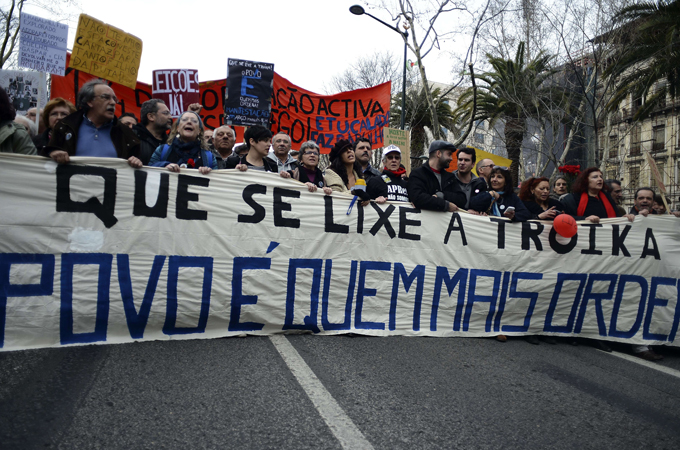
Anti-austerity Protestors in Portugal: "Screw the troika, we want our lives back"

Austerity is spreading across the globe like a bad virus, despite the vehement opposition of the general population. In Portugal, thousands of demonstrators have held marches across the country in protest. From Al Jazeera:
Tens of thousands of people filled a Lisbon boulevard during Saturday's protests and headed to the finance ministry carrying placards saying "Screw the troika, we want our lives back". 
The troika is a reference to the European Commission, the International Monetary Fund and the European Central Bank, the lenders behind the country's financial bailout. 
Many protesters were singing a 40-year-old song linked to a 1974 popular uprising known as the Carnation Revolution. 
Portugal is expected to suffer a third straight year of recession in 2013, with a two percent contraction. The overall jobless rate has grown to a record 17.6 percent. The marches were powered mostly by young people among whom unemployment is close to 40 percent.
 ...After several years of tax increases and welfare cuts, austerity is poised to deepen as the government looks for another $5.2bn to cut over the next two years. The national health service, education, pensioners and government workers are likely to be the hardest hit. The government is locked into debt-cutting measures in return for the $102bn financial rescue set up in 2011.  
More tax hikes and spending cuts are on the way for Portugal: when it comes to the IMF, you must pay your debts regardless of the consequences. That was always the IMF way of course, but when austerity plus regressive taxation was being imposed on impoverished countries with disastrous social and economic results, the global North didn't seem too bothered by it. One protestor in Lisbon is quoted as saying, "This government has left the people on bread and water, selling off state assets for peanuts to pay back debts that were contracted by corrupt politicians to benefit bankers." That scenario is lifted straight out of the IMF's playbook throughout Africa in the 1990s.

Tuesday, February 12, 2013

Protesters Confront "Fix the Debt" Leader over Corporate Tax Breaks

And they do it with a big sign:


The protestors are calling themselves "Flip the Debt."  From truth-out:

While speaking at a Fix the Debt conference on Monday, Honeywell International Inc. CEO David Cote [he of "union busting for dummies" fame] was interrupted several times by Flip the Debt protesters over tax loopholes that allow companies like Honeywell and General Electric to pay far less taxes than ordinary Americans. 
Three minutes into Cote's keynote address, the first heckler trumpeted: 
...Fix the Debt is nothing more than a CEO lobby whose real objective is huge corporate tax breaks and drastic cuts in Social Security, Medicare and Medicaid. David Cote and his CEO friends receive a lot from government: In 2011, Honeywell received $725 million in government deals, making it the 35th largest federal contractor. However, Honeywell and other companies pay next to nothing in taxes. Honeywell's tax rate from 2008-2011 was 2 percent. Does anyone in this room pay 2 percent?"
 The crowd applauded, but Cote only laughed nervously.
So, he neither confirmed nor denied whether he paid 2%.  An interesting nod to the UK, similar to the spread of the "Uncut" movement across the atlantic:
Gan Golan, cofounder of Flip the Debt, laid out his group's goals. "We will disrupt Fix the Debt meetings across the country to elevate our message that the biggest corporations in the country aren't paying taxes, and now they want the rest of us to pay for it. Sustained public pressure against corporate tax dodgers in the UK has put the issue at the top of the agenda there, and we hope to do the same."
The article mentions the Sanders bill to end deferral, and ends on the connection between tax dodging by multinationals and the dismantling of the welfare state:
Charlie Balban, president of the Alliance for Retired Americans-New Hampshire, grilled Cote during a question-and-answer period. "We should do something about the debt, but we don't need to cut programs that people depend on. Instead of reducing the deficit on the backs of working Americans, corporations should pay taxes like the rest of us."
It can't be too much longer before someone draws up a menu of welfare state expenditures in the US and then ties each item to a specific company and what they might have paid in taxes had they incurred the statutory rate on their income for the year.  If you see such a thing, please send me a link.

Friday, December 7, 2012

Pledge to HMRC notwithstanding, Starbucks sit-in is on

Check out the logo. It juxtaposes the austerity-driven dismantling of the welfare state against an apparent cause: high-profile taxpayers with available wealth who are withholding it from society.

I don't know if it works for an uninformed passerby--could it not rather convey something about Starbucks' giving nature, Starbucks aligned in the cause? Hey, Starbucks is giving HMRC £20m, that more than covers the £5.6m that "is being directly cut from domestic violence services," per the activists! Sure, we're all in this together!

Not so fast, says UKUncut:
Offering to pay some tax if and when it suits you doesn’t stop you being a tax dodger. Starbucks have been avoiding tax for over a decade and continue to deny that it paid too little tax in the past. Today’s announcement is just a desperate attempt to deflect public pressure. There’s no money yet, and hollow promises on press releases don’t fund women’s refuges or child benefits.
 As a result, UK Uncut is planning 40 'actions' across the UK: "People will be transforming Starbucks stores into refuges, crèches and other services which the government are cutting with their unjust and unnecessary austerity plans.”

Also, isn't Starbucks' decision in conflict with it's duty to maximize shareholder profits? Maybe this an opportunity to bring a lawsuit charging breach, arguing that Starbucks' duty is to pay the lowest amount of taxes it possibly can under the law. If the suit fails (debatable--in the US anyway), it might help lay to rest the fiction that the shareholder is the only relevant stakeholder in the scope of managers' fiduciary duties.