Showing posts with label austerity. Show all posts

Sunday, August 4, 2019

Krings et al on tax levels, scalar dumping, and democratic preferences

Professors Amy Krings, Dana Kornberg, and Erin Lane recently published Organizing Under Austerity: How Residents’ Concerns Became the Flint Water Crisis, Critical Sociology 45 (4-5), pp. 583-597 [gated]. The article examines the politics of austerity, of interest to tax researchers for lots of reasons but perhaps especially for the expression it gives to the connection between tax levels and democratic preferences through the phenomenon of scalar dumping. Here is the abstract:
What might it take for politically marginalized residents to challenge cuts in public spending that threaten to harm their health and wellbeing? Specifically, how did residents of Flint, Michigan contribute to the decision of an austerity regime, which was not accountable to them, to spend millions to switch to a safe water source? Relying on evidence from key interviews and newspaper accounts, we examine the influence and limitations of residents and grassroots groups during the 18-month period between April 2014 and October 2015 when the city drew its water from the Flint River. We find that citizen complaints alone were not sufficiently able to convince city officials or national media of widespread illness caused by the water. However, their efforts resulted in partnerships with researchers whose evidence bolstered their claims, thus inspiring a large contribution from a local foundation to support the switch to a clean water source. Thus, before the crisis gained national media attention, and despite significant constraints, residents’ sustained organization—coupled with scientific evidence that credentialed local claims—motivated the return to the Detroit water system. The Flint case suggests that residents seeking redress under severe austerity conditions may require partnerships with external scientific elites.
As to scalar dumping, the paper explains that:
A central feature of neoliberal governance in the United States has been the production of austerity conditions in cities. Jamie Peck (2012) has described how urban austerity regimes emerge through processes of scalar dumping, whereby financial responsibility for public goods is passed down from national to state and local governments. The logical priority that scalar dumping sets in motion is clear: cash-strapped cities must either raise revenue through taxes, fees, or service costs for public goods or they must cut spending. Scalar dumping disproportionately strains cities like Flint, which have already suffered severely because of deindustrialization, residential abandonment, aging infrastructure, high poverty rates, and racial segregation. Thus, although a city’s municipal budget is shaped by a range of economic factors beyond the control of city leaders, financial hardships tend to be borne by residents. 
When cities fail to be self-sufficient, officials may employ legal tools such as emergency management laws to label budget shortfalls as financial “emergencies.” This characterization can provide justification for punitive intervention—including democratic curtailment coupled with cuts to public services—by higher levels of government (state, national, or international). Thus, austerity is indeed a “politically imposed condition”. Additionally, by characterizing the city as experiencing a fiscal emergency, policies that entail additional public spending are removed from contention and effectively blocked from the political agenda. And by focusing on the short-term alleviation of fiscal problems, longer-term structural problems—such as the loss of revenue due to a declining tax base, decreases in state revenue sharing, and growing unemployment—are cast outside the sphere of public debate. [internal citations omitted]
The authors explain that “social action is necessary to counter the dangerous effects of austerity policies,” but note that “the possibilities for democratic influence have been severely curtailed. Additionally, as environmental regulatory rules are relaxed, 'the operating principle is that toxic chemicals are presumed innocent of harming human health unless proven guilty.'” They conclude by noting that the emergency management system that led to Flint's water crisis remains in place, and quote Clare McClintock of the Democracy Defense League that “This is a new model of governance that is dangerous and unacceptable. And it’s spreading to a town near you.”

Thursday, January 16, 2014

Ireland: Oasis for American multinationals, desert for Irish workers

From last Sunday's NY times, opinion write Fintan O'Toole discusses life in Ireland, after it first gorged on a panoply of tax reforms meant to lure in multinationals, and then starved under austerity under financial crisis. Of note:
...Ireland has two economies: a global one dominated by American high-tech companies, and a domestic one in which most Irish workers have to make their living. The first is indeed booming. Not least because of those low corporate taxes, large global corporations find Dublin convivial for reasons other than its pubs and night life. The sheer scale of Ireland’s dependence on this kind of investment for its exports can be judged by the fact that Irish gross domestic product took a serious hit in 2013 when Viagra (which is made by Pfizer in County Cork) went off patent in Europe. Broadly speaking, however, the global side of the Irish economy has remained robust. 
But home is where the heartache is: in the domestic economy outside the gated community of high-tech multinationals. Outside Dublin, property prices are still falling. Wages for most workers have dropped sharply. Unemployment remains very high at 12.8 percent — and that figure would be higher if not for emigration. There’s always been a simple way to measure how well Ireland is doing: Go to the ports and airports after the Christmas vacation and count the young people waving goodbye to their parents as they head off to the United States, Canada, Australia or Britain, where they have gone to find work and opportunity. 
...[People in Ireland] are not convinced that the cruel scale of the punishment was necessary or that the nasty medicine has, in fact, worked. 
Behind both of these propositions looms the great contradiction in the supposed success story of Irish austerity. It was austerity only for citizens. Running parallel to all the cuts in public spending and all the calls for fiscal responsibility has been a program of spending so lavish that it makes a drunken sailor look stingy. 
The converse proposition is that when it comes to contributing to the mechanisms of the state--rule of law, infrastructure, educated workforce, etc etc, which fully support those multinational gated communities--the state looks primarily to workers to do the bulk of the heavy lifting, in the form of personal income taxes (41% at the top) and consumption taxes (23% on most goods). But Ireland is not alone in this political decision.

The story of feasts for corporations, famine for workers is a familiar one, and the trade off is supposed to be the positive externalities corporations bring. In other words, the political tradeoff that politicians think they are making goes as follows: we can give up our tax on corporate income if that lures more corporations into our jurisdictions which then hire our workers, whom we can then tax on their incomes and then again on their consumption, to pay for luring in more corporations, in a virtuous cycle. O'Toole's column strongly suggests that the externalities are not anywhere near what was expected or would be needed to continue the virtuous cycle.

The problem for the state is that the owners of corporate capital have received their benefit up front, but when they do not produce their side of the equation in exchange, there is no way for government to demand a refund.

Thus we can add Ireland's story to the multiple examples that exist in various iterations of it around the world, including for example the constant intra- and inter-state fights to lure in manufacturers, filmmakers, and sports teams. Maybe governments should be thinking about adding a carve-back clause to the fiscal bargain that creates oases for bargain-seeking multinationals, which would disgorge untaxed profits when it is clear a party to a tax incentive-fueled deal is not bringing what they said they would or could.

Monday, April 22, 2013

The Boundaries of Tax Justice

I posted a draft of this paper on SSRN some time ago but neglected to post it here, so here it is. I argue that because governments chase wage-earners and consumers doggedly while selectively overlooking or ignoring other taxpayers, the imposition of income taxation as it is practised by states today is fundamentally unjust. Abstract:
The story of our time may be the awakening of society to an epidemic of global tax dodging by the world’s elites. Citizens, watchdog groups, and even government officials are puzzled, frustrated, and sometimes outraged by the phenomenon, wondering where the nation-state lost its way in regulating its people and its resources, and why it is standing by, apparently helplessly, as its tax base erodes while austerity measures undermine the welfare state. This paper demonstrates that the sequence of tax base erosion-austerity-welfare state erosion is a story about a crisis of tax justice. It does so by revisiting how Canada's historic Royal Commission on Taxation, in its search for guiding principles for tax reform, turned to tax justice as the central component for any tax system. It shows why nations have consistently failed to meet these guiding principles, instead taxing the easy-to-tax more or less comprehensively, the hard-to-tax more or less randomly, and the impossible-to-tax not at all. It demonstrates that the result is that no state today imposes taxation justly: instead, taxation as exercised around the world today is overwhelmingly characterized by arbitrariness and injustice. The paper concludes that if governments cannot or will not pursue justice in taxation, they have at minimum a duty to explain to society why this goal is no longer worthy of pursuit.
This paper includes a discussion of who should be considered a "taxpayer" by a state. I argue that citizenship-based taxation is unjust from both a human and statist perspective, and I therefore make the case for residence-based taxation. As always, comments are welcome.

Wednesday, March 6, 2013

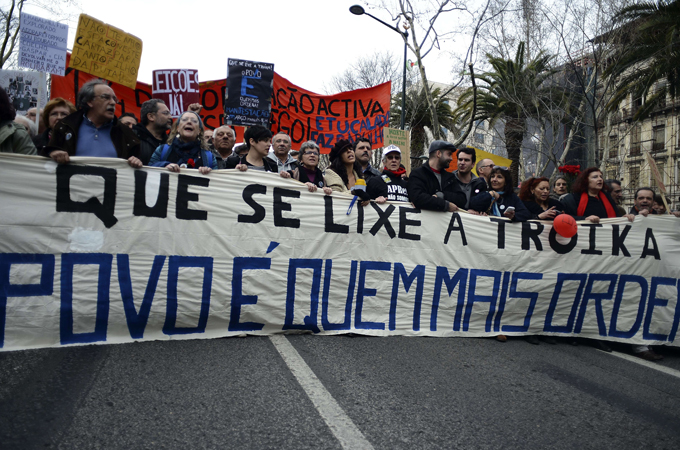
Anti-austerity Protestors in Portugal: "Screw the troika, we want our lives back"

Austerity is spreading across the globe like a bad virus, despite the vehement opposition of the general population. In Portugal, thousands of demonstrators have held marches across the country in protest. From Al Jazeera:
Tens of thousands of people filled a Lisbon boulevard during Saturday's protests and headed to the finance ministry carrying placards saying "Screw the troika, we want our lives back". 
The troika is a reference to the European Commission, the International Monetary Fund and the European Central Bank, the lenders behind the country's financial bailout. 
Many protesters were singing a 40-year-old song linked to a 1974 popular uprising known as the Carnation Revolution. 
Portugal is expected to suffer a third straight year of recession in 2013, with a two percent contraction. The overall jobless rate has grown to a record 17.6 percent. The marches were powered mostly by young people among whom unemployment is close to 40 percent.
 ...After several years of tax increases and welfare cuts, austerity is poised to deepen as the government looks for another $5.2bn to cut over the next two years. The national health service, education, pensioners and government workers are likely to be the hardest hit. The government is locked into debt-cutting measures in return for the $102bn financial rescue set up in 2011.  
More tax hikes and spending cuts are on the way for Portugal: when it comes to the IMF, you must pay your debts regardless of the consequences. That was always the IMF way of course, but when austerity plus regressive taxation was being imposed on impoverished countries with disastrous social and economic results, the global North didn't seem too bothered by it. One protestor in Lisbon is quoted as saying, "This government has left the people on bread and water, selling off state assets for peanuts to pay back debts that were contracted by corrupt politicians to benefit bankers." That scenario is lifted straight out of the IMF's playbook throughout Africa in the 1990s.

Sunday, February 24, 2013

Fix the Debt: bipartisans fooling some of the people all of the time (a primer on the solidarity of the 1%)

Gaius Publius is upset with bipartisan support for Fix the Debt, and points out the class-based solidarity of the rich (which of course aligns interests both within and beyond the nation state in ways that appear unprecedented to us today, but remind us of how things were during the last gilded age). He says:
Most left-side commenters paint "Fix the Debt" — the well-funded campaign to scare Americans into believing the debt is not only going to destroy us all, but that massive cuts to Medicare, Social Security and Medicaid are the only way to "fix" the "problem" — as a billionaire-led, CEO-led operation to kill (or at least seriously maim) the social programs by delivering one blow after another. But Fix the Debt is also a bipartisan operation.
This is about bipartisanship — real bipartisanship, bipartisanship in the bad way. 
...The real divide in this country is not Left versus Right — it's the Rich versus the Rest. It's the horizontal division between the people taking all the money they can, and those they're taking it from.
Among the rich, there's a widely-agreed center position — more for us, less for everyone else on the planet.
GP directs us to research done by watchdog group SourceWatch: a Fix the Debt portal, where they say:
The Campaign to Fix the Debt is the latest incarnation of a decades-long effort by former Nixon man turned Wall Street billionaire Pete Peterson to slash earned benefit programs such as Social Security and Medicare under the guise of fixing the nation's "debt problem." Through this special report -- and in partnership with The Nation magazine -- the Center for Media and Democracy exposes the funding, the leaders, the partner groups, and phony state "chapters" of this $60 million "astroturf supergroup," whose goal is to achieve a grand bargain on austerity by July 4, 2013.
SourceWatch lays out the various supporters and their bipartisan credentials, corporate ties and conflicts of interest; most have transitioned at least once from politician to lobbyist and/or vice versa, and big pharma, big oil, big finance, and the health insurance industry are all well-represented.  This is a delightful romp through the revolving door of democracy, American style.

GP says many (or most) of these individuals also have big-time conflicts of interest, as documented by Source Watch; they stand to benefit personally if what is now public becomes private and for-profit. They are all simple rent seekers, in other words, and the national debt is their trojan horse (or is it a rabbit).  This is not (or should not be) news, yet time and time again we see that you can fool some of the people all of the time...and, per George W. Bush,  "those are the ones you want to concentrate on.”

For an absolutely terrifying view of what that kind of concentrating looks like, GP ends with this video (which I can't even get all the way through so I can't tell you how it ends). The sheer number of rhetorical games played in the first 15 seconds alone is enough for me; when they get to the dancing I just want to weep.


Tuesday, February 12, 2013

Protesters Confront "Fix the Debt" Leader over Corporate Tax Breaks

And they do it with a big sign:


The protestors are calling themselves "Flip the Debt."  From truth-out:

While speaking at a Fix the Debt conference on Monday, Honeywell International Inc. CEO David Cote [he of "union busting for dummies" fame] was interrupted several times by Flip the Debt protesters over tax loopholes that allow companies like Honeywell and General Electric to pay far less taxes than ordinary Americans. 
Three minutes into Cote's keynote address, the first heckler trumpeted: 
...Fix the Debt is nothing more than a CEO lobby whose real objective is huge corporate tax breaks and drastic cuts in Social Security, Medicare and Medicaid. David Cote and his CEO friends receive a lot from government: In 2011, Honeywell received $725 million in government deals, making it the 35th largest federal contractor. However, Honeywell and other companies pay next to nothing in taxes. Honeywell's tax rate from 2008-2011 was 2 percent. Does anyone in this room pay 2 percent?"
 The crowd applauded, but Cote only laughed nervously.
So, he neither confirmed nor denied whether he paid 2%.  An interesting nod to the UK, similar to the spread of the "Uncut" movement across the atlantic:
Gan Golan, cofounder of Flip the Debt, laid out his group's goals. "We will disrupt Fix the Debt meetings across the country to elevate our message that the biggest corporations in the country aren't paying taxes, and now they want the rest of us to pay for it. Sustained public pressure against corporate tax dodgers in the UK has put the issue at the top of the agenda there, and we hope to do the same."
The article mentions the Sanders bill to end deferral, and ends on the connection between tax dodging by multinationals and the dismantling of the welfare state:
Charlie Balban, president of the Alliance for Retired Americans-New Hampshire, grilled Cote during a question-and-answer period. "We should do something about the debt, but we don't need to cut programs that people depend on. Instead of reducing the deficit on the backs of working Americans, corporations should pay taxes like the rest of us."
It can't be too much longer before someone draws up a menu of welfare state expenditures in the US and then ties each item to a specific company and what they might have paid in taxes had they incurred the statutory rate on their income for the year.  If you see such a thing, please send me a link.

Monday, January 7, 2013

Lobbying pays: the skewed impact of the fiscal cliff deal, in one striking chart

From Citizens for Tax Justice:
In 2013, the richest one percent of Americans will receive 18 percent of the tax cuts while ...[t]he bottom three-fifths ... will receive 18 percent of the tax cuts. In other words, the richest one percent of Americans will receive the same share of the tax cuts as the poorest 60 percent of Americans:


Note that it is hard to give tax breaks to the poorest, since they aren't much in the tax net to begin with. But what explains the middle? CTJ notes that the deal made permanent 85% of the Bush income tax cuts and 95% of the estate tax cuts, which we already know were skewed toward the wealthy and have presided over the largest widening of the income gap in US history since the gilded age. That is destroying the middle--there aren't so many people in that category any more.  And the ones still in the category have much less to work with:

Why did the fiscal cliff turn into welfare for the 1%? We know the answer, it's always the same. Incidentally Matt Stoller wrote a follow up piece arguing that if we understand how lobbying corrupts policymaking in the US, we can work against it.  But I am not optimistic.

Lobbying is policy in the US. That is how governance works. There are good aspects and bad aspects to the ability of the public to influence lawmakers in a democracy; the issue is what happens to democracy when you have to pay enormous sums to play. It seems that one thing that happens for sure is that elected officials become "utterly unresponsive to the policy preferences of millions of low-income citizens.” Major social imbalance is the result when, as Nancy Folbre says:
Our most affluent citizens now have less to gain from cooperation with the rest of us than they once had. They can effectively threaten to opt out and invest elsewhere. They can also invest vast resources in lobbying and electioneering.
I am still puzzled as to how on earth the NY Times managed to get their headline so wrong. Yves Smith calls it a big lie, and I would have to concur.

Wednesday, December 12, 2012

Is the Hobbit a Public Good? If no, why am I paying for it with taxpayer $$?

Hard on the heels of the story about why states are broke comes another example in the ongoing parade of horribles that is the global film tax incentive race to the bottom. Is the Hobbit a public good? If not, it's hard to understand why New Zealand gave its producers $120 million and changed its labor laws to prevent collective-bargaining, among other moves designed to keep production in New Zealand. This is a film that is expected to generate $3 billion in proceeds: they obviously don't require subsidies or labor suppression efforts in order to turn a profit. 

How many steps lie between the denial of labor rights in New Zealand to the appalling conditions and loss of life in Bangladesh? Not many. And why should a state ever be involved in driving its people down that road to serfdom?

Joe Karagnis has an account of the subsidies and legal reforms: To save regular earth, kill Hobbit subsidies. He says:
Film money is the hottest of hot investment money, fast in and fast out. Production is very mobile, and studios have become adept at extracting subsidies from governments for a few trinkets and promises of jobs.
Translation: film production acts just like capital. Countries (and states) compete for it, and it flows to the most welcome jurisdiction. That probably means tax incentives though there are lots of reasons to believe tax incentives aren't enough--investors need rule of law, good physical and financial infrastructure, competent workforce, etc. Really, what companies want is:
  • a highly educated workforce
  • that can't organize or demand high wages
  • a well organized legal system that protects contracts and property rights
  • but only (or mainly) of multinationals
  • a well-organized financial system that protects the investment from currency/inflationary etc pressures
  • but only if multinationals don't have to support it with taxes
Karagnis demonstrates the global spread of the problem: 
in the US ... state and local subsidies rocketed from US$2m in 2003 to about US$1.5b in 2012. Film subsidies are epidemic in Europe, where countries compete to attract and retain productions. And it has been a major part of New Zealand's cultural and industrial policy, where more than US$400m has been invested in The Lord of the Rings, Avatar and a handful of other productions over the past decade. 
But competitive subsidies are the quintessential sucker's game, in which winning is losing.
And a part of the story I just don't get at all:
For keeping Warner Bros happy, Prime Minister John Key - a former Merrill Lynch currency trader - got a replica magic Hobbit sword from President Obama...
This is puzzling and ridiculous (not to mention kind of embarrassing on both sides). The race to the bottom in film incentives is just another form of offshoring. Of course, it spreads US culture which is apparently viewed by someone that matters as the more important objective. My view: it is well past time for a little austerity for the film industry.

Friday, December 7, 2012

Pledge to HMRC notwithstanding, Starbucks sit-in is on

Check out the logo. It juxtaposes the austerity-driven dismantling of the welfare state against an apparent cause: high-profile taxpayers with available wealth who are withholding it from society.

I don't know if it works for an uninformed passerby--could it not rather convey something about Starbucks' giving nature, Starbucks aligned in the cause? Hey, Starbucks is giving HMRC £20m, that more than covers the £5.6m that "is being directly cut from domestic violence services," per the activists! Sure, we're all in this together!

Not so fast, says UKUncut:
Offering to pay some tax if and when it suits you doesn’t stop you being a tax dodger. Starbucks have been avoiding tax for over a decade and continue to deny that it paid too little tax in the past. Today’s announcement is just a desperate attempt to deflect public pressure. There’s no money yet, and hollow promises on press releases don’t fund women’s refuges or child benefits.
 As a result, UK Uncut is planning 40 'actions' across the UK: "People will be transforming Starbucks stores into refuges, crèches and other services which the government are cutting with their unjust and unnecessary austerity plans.”

Also, isn't Starbucks' decision in conflict with it's duty to maximize shareholder profits? Maybe this an opportunity to bring a lawsuit charging breach, arguing that Starbucks' duty is to pay the lowest amount of taxes it possibly can under the law. If the suit fails (debatable--in the US anyway), it might help lay to rest the fiction that the shareholder is the only relevant stakeholder in the scope of managers' fiduciary duties.

Saturday, December 1, 2012

CEOs: welfare is good, but only if it's corporate

From Naked Capitalism, 9 Greedy CEOs Trying to Shred the Safety Net While Pigging Out on Corporate Welfare:
A gang of brazen CEOs has joined forces to promote economically disastrous and socially irresponsible austerity policies. Many of those same CEOs were bailed out by the American taxpayer after a Wall Street-driven financial crash. Instead of a thank-you, they are showing their appreciation in the form of a coordinated effort to rob Americans of hard-earned retirements, decent medical care and relief for the poorest.
...they are gearing up to pull the wool over the public's eyes by cutting Social Security, Medicare and Medicaid. The CEOs are part of the Fix the Debt campaign ... which plans to unleash tens of millions pushing for a deficit reduction deal that favors the rich.
...these Scrooges are so bold as to publicly announce their desire to pick the pockets of fellow Americans while simultaneously pigging out at the corporate welfare trough. Multitasking!
NC provides a sample of what it calls the Fix the Debt CEO Council Hall of Shame (complete list at the Fix the Debt website here):
1. Lloyd Blankfein, chairman and CEO, Goldman, Sachs & Co. Blankfein, infamous for describing his financial activities as "God's work," shared his attitude toward society with CBS news recently. He explained his keen desire to see Americans lowering their sights for the future. ...he gives a pithy summary of what life is going to be like for the 99 percent:
You're going to have to do something, undoubtedly, to lower people's expectations of what they're going to get, the entitlements, and what people think they're going to get, because you're not going to get it.
...Since the financial crash, Blankfein's company, Goldman Sachs, has received tens of billions of dollars in ..."direct and indirect succor from the Fed."...
2. Jeffrey Immelt, chairman and CEO, General Electric Company. ...supporting disastrous financial deregulation, dodging taxes and helping to destroy American manufacturing has not satisfied Immelt. He'd like to add insult to injury by making sure that people who have been screwed by the reckless activities of short-sighted corporate titans like himself are left to starve in their golden years and go without medical care. And as for the poor, well, couldn't they be just a little bit poorer? Immelt thinks that would be swell.
After the 2008 crash, the government gave a giant boost to hard-pressed GE Capital, the company's financing arm, through the Temporary Liquidity Guarantee Program. GE has also helped itself to enormous taxpayer-funded subsidies, especially in green energy. And guess how much GE paid in taxes in 2010? Nothing. ...
3. Jamie Dimon, chairman and CEO, JPMorgan Chase & Co. ... Dimon is deploying a familiar scare tactic on the topic of the so-called fiscal cliff. He's claiming that his company will be forced to cut down on hiring and so on if a budget plan is not tailored to enrich the wealthy. ...Maybe Dimon's company would be better served figuring out what happened to the $6 billion that recently went up in smoke in the "London Whale" derivatives fiasco.
NC covers several more including the CEO of Honeywell (of powerpoint "union busting for dummies" fame), all at the link.

Thursday, June 21, 2012

Choosing Austerity

Menzie Chinn says the austerity being imposed on Greece, Spain etc is self-defeating, while in the US the states are voluntarily choosing austerity, to their own GDP detriment, in order to reduce the state for political reasons.  More:
...the approach of muddling through, dealing on an ad hoc basis with each crisis with aid conditioned on fiscal consolidation, is not working. It's not working partly because in the demand determined models we teach in intermediate macro work cutting government spending and raising taxes tends to depress output, as highlighted in this post. But when the countries affected are closely linked by trade, then the total effect of the contractionary policies conducted in individual countries results in even greater contraction.
Had these economies been on floating exchange rates, the contractionary effects might have been mitigated by depreciated currencies. But membership in the eurozone meant that shock absorber was gone. That is why the prospect of an expansionary fiscal contraction was never very plausible in the case of the GIIPS. But as long as the rest of the eurozone countries were unwilling to provide substantially more financing or transfers to the GIIPS, these governments had little alternative to fiscal consolidation. That is the fate of many, many countries that have faced IMF stabilization packages in earlier decades.
In contrast, the U.S. has currency flexibility so it can save itself, but the states chose austerity, and Chinn shows this has led to lower GDP growth.  Chinn says:
In contrast to Europe, the choice to slash spending and taxes was unforced. In the absence of tax cuts, spending could have been maintained at higher levels. Furthermore, the Federal government had the resources to further support the state and local governments. 
...Truly, much of the distress at the state and local level is essentially a self-inflicted wound, that allows a push for smaller government to proceed under the guise of austerity. 
Charts and more analysis at the link.