Thursday, October 11, 2012

So much for the end of men


NPR has a story on the college payoff, showing that while students pay much more for a college education in the U.S. than they do in most other countries, they also get a bigger return on their investment.  But for me the big story is the enormous gender difference in that payoff.  Wow!  There continues to be a huge premium for maleness across the globe, but it is striking indeed how much more being male in America gets you:

How Much We Pay For And Gain From College

And what explains why college costs more for women in the U.S., Germany, and Canada?  It can't be a base price differential along gender lines, I would think (lawsuit, anyone?), so is it that men are given more scholarships?

The story points us to this study from Indiana University with more detail on the gender gap, including this chart showing that women must obtain associate's degrees to match the salary levels of men with high school degrees:  
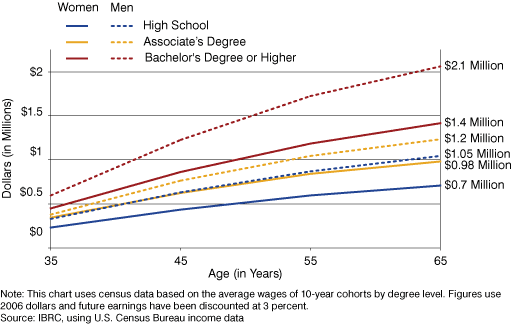
I can't see how this information in any way squares with the notion that women are pulling ahead of men. 


Wednesday, October 10, 2012

If you're entitled, you probably don't deserve it.

What does it mean to be entitled to something?  It used to mean you earned it, and are owed it, and it would be unfair not to give it to you.  Now it means you are demanding something that you have not earned, are not owed, and cannot in fairness be given.  I view this rhetorical shift as a subtle but very destructive development for spending programs that are tied to revenue sources, e.g., social security in America.  Roosevelt famously insisted on tying the benefit to the tax that funded it:
“We put those payroll contributions there so as to give the contributors a legal, moral, and political right to collect their pensions and their unemployment benefits,” he reportedly responded. “With those taxes in there, no damn politician can ever scrap my social security program.”
But if it becomes rhetorically acceptable to use entitlement to mean the opposite of entitlement, this creates a license for the damn politicians to scrap these programs after all.  This is so even if, like social security, such programs are not actually in fiscal straits.  Rhetoric matters, maybe far too much, in politics.  It is all too easy to convince people that entitlements are not deserved, therefore anything called an entitlement can and should be eliminated.  Worse, so long as you use another term to describe other benefits doled out by government, you get a pass from this scrutiny and judgment.  "Tax incentives" is a ready candidate to fil that rhetorical space, as we have seen in this campaign.  

Elites call for higher taxes in France, stamp feet when their wish is actually granted

Its fascinating to me that elites will only accept high marginal tax rates for purposes of destruction, namely, war.  When it comes to building something, a marginal 75% tax rate on top incomes is seen as outrageous and out of the question-no sane person could support it.  Tax resistance is really anti-social in that way.

Friday, October 5, 2012

Evidence: it's ok to tax millionaires

Richard Murphy points to this story that argues, contrary to conventional wisdom, millionaires do not necessarily flee high tax jurisdictions in search of tax havens:

From the article:

This newspaper's review of tax return data for 2010, the most recent year for which data is available, found no link between the state income tax rate and the number of people who reported adjusted gross income of at least $1 million.
Consider:
  • The states with the most and fewest rich people per capita are Connecticut and West Virginia, respectively. In Connecticut, one of 190 taxpayers earns at least $1 million in adjusted gross income. In West Virginia, just one out of every 1,400 filers make that much. Yet both states tax rich people about the same.
  • Our neighbors: Nevada is income-tax free; Oregon has one of the nation's highest income taxes on the rich; and Arizona is about average. Yet all three have a below-average number of rich people per capita.
  • In the Midwest: Illinois and Ohio charge about the same income-tax rates and have similar populations. Yet Illinois has 233 millionaires per 100,000 taxpayers, while Ohio has 107 per 100,000 taxpayers.
  • In the Northeast: Massachusetts has more than double the millionaires per capita than neighboring New Hampshire, which is income-tax free.

Murphy concludes from this report that "It's fairly easy to move in the US. But people don't."  He therefore suggests we lay the mobility myth to rest since it would be comparatively much more difficult to move across national borders.  If people don't do it when it's easy, what will make them do it when it's hard?

I think and hope this is generally true--that people have cultural/social ties to places that prevent purely fiscal decision-making, so we don't need to coddle the rich out of fear of a Randian exodus, but can ask them to contribute more to the societies in which they live.  But the high profile cases we see in the news suggest that when it comes to the super-rich things might not be so clear.  Maybe they stay put but nothing stops them from engaging in the standard game playing that puts money out of sight to governments while doing so.  It could even be worse for society if they physically hang around but play all kinds of games rather than paying their taxes; in that case, it might be preferable if they pull a Saverin.


Students in their Classrooms

A fascinating set of photos from Visual News: 

England, Washington, Year 7 (first day), Registration

England, Erith, Year 10, English

England, Wolsingham, Year 12, English

Argentina, Buenos Aires, Grade 4, Natural Science

Saudi Arabia, Dammam, Kindergarden, Activities

Yemen, Manakha, Primary Year 2, Science Revision

Qatar, Grade 8, English

Bahrain, Saar, Grade 11, Islamic

Brazil, Cipó, Series 4, Geography

Brazil, Belo Horizonte, Series 6, Mathematics

Peru, Cusco, Primary Grade 4, Mathematics

USA, Oklahoma, Avant, Grade 4 & 5 Social Sciences

USA, St Louis, Grade 4 & 5, Geography

USA, Oklahoma, Barnsdall, Grade 4 & 5, Science

Nigeria, Kano, Ooron Dutse, Senior Islamic Secondary Level 2, Social Studies

Tokyo, Japan, Grade 5, Classical Japanese

Argentina, Buenos Aires, San Fernando, Year 3 Secondary

Taiwan, Ruei Fang Township, Kindergarten, Art

Cuba, Havana, Playa, Year 9, national television screening of film 'Can Gamba' (about Cuban participation in Angolan Revolution)

Germany, Düsseldorf, Year 7, English


MRU lectures on development

From Marginal Revolution:
At MRUniversity we just released over 30 new videos on leading thinkers on development. We cover Amartya Sen (who gets three), Bela Belassa, Karl Polanyi, Adam Smith, Paul Romer, William Easterly
 I'm glad to see Polanyi on the list, and right beside Adam Smith, precisely correct (though in their full listing the two are separated by Schumpeter and Gerschenkron, fair enough.  As to Easterly I am not as enthusiastic but I will watch it anyway.  Also on the list: Krugman, Stiglitz, Ostrom, Rodrik, Acemoglu, Banerjee, Collier, more.  Yes, the list is almost wholly male--only Ostrom, Anne Kreuger and Esther Duflo are included and all three are American (ok, Duflo is also French). Nevertheless it looks like a fascinating series.


Thursday, October 4, 2012

Tax games? Glencore's self-insurance plan

From the Guardian: Glencore accused of slashing tax bill by using complex insurance deals; Commodity trader's UK profits are being depressed, but company says contracts are not designed to avoid tax.

A leading tax expert has accused Glencore of cutting its UK tax bill by tens of millions of pounds after profits at the commodity trader's London arm were depressed by complex insurance contracts taken out with its own parent. 
...The derivative instruments being employed by Glencore are widely used by companies to insure – or hedge – financial risks. They theoretically guarantee a certain return.
Last year, Glencore UK's derivative trading with other parts of the group totalled $383bn (£267bn), more than twice the yearly budget of the National Health Service. The practice resulted in a $122.8m loss for the London-based business, effectively docking that amount from UK profits and transferring it to the main group based in the low-tax Swiss canton of Zug. 
Richard Murphy, of Tax Research UK, said: "Glencore is insuring itself with itself. If I insure my house for fire with myself and it burns down, I've got to pay myself for the house which has burnt down. That's what Glencore is doing, and the consequences are that the risk is never leaving Glencore; it's still inside the group. That's $383bn worth of trades that, on the face of it, make no sense whatsoever. We don't know, but it is highly likely that the motivation is not genuine insurance and it looks like a significant amount of tax planning takes place within this trading function." 
Murphy said ..."This is totally legal but what we are seeing is a significant change in the way in which multinational corporations are now looking to move their profits around the world.
"All the evidence is that throughout the extractive industries – the mining industry, the oil industry, the gas industry and so on – the way in which people are shifting profits now are derivative financial products." 
Glencore UK's accounts show that its massive turnover of $59.8bn in 2011 resulted in a pre-tax profit of $99.1m, a margin of less than 1%. A tax credit, the result of unrelated employee share awards, took total profits for the year to $115.7m. Had the $122.8m derivatives loss remained in the UK and been added to those profits, it would have attracted taxes of about $32m. 
Glencore insisted that lowering its tax bill was not the purpose of the derivative trades. 
Glencore's Baar-based spokesman said: "The derivative contracts Glencore Energy uses in London with its parent company in Switzerland are effectively tools to help it manage risk.
"They enable risk to be concentrated at the centre, where it can be absorbed due to the size of its capital base. These are standard contracts used by many companies across many industries. This is about managing risk and nothing to do with avoiding tax. Like all major global corporations, we work closely with local tax authorities to ensure that we pay the correct and appropriate amount of tax." 
In 2010, Glencore UK made a profit $186.5m on insuring itself with its parent, although those winnings were virtually all cancelled out by losses on external derivative contracts. ...
Richard Murphy carries the story and responds:
I note what Glencore say but cannot agree. There [sic] argument appears to be London cannot bear the risks of these trades so they have to be moved on but a simple guarantee (or more capital)  would overcome that issue and save the enormous cost of $383 billion of trading. However, those trades do take place which means there must be an economic justification for the cost of doing them, and tax is the only one I can see.  

Call for Papers: Tax and Inequality

And here's another call for papers, from TJN: 
Call for papers for a Research Workshop on
TAX AND INEQUALITY
City University, London, 4th and 5th July 2013

The 2013 research workshop co-organised by the Association for Accountancy & Business Affairs,i City University,ii and the Tax Justice Network,iii  will explore connections between tax justice and inequality.  This opens up possibilities for papers on a wide variety of themes, including taxation of wealth, case studies of innovative tax measures to reduce inequality, how tax expenditures favour particular groups, tax and access to housing, tax and inter-generational wealth distribution.
Other related themes are likely to emerge as the workshop programme develops.
Offers of papers are especially welcome and early submission of an abstract of no longer than 300 words is encouraged.  All submissions will be considered by the organising committeewhich comprises:
  • John Christensen (Tax Justice Network)
  • Jo Marie Griesgraber (New Rules for Global Finance, Washington)
  • Richard Murphy (Tax Research LLP)
  • Ronen Palan (City University, London)
  • Sol Picciotto (Lancaster University)
  • Prem Sikka (Essex University)
This workshop will bring together researchers, academics, journalists, policy staff of civil society organisations, consultants and professionals, elected politicians and/or their researchers, and government or international organisation officials.  The purpose of the workshop is to facilitate research through open-minded debate and discussion, and to generate ideas and proposals to inform and shape the political initiatives and campaigns already under way.
There will be a small charge for attendance at the Workshop. Participants are usually expected to finance their own travel although applications from students and others with limited means for bursary support will be considered. 
You can download a PDF version of this Call for Papers here.
More information about this workshop is available from:  John Christensen, Tax Justice Network, john@taxjustice.net

    Call for Papers: Philosophy of International Law

    Interesting call for papers, maybe tough for a typical international tax scholar/armchair philosopher to pass peer review, on the other hand I think international tax scholars are increasingly confronting the kinds of questions outlined here.  Details:


    The Journal of Philosophy of International Law (JPIL) is a peer-reviewed (and currently an open source Journal) published by ElectronicPublications.Org Ltd—a publisher with no institutional affiliation. The JPIL’s sister publications are the Manchester Journal of International Economic Law and  the Journal of Islamic State Practices in International Law. The JPIL is being re-launched and will be published twice a year (May and November). The Journal has a distinguished Advisory Board and its aim is to provide an established scholarly platform for the philosophy of international law.
    The aims of the JPIL are to promote:
    • Critical examination of and legal reflection on the foundations of International Law.
    • Philosophical analysis and critique of the nature of the international legal order or any aspect thereof.
    The areas that might be covered by these aims include, but are not confined to the following:
    • Historical enquiry into International Law for philosophical purposes, or intellectual history as related to the foundations and development of International Law.
    • Ethical issues in International Law or the uses of International Law for ethical debate.
    • Ontological questions of the existence of International Law and the nature of the reality it attempts to regulate, such as states, humanity and world society.
    • Epistemological questions of an interdisciplinary nature and enquiry into the limits of disciplinary approaches such as positivism in International Law.
    Guidelines for Authors:
    The Journal welcomes submissions of articles and reviews for consideration with a view to publication. The normal word length for article contributions is between 4000-8000 words. The normal word length for reviews/commentaries should be 1000 to 1500 words. Submissions (except reviews/commentaries) should include a short abstract of not more than 60 words. The style guide for references is Oxford University Standard for Citation of Legal Authorities (OSCOLA).
    Editorial correspondence, including submissions to the Journal, should be made electronically to the Editor-in-Chief: at JPIL-submissions@mail.com, JPIL@electronicpublications.org

    HT Jacob Katz Cogan.

    Trickle down government...wha??

    I'm still scratching my head over this. So...is trickle down nonsense now? Or is it affirmed as solid doctrine, but bad if it involves government? Is it an argument that government should inure to the benefit of the top, whose contributions to society will have the effect of trickling government largesse down to the 47%? Or is it to say that government programs aimed at the top are no good because they will (or will not?) trickle down? I'm stumped.

    Wednesday, October 3, 2012

    Expensive to be poor: dental edition

    From Propublica, a look at dental treatment for the poor.  First, medicaid pays so little that many dentists won't accept medicaid patients at all; second, when they do accept these patients, they exploit them ruthlessly to extract every possible dollar, either from medicaid or the patients themselves or both.  For those without access to dentists, the Romney plan (emergency room care for all) doesn't appear quite workable:

    Not that many dentists actually accept Medicaid. There are some states where the reimbursement rates are so low that even the chains don't go there. Like in Florida, for example, the Medicaid rates are so low there that chains don't really even bother. So children end up going to the emergency room because they have a toothache and there's nothing else they can do. They end up in hospitals to treat a tooth. 
    There was a famous case in Maryland where a 10-year-old boy had a toothache and it was abscessed and he ended up dying because he didn't have a dentist.
    But for those lucky enough to find a dentist who will take them on, the situation seems only marginally better: instead of dying, you get this:


    We looked at two of the larger [dental] chains, and found evidence that these companies were putting pressure on their dentists to produce at certain revenue targets, thus encouraging them to do procedures that may have been unnecessary.
    ... One of the chains focused on kids on Medicaid, and the reimbursement rates for Medicaid are pretty low. So in order to get a lot of revenue from these patients they were doing things like taking x-rays that were not needed, or putting stainless steel crowns instead of fillings on their teeth. They could make twice as much money from Medicaid on these crowns versus just putting a filling on a tooth. Kids were getting treatments that they really didn't need.
    ...We had one example of an 87-year-old woman who had already been to the dentist and she went in to have two teeth pulled, thinking it would be cheaper at [New York-based] Aspen Dental. Instead they looked at her mouth and they came up with a treatment plan that was going to cost $8,000. They convinced her though hard-sell tactics to borrow that money through a credit card, and something like $2,000 of that was just to clean her teeth. (Aspen Dental's response is here.)
    How do these dentists sleep at night?  Well, they have big loans to pay off, you see:

    These days, when dentists get out of dental school, they often owe anywhere between $200,000 and $300,000 dollars. Dental school is actually more expensive than medical school. So they come out with these huge debts, in a lot of cases they can't really afford to start their own practice. 
    These dental chains hire people, a lot of the time right out of dental school, and they pay fairly decent salaries and they have a bonus system where the more work you do on a patient the more you get paid. That's true for a private dentist as well, but the difference is that these companies are owned by private equity firms, and they're managed in a different way. You have people who are not dentists coming up with a business plan that's based on metrics. They try to get new patients in who haven't been to the dentist in a while, and they've already calculated how much revenue the average new patient should generate. 
    If you happen to go in and you don't really have anything wrong with your mouth and you're a new patient you're not fitting the model. That creates pressure for the dentists to find things that are 'wrong.'
    The report goes on to show that the problems are mostly undetected because there is insufficient oversight.  A scholar who works on corruption in governance once told me that the recipe for corruption is greed plus opportunity.  You can't stop greed, he said--that's human nature.  But society has got to find ways to curb opportunity.  That's after all one of the main reasons to form a society at all--namely, to curb the human animal's propensity to exploit and destroy one another for personal gain.  For more on this issue, you can watch "Dollars and Dentists" at PBS.

    Tuesday, October 2, 2012

    "IRS Rules" is Wrong!

    One of my, if not my biggest, pet peeves with popular press reporting on taxes is when reporters blame "IRS Rules" for some perceived tax abuse.  For example, today's New York Times (also linked on TaxProf) claims that the difference in tax treatment between a partnership interest and a fee from a corporation is one such rule.

    I thought the Internal Revenue Code provided for a separate tax on corporations and for partnerships to be treated as flow-through entities, which is why carried interest is taxed differently than fees paid by a corporation.  Or maybe the Supreme Court? Or the Circuit Courts?  Even Treasury Regulations don't come directly out of the IRS.  The IRS does an incredible amount of work administering the tax laws of the largest economy in the world, and there really are rules published by the IRS that can have substantive effect , but the IRS does not (and cannot) make these more fundamental structural legal choices.

    Why care so much?  Because the use of "IRS rules" gives the impression that somehow there is a shadowy underworld of bureaucrats conspiring with shifty practitioners and taxpayers to avoid or undermine obviously correct tax consequences, rather than face the difficult policy choices inherent in constructing a tax law which involve real and difficult trade-offs.  As someone who struggles with these issues, this concerns me. How is the country supposed to engage in a real policy debate without directly confronting these difficult policy choices?    Perhaps not all is lost, though - the Times editorial board seems to be able to get it right.

    More personally, however, I suppose I am just tired of explaining to people that the IRS had nothing to do with why Bain can form entities in the Cayman Islands and defer paying taxes.  Oh well.

    Sunday, September 30, 2012

    Underground Economy in Canada, 1992-2009

    Interesting stats, suggesting that the underground economy is not currently growing in Canada.  The CRA is careful to say that the UE is not an estimate of the tax gap, but CRA will look at these stats in light of the need to ensure everyone is "paying a fair share."  I'm only aware of an official statement of a "tax gap" by the U.S. and U.K.   

    Friday, September 28, 2012

    Carter Commission after 50 years, cont'd

    Today's panels were interesting and informative. Neil Brooks kicked things off with a lively and wonderful introduction to the politics and process of the commission and the hopes for tax reflection and reform today (they are dismal, I'm afraid). Tomorrow promises to be equally full, with a deep lineup. Speakers:

    • Jinyan Li - Would Mr. Carter be Happy with the International Tax Developments in Canada
    • Yan Xu - Enduring Echoes in a Changing Landscape: China’s Tax History?
    • Carl MacArthur - From Carter to Copthorne: Judicial Inactivism and the Rise of the GAAR
    • Michelle Markham - Advance Pricing Arrangement Reform in Australia – Is this Relevant to any Future Reform in Canada?
    • Kathrin Bain - Research and Development Tax Incentives: What can Canada learn from Australia’s experiences?
    • Steven Dean - Tax Apps: 50 Years of Tax Expenditures
    • Lisa Philipps - The Role of R&D Tax Expenditures in Canada’s Innovation Strategy: From Carter to Jenkins
    • Michael Livingston - Convergence, Divergence, and the Limits of Globalization in Tax Matters: The Canadian Experience
    • William McCarten - Provincial Strategies for Corporate and Personal Income Tax Design: Positive, Zero, or negative Sum Games?
    • Kathryn James - The Carter Commission and the Value Added Tax
    • Lori McMillan - The Non-charitable Non-profit Subsector in Canada: An Empirical Examination
    • Richard Schmalbeck - The Income Taxability of Gifts: Haig-Simons, the Carter Commission, and the Real World
    • Shu Yi Oei - Who Wins When Uncle Sam Loses? Social Insurance and the Forgiveness of Tax Debts
    • Catherine Brown - Revisiting the Carter Commission's International Tax Policy Analysis
    • Elsbeth Heaman - The Personal Income Tax in Canada Before 1917
    • David Tough - Carter and Company: The Commission’s Critique of Inequality in the Context of Canada’s Rediscovery of Poverty in the 60s
    • Neil Buchanan - The Trinity without the Holy Ghost: Tax Scholarship Without the Illusory Goal of Efficiency
    • David Duff - Haig, Simons, and Carter: Rethinking the Concept of Income in Tax Law and Policy
    • Richard Krever - What is an “Enterprise” in GST Law?
    • Shirley Tillotson - The Politics of Carter-Era Tax Reform: A Revisionist Account
    More at the conference website, here.

    Thursday, September 27, 2012

    Carter Commission After 50 Years

    Tomorrow is the first day of the Dalhousie Law conference, The Carter Commission 50 Years Later: A time for reflection and reform."   On the schedule for tomorrow:

    Neil Brooks - The Carter Report: Brilliant, Imaginative and One of a Kind
    Ajay Mehrotra - The VAT Laggards: A Comparative History of US and Canadian Resistance to the Value-Added Tax
    Miranda Stewart - Tax Reform and Legitimacy in the Global Era
    Faye Woodman - Should the Tax Burden on Babyboomers Be Reduced Because They are Getting Older?: The Age Tax Credit, the Pension Income Credit, and Income Splitting of Pension Income
    Claire Young - Beyond Conjugality: Time for the Tax System to Take that Concept Seriously
    Allison Christians - Drawing the Boundaries of Tax Justice
    Peter Dietsch - Fiscal Obligations to Redistribute in an International Setting
    Thaddeus Hwong - A Comparison of Trends in Tax Levels and Tax Mixes in Canada and Other OECD Countries Before and After Carter
    Chris Sprysak - Taxing Me or We: Yet Another Look at the Carter Commission’s Recommendation for Joint Returns
    Tamara Larre - Dependency Under Canada’s Income Tax System
    Kirk Collins - Capital Markets, Interest Imputation, and the Carter Report’s Proposed System of Full Integration of the Corporate-Shareholder Income Taxes
    Martha O’Brien - Corporate Group Taxation: Here and Now, There and Then

    And that's just the first day.  You can access the full schedule at the link.

    Wednesday, September 26, 2012

    Today at McGill Law: Miranda Stewart

    Miranda Stewart will present a paper on the sham doctrine today as the first speaker of the McGill Tax Policy Colloquium.  It's an interesting paper that raises difficult questions about form and substance in tax law.  If you're in Montreal, I invite you to attend, details at the link.

    Tuesday, September 25, 2012

    Why does Apple have so much cash offshore?

    And Google and GE and etc etc?  Contrary to popular sentiment, it is not that pesky uncompetitive U.S. tax regime, with its punitive rules that would impose corporate taxes on repatriated cash.  At least, there is not enough empirical evidence to pin solely on this well-worn scapegoat.  Instead, three economists examined the evidence of the growing MNC overseas cash stash and conclude that rather than regulation or governance, a company's spending on research and development intensity explains its cash overseas.  

    The paper is called Multinationals and the High Cash Holding Puzzle.  Here is the abstract:
    Defining as normal cash holdings the holdings a firm with the same characteristics would have had in the late 1990s, we find that the abnormal cash holdings of U.S. firms after the crisis represent on average 1.86% of assets. While U.S. firms held less cash than comparable foreign firms in the late 1990s, by 2010 they hold more. However, only U.S. multinational firms experience an increase in abnormal cash holdings during the 2000s. U.S. multinational firms had cash holdings similar to those of purely domestic firms in the late 1990s, but they hold over 3% more assets in cash than comparable purely domestic firms after the crisis. Further, U.S. multinationals increased their cash holdings since the late 1990s relative to foreign multinationals by roughly the same percentage as they increased their cash holdings relative to U.S. domestic firms. A detailed analysis shows that the increase in cash holdings of multinational firms cannot be explained by the tax treatment of profit repatriations, that it is intrinsically linked to their R&D intensity, and that firms that become multinational do not increase their abnormal cash holdings after they become multinational. There is no evidence that poor investment opportunities, regulation, or poor governance can explain the abnormal cash holdings of U.S. firms after the crisis. 
    The authors discuss the paper here, including these interesting facts:
    U.S. firms hold more cash than comparable firms whether these firms are in developed countries or not, in common law countries or not, in countries that tax income worldwide or not, and in Eurozone countries or not. 
    ...We find that U.S. multinationals held comparable amounts of cash than purely domestic firms in the late 1990s, but now hold significantly more cash than similar purely domestic firms. 
    ...Foley, Hartzell, Titman, and Twite (2007) show that the tax treatment of remittances makes it advantageous for multinationals to keep their earnings abroad and they find that firms for which repatriation is more costly hold more cash. Our findings suggest that the tax costs of repatriation are not the whole story for the increase in cash holdings of U.S. multinationals in the 2000s. ...[T]he Homeland Investment Act of 2004 ... failed to reduce the cash holdings of multinational firms. ...[I]t could be that the incentives of the Act were insufficient to affect firms’ cash holdings. ...[T]he repatriation tax costs could affect more where firms locate their cash rather than how much cash they hold. We expect that the tax cost of repatriation would be more important for high cash flow multinationals, but empirically these multinationals do not hold more cash than low cash flow multinationals. The increase in cash holdings of multinationals is strongly related to their R&D intensity, so that multinationals with no R&D expenditures do not have an increase in abnormal cash holdings compared to domestic firms with no R&D expenditures. Further, a striking result is that, among high R&D spending firms, firms that were already multinationals before 1998 do not hold more cash now than firms that were purely domestic firms before 1998. Among these firms, cash holdings increase sharply for multinationals relative to purely domestic firms, but that is because the cash holdings of multinationals are becoming more comparable to the cash holdings of purely domestic firms. Finally, and perhaps most importantly, we find no evidence that firms that become multinationals start holding more cash after they become multinationals. It appears that firms that become multinationals are firms with attributes that lead them to hold large amounts of abnormal cash even before they become multinationals. 
     Emphases mine.   

    An emergency room is not a health care plan.

    American College of Emergency Physicians (ACEP):
     "Emergency departments have become a health care safety net for everyone, but that safety net is breaking. If you continue to take emergency care for granted, and don’t support it, it eventually won’t be there for anyone.” 
    So, it's not a vey good hammock then, either.  It seems sad to me that the ACEP has to explain why emergency room care is not health care.  An ounce of prevention is worth a pound of cure.  That's a conservative (small c, obviously) idea.  Yes, both cost money.  One you plan for, and it costs x.  The other you don't plan for and it costs x+.   Not having national health care doesn't get everyone out at zero.  I would rather pay for everyone at x instead of everyone at x+.


    Monday, September 24, 2012

    US to Europe: our airlines won't obey your tax laws

    The EU is trying to take the high road on pollution, but the US insists on the low road:
    The Senate unanimously passed a bill on Saturday that would shield U.S. airlines from paying for their carbon emissions on European flights, pressuring the European Union to back down from applying its emissions law to foreign carriers.
    ...Republican Senator John Thune, a sponsor of the measure, said it sent a "strong message" to the EU that it cannot impose taxes on the United States. 
    The aviation industry is happy of course; as the EU was already considering backing down, "to avert a trade war with major economic powers such as China and the United States, allowing time to forge a global agreement on climate charges for the aviation industry."  But that's waiting for Godot: "attempts to address this problem on a global basis have been festering for more than 15 years in ICAO and the United States is at the centre of the problem," according to Transport & Environment, an NGO based in Brussels.

    In the meantime, I'm not sure I understand how the U.S. can simply declare that its airline industry can ignore the law in Europe.


    Who built that: fracking edition

    Love it or hate it, fracking is not the product of private enterprise alone but a partnership between government and private enterprise, as the AP reports:
    Over three decades, from the shale fields of Texas and Wyoming to the Marcellus in the Northeast, the federal government contributed more than $100 million in research to develop fracking, and billions more in tax breaks.  Now, those industry pioneers say their own effort shows that the government should back research into future sources of energy — for decades, if need be — to promote breakthroughs.
    ...The first federal energy subsidies began in 1916, and until the 1970s they "focused almost exclusively on increasing the production of domestic oil and natural gas," according to the Congressional Budget Office. 
    More recently, the natural gas and petroleum industries altogether accounted for about $2.8 billion in federal energy subsidies in the 2010 fiscal year and about $14.7 billion went to renewable energies, the Department of Energy found. The figures include both direct expenditures and tax credits. 
    Congress passed a huge tax break in 1980 specifically to encourage unconventional natural gas drilling, noted Alex Trembath, a researcher at the Breakthrough Institute, a California nonprofit that supports new ways of thinking about energy and the environment. Trembath said that the Department of Energy invested about $137 million in gas research over three decades, and that the federal tax credit for drillers amounted to $10 billion between 1980 and 2002. 
    More at the link.  Too bad all that subsidy has produced a process that sets your water on fire.

     I'd like my money back, please.


    A message to lobbyists in the pulpit: free speech does not mean tax-exempt speech.

    The headline is "More than 1,000 pastors plan to challenge IRS by endorsing presidential candidate."  The case for revocation of federal tax-exemption in these cases is 100% clear.  The U.S. tax code exempts charitable organizations from federal taxation so long as they are not engaged in lobbying:
    Corporations ... organized and operated exclusively for religious, charitable ...[etc] purposes ... no substantial part of the activities of which is carrying on propaganda, or otherwise attempting, to influence legislation ... and which does not participate in, or intervene in (including the publishing or distributing of statements), any political campaign on behalf of (or in opposition to) any candidate for public office [shall be exempt from taxation under this subtitle].  26 U.S.C. 501(c)(3).
    That's the U.S. Code, written by the Congress and enacted through legislative process into law.  Not some whimsical action by the IRS, an agency of the federal government.  Yet the leader of the campaign tries to make this about suppression of free speech by the IRS:
    The purpose is to make sure that the pastor — and not the IRS — decides what is said from the pulpit,” Erik Stanley, senior legal counsel for the group, told FoxNews.com. " “It is a head-on constitutional challenge.”
    This is plain and simple a fabrication. There is no constitutional challenge here because there is no denial of free speech here. The IRS does not tell you what you can or can't say from the pulpit, any more than it tells you what you can or can't say anywhere else.  Rather, the IRS is supposed to enforce the law as written.  As far as the code goes, it is a pretty clear rule.  You can say whatever you want but the fed does not have to pay you for it. So the right result here is revocation of exemption status.  

    Thursday, September 20, 2012

    Tax transparency in Canada-report

    I recently posted my Canadian National Report prepared for the Vienna University of Economics and Business, Conference on tax secrecy and transparency, Rust, Austria, July, 2012.  From the abstract:
    The aim of the project is to assess how different countries regard the treatment of tax information and tax secrecy. Topics include the collection of data, the sharing of information domestically and internationally, interaction of tax rules with related regulatory rules, and access to taxpayer information by the public. This report discusses Canada's relatively low profile in the global market for offshore financial services. Overall, Canada’s tax regime attempts to strike a balance between protecting taxpayer rights to privacy and confidentiality, and ensuring that the government has sufficient information about taxpayers in order to enforce its own laws, as well as to cooperate with efforts by other countries to enforce their tax laws in respect of their residents who invest in Canada.
     I invite you to download the paper from SSRN here. (link fixed, i think)

    Latest on Vodafone in India

    Vodafone is setting aside some pretty big numbers, notwithstanding the Economist's characterization of the rules as delayed and diluted.


    What can you do with a shell company?

    NPR's Planet Money has a new podcast that is a must listen:
    A few months back, we set up a couple shell companies — Unbeliezable, Inc., in Belize, and Delawho? in Delaware. 
    On today's show, we talk to some tax lawyers to try to figure out what we can do with our companies. We draft a resolution so we can go to Belize to meet the fake director and fake shareholder of our company. And we learn owning shell companies in tax havens is a lot more of a hassle than we thought.


    Wednesday, September 19, 2012

    What's So Wrong with the St. Kitts & Nevis Investor Citizenship Plan?

    Allison recently blogged about a plan from St. Kitts & Nevis to grant citizenship to investors in a hotel recently opened there.  This is seen by some as a fundamental threat to democracy, sovereignty, and all other forms of good things.  Apparently, the reason is supposed to be self-evident.  Unfortunately, I am having trouble seeing it.

    For decades, countries have been told that the problem with tax havens is that income is allocated to them with no "real" corresponding economic activity.  Proposals to fight this have included punishments for taxpayers who invest in countries without "real" economic activity and a shift from transfer pricing to formulary apportionment based on "real" economic factors such as sales.  The theme seemed pretty clear - real economic activity is necessary to apply tax laws.

    So St. Kitts & Nevis found a way to build a real hotel really located in the real country.  Isn't this exactly what all these people wanted?

    Perhaps what bothers some is the appearance that a state seemingly "sold" its citizenship, and that states should not use their sovereign powers for such crass ends as private economic gains.  But how is this any different than the state of Connecticut using its sovereign eminent domain power to take land away from poor, local residents and give it to a wealthy out-of-state private corporation?  There is no doubt (at least according to the Supreme Court) that this is just fine - so how is it any different from what St. Kitts & Nevis is doing?

    Similarly, the United States has no problem granting citizenship to engineers or other high-skilled people (including its own investor visa program), while it denies citizenship to poor migrant workers.  What's the difference?  Should St. Kitts & Nevis only be allowed to grant citizenship to poor, unskilled people and leave the wealthy and skilled to countries such as the United States and United Kingdom?

    If a real hotel, really located, and really operating in St Kitts & Nevis is not sufficient to allow St Kitts & Nevis to impose its laws on the hotel's investors (whether good and bad), it is difficult to think of what would be.  Perhaps that is the real threat to sovereignty and democracy.

    Tuesday, September 18, 2012

    Private vs Public Healthcare Systems

    Here is an interesting paper on private vs public health care systems in low- and middle-income countries, published earlier this year in PLOS Medicine, an open-access medical journal, in which the authors find that private systems don't deliver better efficiency, accountability or medical effectiveness in comparison to public systems.  But they might be faster and nicer to you in a private care system.  From the paper:
    Introduction
    Private sector healthcare delivery in low- and middle-income countries is sometimes argued to be more efficient, accountable, and sustainable than public sector delivery. Conversely, the public sector is often regarded as providing more equitable and evidence-based care. We performed a systematic review of research studies investigating the performance of private and public sector delivery in low- and middle-income countries. 
    Methods and Findings
    ...Comparative cohort and cross-sectional studies suggested that providers in the private sector more frequently violated medical standards of practice and had poorer patient outcomes, but had greater reported timeliness and hospitality to patients. Reported efficiency tended to be lower in the private than in the public sector, resulting in part from perverse incentives for unnecessary testing and treatment. Public sector services experienced more limited availability of equipment, medications, and trained healthcare workers. When the definition of “private sector” included unlicensed and uncertified providers such as drug shop owners, most patients appeared to access care in the private sector; however, when unlicensed healthcare providers were excluded from the analysis, the majority of people accessed public sector care. “Competitive dynamics” for funding appeared between the two sectors, such that public funds and personnel were redirected to private sector development, followed by reductions in public sector service budgets and staff. 
    Conclusions
    Studies evaluated in this systematic review do not support the claim that the private sector is usually more efficient, accountable, or medically effective than the public sector; however, the public sector appears frequently to lack timeliness and hospitality towards patients.  
    The incentive structure is interesting and echoes thoughts I've had before on privatizing water and waste disposal.  This study is not about high income countries, but the health care cost difference between the US and the rest of the high-income world suggests the findings might translate beyond the sample studied.

    How the Wealth Gap Damages Democracy

    Pacific Standard reviews Inequality and Instability by James K. Galbraith and Affluence & Influence, by Martin Gilen:
    Gilens and James K. Galbraith are among the few experts who’ve been working on the subject for more than a decade. Their conclusions reinforce the fears of those of us who’ve suspected that inequality is a blight on American society. Indeed, the damage to democratic values is not in some distant dystopian future: Gilens states plainly that the relationship between the policy desires of the wealthiest 10 percent of the population and actual federal public policy over recent decades “often corresponded more closely to a plutocracy than to a democracy.”
    ...Galbraith believes that recent volatility in inequality levels stems almost entirely from the increased accumulation of wealth among those working at the top of the technology and finance sectors.
    The biggest problem, he insists, is that in recent decades, we seem to have forgotten how to grow the economy except by increasing inequality. The result has been a series of bubbles, and bubbles always cause damage when they pop.
    ...Gilens’s concerns are different, more pessimistic. He maintains that the poor and middle class have precious little representation in federal policymaking. Surveying a 40-year period, he finds that legislative outcomes almost never correspond to the public opinion preferences of the poor (at least when their expressed interests differ from those of the rich), whereas they much more frequently match the policy preferences of the wealthiest 10 percent. He does not flinch from the harsh conclusion: “The complete lack of government responsiveness to the preferences of the poor is disturbing and seems consistent only with the most cynical views of American politics.”  
     I haven't read either book yet but both sound worth reading.

    Congress left our embassies exposed

    Salon explores how tax policy decisions contributed to under-protected U.S. embassies:

    Among the worst trends in U.S. foreign-policy making in recent decades is the decline of the State Department and the corresponding rise of the Defense Department. State is responsible for American diplomacy — the hard work of negotiating and maintaining relations with other countries; Defense (formerly the Department of War, a more honest designation) looks after war-making and protecting national security. Few things reflect America’s skewed foreign-policy priorities more than the funding discrepancies between the two departments. Consider the numbers:

    • ...The State Department’s funding request for 2013 was $51.6 billion, $300 million less than 2012, because, it said, “this is a time of fiscal restraint.”
    • The Pentagon’s 2012 budget? $614 billion. Mitt Romney promises to increase defense spending dramatically.


    More discussion at the link.


    Tax transparency: EU development

    Richard Murphy points to a press release from Global Witness regarding developments in country-by-country reporting for the extractive industries in the EU:
    Global Witness welcome today's European Parliamentary committee vote requiring that EU oil, gas, mining and timber companies publish their payments to governments to help deter corruption.  
    The vote brings Europe one step closer to shining a light on payments worth billions of Euros by extractive companies to governments, which have previously remained secret, enabling corrupt government officials to siphon off or misappropriate natural resource revenues.
    ...The text also contains thresholds for payments that align with similar US 'sunshine' rules for US listed extractives companies set at the end of August.
    ...a final version of the directive goes to all MEPs for a European Parliamentary vote later in the year.
    Arlene McCarthy MEP, the Parliament Rapporteur on the Transparency law, said after the vote in the legal affairs committee: "With this vote we now have a strong negotiating mandate to force the Member States and Commission to accept the Parliament's amendments, putting us on track to create strong global transparency standards, with equivalent rules in the EU and the US." 
    More at the link.  

    Monday, September 17, 2012

    Dutch people must pay to throw it away

    MR reports:
    The Netherlands is rolling out some 6,000 smart garbage cans that can only be used when residents scan an RFID-enabled ID card.  Besides monitoring just how much trash someone disposes of, the cans will also measure and charge the user based on how much refuse they tossed.
    Tyler Cowan responds: "I don't think this will do much to encourage littering or illegal garbage disposal.  It may encourage the purchase of less packaging and waste."  But why would this kind of tax not encourage avoidance and even evasion?  Is this a culture argument?


    More on those charter cities/ultimate gated communities

    Peter Spiro notes that "appeals from courts in the cities would be to Mauritius and then to the UK Privy Council... This strikes me as the leading edge of a potentially huge development, in which private actors more formally get their own pieces of turf and the lines between sovereign entities further blur.  ...  it will require legal innovation to situate the new, private city-state in the world of international law."

    I still think this is just a new twist on an old idea.  But I agree that there are serious implications for thinking about the nation state, sovereignty, autonomy, and the rule of law.

    Which Americans have no health insurance?

    The Census has published Income, Poverty and Health Insurance Coverage in the United States: 2011, which yields the following picture of where the 48.6 million Americans without health insurance live (numbers in thousands):
    So almost half live in the south, most of which are red states (opposed to national health care, writ large):

    Summary of results of the 1996, 2000, 2004, and 2008presidential elections:
      States carried by the Republican in all four elections
      States carried by the Republican in three of the four elections
      States carried by each party twice in the four elections
      States carried by the Democrat in three of the four elections
      States carried by the Democrat in all four elections
    Source: Wikipedia

    They are also many of the poorest states:

    Many (but not all) spend the least on health care:

    And they are among the states with the worst health outcomes across the nation:


    U.S., U.K. sign FATCA pact

    The WSJ blog reports that the U.K. is the first country to agree to implement the  tax-reporting requirements under FATCA:

    Treasury said it expects to sign agreements with other countries in the near future, noting the U.K. deal is based on a model agreement developed in consultation not just with London but the governments of France, Germany, Italy and Spain. 
    “We are pleased that the United Kingdom, one of our closest allies, is the first jurisdiction to sign a bilateral agreement with us and we look forward to quickly concluding agreements based on this model with other jurisdictions,” said Mark Mazur, assistant Treasury secretary for tax policy, in a statement. 
    ...While the U.K. agreement is reciprocal, allowing for the sharing of information on U.K. residents held in U.S. financial institutions, other deals may not allow for such exchanges.
    It's not clear what's in it for the other country if an agreement does not provide for reciprocity; indeed, at least a superficial reciprocity is in general fundamental in the whole history of international tax agreements and I would like to know on what grounds a nonreciprocal agreement would even be contemplated.  Why would another country agree to share info with the U.S., to benefit the U.S. alone?  This is hardly a model for global tax cooperation, OECD praise notwithstanding.  Also each time I see another article about agreements on FATCA, regardless of the substantive content or likely efficacy thereof, the silence between the U.S. and Canada on this issue looms larger.

    Do tax cuts lead to economic growth? Again, No.

    Following on the report on state tax incentives, here is another report, this time from the Congressional Research Service, on the topic of taxes and economic growth.  David Leonhardt reports that the CRS finds that "changes over the past 65 years in the top marginal tax rate and the top capital gains tax rate do not appear correlated with economic growth."  

    Friday, September 14, 2012

    How to go offshore and disappear for a mere $400k

    Richard Murphy got an email advertising an investment opportunity in St Kitts & Nevis:
    A US$400,000 investment in the new Park Hyatt St Kitts development entitles the buyer to:
    • An investment in shares of a globally recognized brand
    • Annual income estimated between 2%-5%
    • St Kitts Citizenship benefits (with passport)
    • Security with an international developer and globally recognized brand
    • Complimentary enrollment in the Hyatt Gold Passport Diamond Level, the highest tier of Hyatt's guest loyalty programme.
    As one of the oldest of its kind in the world, the St Kitts & Nevis Citizenship by Investment Programme provides the following prime benefits:
    • Fast processing of passport within four months
    • visa-free travel to more than 130 countries including Schengen Zone
    • No tax on worldwide income
    For more information please click here
    Murphy responds:
    So, buy your holiday apartment and get a passport thrown in for free with no worldwide taxation. Now why would that appeal to anyone? 
    As an example of a secrecy jurisdiction literally putting itself and its regulation - right down to citizenship – up for sale this one takes some beating. At the same time it shows just how tax haven activity is designed to undermine the very notion of the state whilst exploiting the power of the states that tax haven abuse captures to do so. The paradox and hypocrisy is all too apparent. 
    Have no doubt that when I and others suggest tax haven abuse is meant to challenge democracy, our way of life and the states that support it we mean it. Reducing the state and its processes to a commodity is part of the process of destroying it.

    What is the middle class?

    Apropos of this, Jason Myers asks, " If I referred to the middle of my car as every part of it except for the front and rear bumpers, would I have something in mind other than obfuscation or misdirection?" 

    Here is one picture of incomes in America, in case anyone has lost track:


    from the Economic Populist, more at the link.

    Wednesday, September 12, 2012

    Do state tax incentives increase economic growth? No.

    Taxprof points to this paper by Kenneth Meier and Soledad Artiz on whether state tax incentives actually deliver the economic growth their advocates consistently promise.  Their answer is no:
    "Contrary to expectations, business taxation shows a significant positive relationship with the growth rate of GSP, implying that lowering business taxes may actually be harmful to the overall state economy. ... 
    Rather than boosting the economy as expected, in reality these policies have been associated with a decrease in the growth rate of GSP and resultantly economic decline. Likely, although these policies bring in businesses, these businesses are not generating growth. This could also stem from the fact that a decrease in taxation limits the state’s ability to provide public services: a necessary component of a strong business climate. Overall, the most conservative interpretation of these results is that decreasing business taxes will not generate an increase in GSP."
    Yet I don't expect massive changes in tax policy, because as the authors state, tax incentives = economic growth is a matter of faith:

    The belief that tax rates affect business decisions, which in turn influence economic growth, is virtually universal among state politicians...
    Although the theoretical support for a negative relationship between business taxation and economic development seems clear, few empirical studies have documented this relationship... 
    Even though a negative relationship between business taxation and economic development is theoretically expected, empirically this relationship is still unknown.
    There are thirty pages of appendix in the article, but somehow I doubt the data will alter the politics.


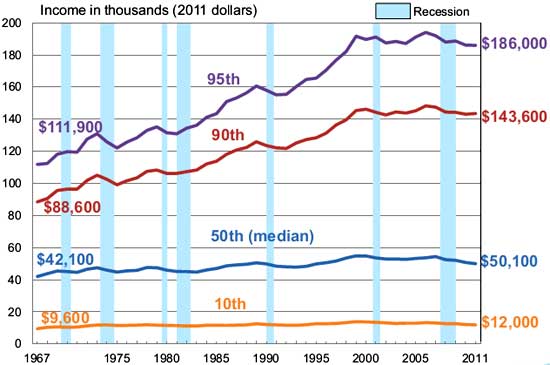
    Moving McJobs-ward: more jobs but smaller paychecks, plus stagnation in pay equity

    There's always plenty of talk about how many jobs have been saved or created but not nearly enough of what kind of jobs there are.  That's because quantity is relatively much easier to articulate than quantity and by articulate I mean "use for political purposes."  But today, NPR has this:

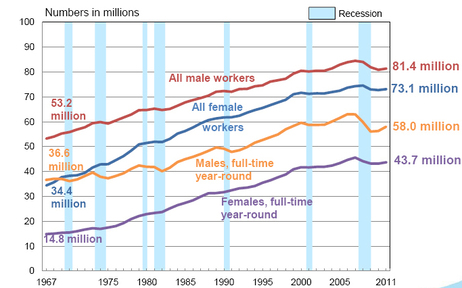
    and this:

    NPR says nothing about the gender pay gap, but isn't it amazing that since...oh, somewhere in the late 80s I guess (the graph inexplicably has no bottom axis but indicates it covers 1967-2011, but the tick marks don't seem to add up right), the two lines stop slowly coming together as they had been, and start moving up and down in sync, apparently perfectly preserving the inequality?

    Also for the top chart, I note that of all male workers, 71% are currently in full time jobs now, versus 68% in 1967, while for female workers about 60% are currently full time, versus 43% in 1967.

    NPR's  point is that "while high unemployment remains a big problem for the U.S. labor market, it's not the only problem. There's also a long-term stagnation in real earnings for people who have jobs."

    Moreover one full time job with middle class wages, sick pay, vacation pay, health care benefits, and a pension plan is not equal to one part time job at minimum wage with no benefits of any kind.  And the trend is indeed McJobs-ward.  Yet the raw number is the primary message of the monthly obsession over job creation/savings.