Murphy adds " that this much wealth is offshore is not just plausible – it only requires us to make modest assumptions about the proportions of various known types of portfolio that actually exist to think that such level of offshore holding is likely." He acknowledges in the comments that of course any attempted measure of that which is completely hidden can be nothing more than an estimate. Of course, governments and banks around the world certainly have the info, and confirmation could be obtained if disclosure was compelled. But the OECD has not taken the high road on this. Instead it has supported the veneer of transparency over the systemic support of an international architecture of obscurity.
Tuesday, July 31, 2012
About that $21-32 Trillion Hidden Offshore
Murphy adds " that this much wealth is offshore is not just plausible – it only requires us to make modest assumptions about the proportions of various known types of portfolio that actually exist to think that such level of offshore holding is likely." He acknowledges in the comments that of course any attempted measure of that which is completely hidden can be nothing more than an estimate. Of course, governments and banks around the world certainly have the info, and confirmation could be obtained if disclosure was compelled. But the OECD has not taken the high road on this. Instead it has supported the veneer of transparency over the systemic support of an international architecture of obscurity.


Africa's US/UK offshore problem
Complicity with global tax evasion by the US and UK continues to be a big problem for Africa:
When we say offshore centers, when we say secrecy jurisdictions, when we talk about banking secrecy, people may think that these are alien lands, in no-man lands, but actually you will be surprised to know, if you didn’t know—I’m sure you know, but for those who didn’t know, they will be surprised to hear that the biggest offshore centers are in countries like the U.K., in London, the U.S., in New York, Paris in France. These are the biggest offshore centers where you find banks colluding with corrupt leaders, corrupt private investors, in hiding and not disclosing their investments and their bank accounts, because some of it was acquired illegally, was transferred illegally, is held illegally in the sense that it’s not reported to the government.From RNN via NC.
Monday, July 30, 2012
Keeping it all to himself: Romney versus recent presidents
Check out Romney's income and tax rate versus the last five US presidents:
 From flowing data. Something really is wrong with this picture. No wonder then that Romney prefers to keep all of his tax info to himself. Look at Reagan, all the way over to the right by himself.

Olympics tax breaks
McDonald's and Coke won't take corporate tax breaks offered by the UK in connection with the Olympics, after an NGO campaign entitled "Stop the Olympic Tax Dodging." It's not strictly speaking "tax dodging" to take advantage of an exemption expressly granted by law, but this particular exemption has generated a lot of protest as a wholly unnecessary giveaway on the part of the UK. Indeed, it is an unnecessary and wasteful giveaway, as sponsorship in the Olympics (aka the World's Longest Commercial Break) is such a hot commodity.
Unbelizable: How to go offshore and disappear
Here is yet another story on how easy it is to set up offshore (especially if you are trying to do so in the USA), accompanied by an infographic:


This is from Planet Money and Adam Davidson has a related column. Notice that "It's all legal," so this is not about evasion. Really! It's about protecting your assets from a greedy spouse or undeserving creditors (or is it the other way around). Of course it's not about evasion. It's about the ability to say of your investments, "I don't manage them. I don't even know where they are."
From the story:
Right now, the team here at Planet Money are the proud owners of two companies. Unbelizable Inc., in Belize City, and Delawho?, right here in the United States. We have a packet of incorporation documents and a lot of questions about what exactly people do with these kind of companies. Our plan is to find out.Adam Davidson tries to pin the blame for offshore on overly complex regulations:
One often-overlooked lesson of the financial crisis is that shenanigans don’t happen in the absence of regulation; they happen when regulations are exceedingly complex and involve confusing, overlapping regulatory authorities.That is completely disingenuous. Cheating is not about not overly complex regulations. It is purely and simply about a desire and willingness to cheat plus an ability to get away with it. Once again, I have to quote Charlie Kingson: When a large corporation says it wants simplicity, it wants money." The Great American Jobs Act Caper, 58 Tax Law Rev. 327 (2005).
Tim W-thanks for the link.
Greek islands tax evasion rates: 60-100%
This story reports that in resorts on a number of the Greek islands including Crete, the rate of tax evasion is 100% or nearly so. I'm not sure it's properly called evasion if there is apparently zero enforcement. That's not a bug, that's the system?
Sunday, July 15, 2012
Americans don't holiday, update
Remember that Americans don't take vacations because they are collaborating in their own self-destruction; here is some new data from the OECD to confirm:

Link from Opinio Juris. That pitiful blank spot on the far right is the US. You can see the original chart and much more in a paper entitled "NoVacation Nation" by Rebecca Ray and John Schmitt [pdf]. Some highlights:
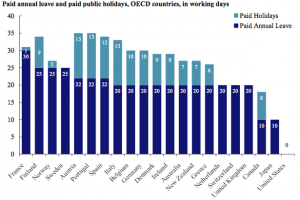
Link from Opinio Juris. That pitiful blank spot on the far right is the US. You can see the original chart and much more in a paper entitled "NoVacation Nation" by Rebecca Ray and John Schmitt [pdf]. Some highlights:
[W]orkers in the United States are less likely to receive paid annual leave and paid public holidays, and those U.S. workers that do receive paid time off generally receive far less than their counterparts in comparable economies.
... The United States is the only advanced economy in the world that does not guarantee its workers paid leave.
...In all countries many employers offer, usually as a result of collective agreements, public holiday entitlements over and above statutory minima. ... in the United States, almost one in four workers there has no paid leave and no paid public holidays at all.
...lower wage workers are less likely to have any paid leave (69%) than higher-wage workers (88%); part-timers (36%) far less likely to have paid leave than full-timers (90%); and workers in small establishments (70%) are less likely to have paid leave than those in medium and large establishments (86%).For low wage, part time, and small business workers in America, life is a relentless grind. NC had a post recently by Alternet's Lynn Parramore on "Pain and Bondage in the US Workplace," which uses the recent fascination with Fifty Shades of Grey to describe how Americans, so exercised about freedom, willingly submit to increasing repression when it comes to contracting out their labor:
Americans are supposed to be people who love freedom above everything else. But where is the citizen less free than in the typical workplace? Workers are denied bathroom breaks. They cannot leave to care for a sick child. Downtime and vacations are a joke. Some – just ask who picked your tomatoes – have been reduced to slave-like conditions. In the current climate of more than three years of unemployment over 8 percent, the longest stretch since the Great Depression, the worker has little choice but to submit. And pretend to like it.Parramore recalls the 60s, when unions and progressive national policies tempered repression in the workplace, but as we know most of that came to a screeching halt with the Reagan election. Three decades later plenty of Americans who have suffered the stagnant wages and stripped benefits that characterize life in the contemporary American workforce continue to support the policies and politicians that ensure and increase their submission, while reviling both unions and federal regulatory policy as assaults on freedom. That is perplexing.
Saturday, July 14, 2012
US continues campaign against EU airline tax
The US will host a meeting in order to "pil[e] further pressure on the EU to back down and the international community to find a global solution..." to greenhouse gas emissions. From Reuters. "Finding a global solution" is of course a euphemism for "doing nothing." That's because of course the EU tax is a step toward a global solution, and it would be effectively global if the US adopted it. Instead, the plan here is to gather officials from similarly opposing countries including India and China--a "coalition of the unwilling"--to agree to retaliatory measures against the EU. Behind every diplomatic effort is a lobbyist:
Airlines will not have to pay for the permits until next year, and are pressing their governments to agree on a global deal before then.
Russ Bailey, a senior attorney for the Air Line Pilots Association, a U.S. lobby group, said time is running out for EU ETS opponents to come up with a viable alternative.
"There is a sense of urgency because airlines have to start paying next April. We hope there will be a resolution that becomes clear enough before then," he told Reuters Point Carbon."I doubt that Bailey has in mind a resolution that every country will adopt the EU system, even though that would be crystal clear as far as resolutions go. The global deal sought here is reversion to the status quo, of that there can be little doubt.
Wednesday, July 11, 2012
Taming FATCA
For US persons living abroad, living their lives means having foreign bank accounts. Regimes like FATCA and FBAR are particularly harsh for these persons, many or perhaps most of whom are either dual citizens themselves or are in families with dual and multiple citizenships. While it seems clear to me that the US can impose its sovereign jurisdiction with regimes like FATCA and FBAR, it's less clear to me that it should do so, especially with a one-size-fits-all approach that appears to treat everyone with a foreign bank account as a potential tax criminal. The question is whether and how these regimes can be tamed so that they fulfill the core mission--catching tax cheats--without becoming a Team America: World Tax Police, bypassing bilateral and multilateral cooperation among governments in order to impose draconian US rules on individuals and financial institutions across the globe.
In my latest Tax Notes International column, "Could a Same-Country Exception Help Focus FATCA and FBAR?" [pdf], I discuss some of the political and practical issues of relaxing the reporting rules for Americans living abroad with respect to accounts they hold in their country of residence. This is not a comprehensive technical proposal but rather a broad look at the pragmatic and political reasons why the US really ought to back off on exercising its tax sovereignty when it comes to its citizens living abroad. I argue that FATCA and FBAR are either a rather nasty piece of arm-twisting, a bit of bad faith in
the U.S. diplomatic relations department, or, worse, they are signaling a loss of faith in the pursuit of cooperation through diplomacy. I suggest that carving out an exception for US persons who are using bank accounts to live their lives as residents and often dual citizens abroad could provide a means of backing away from either of these destructive positions.
In my latest Tax Notes International column, "Could a Same-Country Exception Help Focus FATCA and FBAR?" [pdf], I discuss some of the political and practical issues of relaxing the reporting rules for Americans living abroad with respect to accounts they hold in their country of residence. This is not a comprehensive technical proposal but rather a broad look at the pragmatic and political reasons why the US really ought to back off on exercising its tax sovereignty when it comes to its citizens living abroad. I argue that FATCA and FBAR are either a rather nasty piece of arm-twisting, a bit of bad faith in
the U.S. diplomatic relations department, or, worse, they are signaling a loss of faith in the pursuit of cooperation through diplomacy. I suggest that carving out an exception for US persons who are using bank accounts to live their lives as residents and often dual citizens abroad could provide a means of backing away from either of these destructive positions.
Thursday, June 28, 2012
Jersey to take ball, go home
If the UK won't play nice. It seems that the island of Jersey is growing weary of political attacks coming from the UK that label Jersey as an unrepentant tax haven. Tax analysts reports [pdf]:
"Jersey Chief Minister Philip Bailhache, in a June 26 interview with the U.K. newspaper The Guardian, said relations between Jersey and the U.K. have been "strained" over the past several years as their interests have diverged, and that Jersey should be ready to escape the "thrall of Whitehall" if necessary."
I am not sure how independence will stop the UK from using Jersey and its fellow channel islands as a shield to deflect attention away from the notorious city of London, prime tax haven territory. But in the meantime, the plan is to spend money on marketing to work on Jersey's image:
"Jersey plans to open an office in London with the specific goal of improving the island's tax image among the British public. (Jersey has already opened a similar office, together with Guernsey, in Brussels.) Noting Jersey's many tax information exchange agreements with EU member states and other countries, Bailhache stressed that Jersey does not market itself as a tax haven or a tax avoidance facilitator."
Jersey's $5.1 billion GDP is built on financial services. From the US CIA World Factbook,
Update: Tax Analysts sent me a link to an ungated pdf, link replaced above.
Jersey's economy is based on international financial services, agriculture, and tourism. In 2005 the finance sector accounted for about 50% of the island's output. ... Tourism accounts for one-quarter of GDP. ... Light taxes and death duties make the island a popular tax haven. Living standards come close to those of the UK.That Jersey is a tax haven can't seriously be doubted, I don't think. Of course the same is true for the UK. Jersey's chief minister says if UK taxpayers do use Jersey to shelter their income, that it is a governance failure on the part of the UK:
"despite the island's efforts to downplay its use for tax avoidance, ... the real issue is why the U.K.'s and other jurisdictions' tax laws are written in such a way that they allow legal avoidance, which is then condemned."That's true, but unfortunately for Jersey, it's convenient for them to serve as a focal point for anti-austerity and anti-tax dodger anger in the UK. It would be inconvenient to the UK to target the city of London similarly.
Update: Tax Analysts sent me a link to an ungated pdf, link replaced above.
Wednesday, June 27, 2012
Friday, June 22, 2012
Thursday, June 21, 2012
Wednesday, June 20, 2012
Why don't politicians support public institutions?
Catherine Rampell talks about the vicious cycle that occurs when budget cuts lead to understaffing and inefficiency, which leads to declined trust government institutions, which leads to further cuts. Writing in response to Tyler Cowan's post on the loss of trust in government, she argues that trying to cut government jobs or government spending will erode public trust further, using the Post Office as a case in point:
From Cowan's post:
Cowan says all would be well if we could just wait for prices to rise again:
Because it is still waiting for Congressional approval to make many of these changes, the Postal Service is cutting costs by reducing staff levels and hours at existing facilities. Reducing costs in the way that’s most politically expedient rather than most efficient and economically sensible means that service will most likely get worse, customers will lose confidence in the agency, market share will fall further and the agency will be forced to make more drastic and possibly inefficient cuts.Rampell could have looked to the IRS for a similar and I think very troublesome example of this problem. It seems so perverse to me that politicians can decry and claim to crack down on tax evasion, while using the next breath to argue that IRS funding should be cut in the name of efficiency in governance. Tax compliance is a big project and it requires expertise and resources. Cut those and I think you should expect compliance to fall accordingly. Less compliance leads to less revenues being collected leads to even more pressure on the budget. That's a very vicious cycle and moreover it is the fundamental source of all the budget pressure for all the other institutions of government. But why do politicians let this happen? Isn't it in their interest to have strong institutions creating virtuous cycles?
From Cowan's post:
State and local governments are controlled by politicians and, indirectly, by voters. And for better or worse, those voters have lost faith in the social returns of these jobs and our ability to afford them. The voters have responded by looking to cut expenses, and they’ve chosen state and local government employment as a target.From this we may well extrapolate to the conclusion that politicians undermine government because even though stronger government would be better for politicians as a whole, each individual politician's re-election hinges on satisfying a public that has lost trust in government.
Cowan says all would be well if we could just wait for prices to rise again:
The slow cure for this problem is to allow asset prices, along with perceived wealth and trust, to return to or exceed the previous levels over time. Americans would then spend and invest more money, bolstering both aggregate demand and supply, and in both the private and public sectors. But the process would be cumbersome, partly because trust is more easily destroyed than restored.This sounds sort of ridiculous to me as a strategy. Probably because I am not an economist but I do read children's books and I have heard this story before.
Cowan goes on to talk about the various fixes available to governments, but concludes that basic trust in government needs to be restored before any big policies can be implemented. I think it's certainly true that lack of trust in government is spurring NGO interest in transparency in tax matters, c.f. the EITI and CBCR movements, UK Uncut's suit against HMRC, Oxfam's suit against the SEC, etc. I don't see rising prices doing much for the core concerns there.
Tuesday, June 19, 2012
OECD praises itself via G20 re: progress on tax evasion
The OECD says the G20 reports that "steady progress is being made towards tackling tax evasion more effectively."
I have called the G20 a syndicator of OECD tax views, since the G20 lacks an independent infrastructure in which to form its own positions on tax policy, so when the OECD points to the G20 pointing to success on an OECD initiative, I interpret that as the OECD praising itself.
In this case the praise is out of step with the general sense I have about where things are with tax evasion today. I don't think there is much evidence at all that the OECD is making progress. The evidence seems to suggest rather that the best that can be said is that some counties that were viewed as extremely tax-evasion friendly a few years ago may be less so today. But on the other hand other countries seem to be picking up the slack. That doesn't seem like progress, that seems like something about deck chairs and a big luxury liner. Certainly there are no fewer dollars in tax havens, a point that seems to work squarely against any notion of progress against tax evasion.
The OECD says "The Global Forum reports that more than 800 cross-border exchange of information agreements have now been signed," and 35 countries have signed the Multilateral Convention on Mutual Administrative Assistance in Tax Matters. What can one possibly make of the attempt to use signed agreements as evidence of progress? It is a very formalistic way of thinking about things. "The law exists" is not going to convince anyone that people are in fact following the law, whatever the law may be. Signing an agreement is not exchanging information. And I am not even sure that exchanging information is evidence of making progress on tax evasion. The right information has to be exchanged. It has to be exchanged in a usable way. And the information recipient has to have the will and the means to use the information for that purpose. The commentary I read from non-OECD sources suggests that information is not being exchanged regularly and sufficiently to suggest progress is being made. Nor do other tools in the anti-evasion toolkit seem to come to the rescue: the OECD itself seems a bit stymied on arm's length transfer pricing, another of its prized weapons against tax evasion.
It is the case that only the competent authorities would know for sure what information they are exchanging under tax treaties and whether they are able to use this information to combat tax evasion. The competent authorities do not publish any kind of information on this particular data point. Maybe steady progress is being made. It would be good to have evidence that it was. But no amount of prying seems to be opening the door to public access. We could know so much more about whether progress was being made if we could get some transparency on what the competent authorities do. But there is a lot of resistance to this form of transparency.
I have called the G20 a syndicator of OECD tax views, since the G20 lacks an independent infrastructure in which to form its own positions on tax policy, so when the OECD points to the G20 pointing to success on an OECD initiative, I interpret that as the OECD praising itself.
In this case the praise is out of step with the general sense I have about where things are with tax evasion today. I don't think there is much evidence at all that the OECD is making progress. The evidence seems to suggest rather that the best that can be said is that some counties that were viewed as extremely tax-evasion friendly a few years ago may be less so today. But on the other hand other countries seem to be picking up the slack. That doesn't seem like progress, that seems like something about deck chairs and a big luxury liner. Certainly there are no fewer dollars in tax havens, a point that seems to work squarely against any notion of progress against tax evasion.
The OECD says "The Global Forum reports that more than 800 cross-border exchange of information agreements have now been signed," and 35 countries have signed the Multilateral Convention on Mutual Administrative Assistance in Tax Matters. What can one possibly make of the attempt to use signed agreements as evidence of progress? It is a very formalistic way of thinking about things. "The law exists" is not going to convince anyone that people are in fact following the law, whatever the law may be. Signing an agreement is not exchanging information. And I am not even sure that exchanging information is evidence of making progress on tax evasion. The right information has to be exchanged. It has to be exchanged in a usable way. And the information recipient has to have the will and the means to use the information for that purpose. The commentary I read from non-OECD sources suggests that information is not being exchanged regularly and sufficiently to suggest progress is being made. Nor do other tools in the anti-evasion toolkit seem to come to the rescue: the OECD itself seems a bit stymied on arm's length transfer pricing, another of its prized weapons against tax evasion.
It is the case that only the competent authorities would know for sure what information they are exchanging under tax treaties and whether they are able to use this information to combat tax evasion. The competent authorities do not publish any kind of information on this particular data point. Maybe steady progress is being made. It would be good to have evidence that it was. But no amount of prying seems to be opening the door to public access. We could know so much more about whether progress was being made if we could get some transparency on what the competent authorities do. But there is a lot of resistance to this form of transparency.
Class Mobility in the U.S.
Bruce Bartlett sees some movement in the top and bottom quintiles and notes:
It is indisputable that the distribution of income in the United States has become more unequal. However, many economists say they believe that turnover among both the poor and the rich substantially mitigates its impact. If everyone remained in the same income bracket year after year, the negative effects of inequality would be far worse.
Monday, June 18, 2012
Update: UK Uncut v HMRC
TJN has a video from the UK Uncut movement on their lawsuit against HMRC regarding the Goldman Sachs tax giveaway, which is making progress as the Guardian reports:
In a ruling on Wednesday Justice Peregrine Simon said the matter was "plainly in the public interest" and that any judicial review of the deal which saw Goldman Sachs let off a £10m interest bill, would be separate to an anticipated National Audit Office investigation on maladministration and bad practice.
Higher Taxes Correlate with Prosperity
So higher rates and better tax collection led to more revenues to be collected. The Laffer thesis more or less says that low rates lead to more tax revenues since low rates produce more growth and more growth increases the base to be taxed, while higher taxes drive people out of the market and end up lowering revenues. Leaving aside the evidence (or lack thereof) for the accuracy of this thesis in practice, I take it that MR wants us to understand that revenues did not rise as a result of increased growth producing a bigger base and therefore more revenues at the same low rate as before, but rather England raised its tax rates and collected more taxes as a result. Laffer doesn't seem to have played any role so I'm not sure what the point is of bringing him into this at all. All in all I am finding MR more than usually confusing the point with this note, but I appreciate that they alerted me to the book. Better just to read that, I think.


Must Read: Factual Free Market Fairness
This is required reading for anyone interested in markets, governance, and human flourishing. Dierdre McCloskey never disappoints. I won't even bother to excerpt because you just have to read the whole thing.
Subscribe to:
Posts (Atom)