Friday, May 4, 2012

American Citizens Abroad: Don't Tax Us as Residents

The US should tax on the basis of actual residence, and not citizenship, says Jack Bugnion of ACA.  This is a reprint of remarks he gave in a press release in February, covered here.  The major arguments are the standard three: efficiency, administrability, and fairness (discussed in that order).

The competitiveness argument is the standard "if you change the tax system companies will hire more people."  There is no empirical evidence in support; experience suggests this is unlikely.  I similarly have no way to judge whether FBAR really is FUBAR from an administrative point of view, but it's of course true that Congress perpetually underfunds IRS so we can expect uneven enforcement--that's as much a fairness argument as an administrative one, and probably could be made more compelling.

The fairness argument is that "Americans abroad would not only be freed from the unjust burden of double tax reporting and double taxation but would also enjoy expanded job opportunities overseas and the possibility to invest in local investment vehicles ... now out of reach due to the burdensome U.S. filing for PFICs (passive foreign investment corporations). They would also be relieved of foreign currency risks when purchasing a home."  I don't know that a double reporting burden is unjust.  It's certainly a pain and it's really unfortunate that it is also likely a jobs act for accountants.  But unjust seems like a strong word to use in the grand scheme of things.  Double taxation is relieved by credit and in some cases exemption on the US side though there are undoubtedly limitations and it's complex, no doubt about it, see previous point.  The PFIC and currency risks are more compelling, because now we are talking about investment traps for the uninformed.

The problem is that even if I agreed with every point, there is a fix, and it is revocation of U.S. citizenship or permanent residence.  The price of that citizenship and permanent residence status just went up, maybe remarkably so.  As a result it is hard to argue that the U.S. cannot do what it is doing from a normative perspective.

Brazil Banks to US: Fix FATCA

The Brazilian Federation of Banks has some ideas on FATCA:
We are supportive of regulations that increase tax transparency and reduce tax evasion, as well as prevent money laundry. However, we also understand that these regulations should be enacted by national authorities of each country or through international treaties so that they have reciprocity and are fully compatible with the constitutional and legal order of each country concerned.  
Due to certain legal constraints and high operational costs, F.A.T.C.A., as currently established, may not be fully implementable in each country even if its financial institutions desire to do so, nor achieve the intended results in the most efficient manner. In order to try to minimize these legal constraints and risks, and optimize costs, while still pursuing the major objective of F.A.T.C.A., we have worked on a set of proposals and requested clarifications that we submit to your consideration.
...F.A.T.C.A. clashes with certain aspects of the Brazilian Federal Constitution, especially concerning the fundamental rights of non-prejudice and equality of a US person as compared to any other person, the right to privacy and secrecy of financial data, and the prohibition to use unlawful pressure to do otherwise. F.A.T.C.A. also goes against the Brazilian tax system, since income tax can only be collected according to Brazilian law and to the benefit of the Brazilian Federal Union. Financial market regulations do not allow financial institutions that operate in Brazil to charge the US withholding costs to their customers contractually. The acts of Brazilian financial institutions to pursue F.A.T.C.A. enforcement may thus be considered as illegal and unconstitutional, putting those institutions in a position of having to face unfair US tax costs, civil and regulatory legal suits in Brazil.

Much more in the letter. This sounds similar to the Canadian perspective, perhaps an ad hoc multilateral coalition to oppose FATCA is forming.
 

Thursday, May 3, 2012

Tax transparency, democracy and "expertise"

Transparency is being fully contested in international tax circles:
The hosts were expecting a heated but constructive debate, and for most of the nine-hour conference delegates heard in turn the impassioned arguments of campaigners for country by country reporting and the deliberations of tax professionals whose main argument centred on the complexity of international tax.
The complexity issue is that if regular, uninformed people are given all the data, they will misinterpret it and hang effigies of the innocent.  This is an unconvincing argument that the OECD tried to imply with its consideration of the matter in 2011: “the issue of whether greater transparency could aid public debate on appropriate tax policy” would be “very difficult to assess” because the political discourse would involve “differing arguments, [that] can be used more or less responsibly.”  This is an argument that tax compliance is so subjective, no one could ever make sense of it definitively, so it's best not to argue it in public.  Only experts should do so, and then only in quiet rooms.

I was happy to see Sol Picciotto mentioned in the article, he's a terrific thinker and scholar on international tax:

During a discussion on tax dispute resolution Sol Picciotto, Emeritus Professor of Law at Lancaster University, interrupted James Bullock’s defence of modest meals shared at meetings with HMRC to say that the level of transparency being proposed was ‘quite clear – that taxpayers should declare what tax they pay in each country’.
Picciotto added: ‘As regards disputes, the terms of a settlement should be public. We’re not talking about sandwiches, we’re talking about the transparency of what tax people pay where. If a dispute goes to the tribunal, it’s public. If there’s a settlement, it should be public.’
Later, Judith Freedman, University of Oxford tax prof, said that publishing details of settlements ‘would not be that helpful’ to people: ‘What are they going to make of them? I want to have a properly instituted organisation which has independent experts who can scrutinise those settlements. That’s far better than leaving it to whoever happens to be able to pick up on this, the press …’
‘That’s democracy,’ a delegate shouted from the audience. Freedman continued: ‘I believe it’s the job of properly constituted organisations, rather than the press, to examine this because that would give us integrity and confidence in the system. These are very, very difficult things to understand.’
That statement is distressing on grounds of the expertise question alone.  Who decides what constitutes "a properly constituted organisation"?  Professor Freedman?  The Oxford Center for Business Taxation?

The article closes with a mention of a twitter feed associated with the conference, in which it was tweeted ‘It has to be admitted that few tax experts have oratory skills or passion comparable to [those of] tax campaigners and politicians.’


Perhaps, but it's a matter of backing and platforms, isn't it.

The Impossibility of Accurate Basis Reporting

The new cost basis reporting rules came into effect for stock brokers in 2011 and will come into effect for mutual funds and ETFs in 2012.  Bloomberg ran an article a few weeks ago outlining outlined a series of the major issues; yesterday Steven Rosenthal wrote on the many compliance headaches to expect, and concluded that although he thinks that on balance basis reporting is appropriate and necessary, "the transition will be painful."

I sent the article to David Nangle, a student of mine who has been interested and vocal on the importance of keeping track of basis given the taxpayer's propensity to prevaricate with impunity in the absence of a third party backstop.   He has extensive experience with corporate information management and worked with a software platform that automatically sent trade information and pricing data (including basis and valuation information) to prime brokers and fund administrations for hedge funds including funds of funds.   His response is that enforcement is not just difficult and painful, in fact it is impossible [edited & posted with his permission]:

"Whenever migrating existing a new fund onto our software, I always needed to know how they wanted their basis calculated similar to what the article discusses in #1.  FIFO was among the most popular used by funds, yet not uniform. HIFO - highest in, first out - was equally widespread, and in the case of arbitrage funds (who do thousands of trades a day) they frequently used our 'Min Tax' option or another exotic and rarely used scheme. Obviously heavy trade volume in a particular security clouds the cost basis of your overall position, so it was essential to be able to track different trade tax lots to see which ones were closing off against each other and keep all the different parties involves on the same page. It would be a massive headache for a couple weeks if one institution's internal accounting of the fund's changing portfolio positions was off and we needed to figure out why, though generally speaking after a couple weeks these issues would fade. 
Having seen firsthand the complex nature of this cost basis problem, I have absolutely no faith that regulators could ever successfully track the different tax lots of each trade and ensure that funds are doing it 'right'. There is just no way that the IRS will be able to track every funds' trade activity, along with pricing information, and conclude that particular funds are dodging tax liabilities. Its possible that they could find mistakes if they happened to know which fund or position to investigate, but this would be enormously difficult to look into without a tip that something is amiss in the first place. 
The problem becomes much more complex when the overall structure of hedge funds, mutual funds and fund of funds is considered.  When a fund uses a master feeder structure, or a 'block' fund, it buys a huge chunk of a particular security and then allocates the chunk of securities across multiple funds or investment pools.  This clouds the reporting discussed in the article even more, because technically the brokerage houses are not using the individual fund account numbers to make the purchases, merely the 'block' account.  The fund itself is allocating the shares to different strategies or sub accounts. Eventually, fund admins and brokerages learn the allocations after reconciliation, but that is not captured in the initial trade itself. Allocations can go to sub accounts that might have an existing position in that security, thus distorting the cost basis by either closing out or adding to the position, while other allocations are the first of that security's kind to be allocated to that sub account. 
Therefore it is the fund's internal decision making which will ultimately be reporting this information anyway, and even if the IRS forces a brokerage unit to report on a client funds' trade activity the block account will shield the allocations until the fund has decided the best way to report out their sub portfolios' positions.
I have to agree that the task sounds impossible.  Yet overstating basis is a major problem for the IRS, one made even more challenging by last week's Home Concrete decision [pdf], which tightens the IRS' time to review and investigate even in egregious cases.  Rock: hard place.

Arbitration and Jurisprudence in the Investment Treaty Regime

I'm not a true believer in tax treaty arbitration because I have read some of the literature on investment treaty arbitration that grapples with the many of jurisprudential issues we seem to be all but ignoring in tax.  Susan Franck's latest paper, Managing Expectations: Beyond Formal Adjudication, is a case in point.  It uses the "guidance and clarity on standards" gleaned from arbitration decisions to talk about the jurisprudence of the investment treaty regime, an approach that would be impossible in the international tax regime arbitration structure.  Here is the abstract:
The international investment system has depended heavily on international arbitration to provide guidance and clarification on the standards contained in international investment agreements. In order to assess the system realistically, this commentary discusses unpacking stakeholder expectations by recognizing where expectations may have been overly optimistic and thinking systematically about the mechanisms through which to capture and manage regulatory discretion. This article evaluates ideas expressed by Anne van Aaken and Bart Legum, which consider different ways to achieve regulatory and commercial balance, and offers a lens for thinking systematically about managing stakeholder expectations in the international investment system. A critical issue for international investment law relates to cognitive psychology and how to manage the expectations of differently situated stakeholders. This commentary explores different methods to managing stakeholder expectations and investment treaty conflict such as education and different doctrinal opportunities such as administrative law's model of formal and informal rule-making and adjudication. This commentary concludes that an evidence-based nuanced analysis allows consideration of specific dynamics about stakeholder objectives, enabling a more realistic assessment of the international investment regime.


On Expertise and Influence: Interview with Ann Pettifor

What constitutes expertise as a social, political and cultural matter?  It involves charts, data, lines on a CV, connections, financial support, and a means of repeatedly broadcasting the same message.  In 2003, Ann Pettifor predicted the global debt meltdown but no one was listening; in this interview with the Renegade Economist [posted at NC], she discusses the crowding out of ideas that is perpetuated because of the structure of interest group-funded economics research.  This sounds so much like the Vijay Prashad interview in regards to the silencing of alternative views from UNCTAD which, like Pettifor, is credited with accurate predictions about the economic crisis.  A similar tale can be told about tax treaty policy making and the turf struggle between the OECD and the UN.  In international tax in general we see the cult of expertise in the claiming of "internationally agreed standards" on tax policy, with I think similar effects--the alternative view is too often silenced, sometimes intentionally but often just by lacking the necessary backing and platforms.


Starting at around the 7 minute mark, Pettifor has a lot to say about institutional expertise and about why we will continue to get more of the same policy prescriptions from influential economists: they are mostly "hired guns" who don't have tenure, while those with tenure, who can "afford to say that which is not mainstream," are few and far between.  She says most economists therefore "are employed in think tanks and research departments that are underwritten by the finance sector.  RE agrees: "if you watch Charles Ferguson's film Inside Job and you see the cowardice of the neoclassical economists at the end who jut blankly refuse to answer the questions and then when they do are full of spite, you get a kind of insight into the murky world you're dealing in."  

Pettifor then talks about conferences where neoclassical and heterodox economists are engaging in dialogue, and she says this is unusual because the neoclassicals "aren't used to dialogue with anyone who doesn't share their world view, and that is so damaging."

Jumping to 10:20, she lays out the intellectual/institutional conflict:
"I am right now reading a speech by a man called Ben Broadbent, who is on the board of the bank of England and who was at Goldman Sachs and who's written a paper saying that the cause of the crisis had absolutely nothing to do with easy money, i.e., unregulated money; it had everything to do with the fact that interest rates were incredibly low.   
Now when I read that paper, it is so deceptive really, and yet it's packed with charts and data, and some sources, even, of information, he does neglect to give us the source of some of his data, that paper, I am convinced, has been written in Goldman Sachs's research department and he's delivered the speech on behalf of Goldman Sachs and he's on the bank of the Board of England.   
Now, that's not a conspiracy.  It's huge political and economic power.  And those of us who have an alternative view don't have that sort of backing, and don't have those sorts of platforms, and that's very damaging for public discourse."
Much more on the substantive economic issues and debate as the interview continues.

Wednesday, May 2, 2012

Murphy on country-by-country reporting

If you're following the corporate tax transparency movement, you'll have heard of Richard Murphy, who takes the credit for creating the concept of country-by-country reporting.  He has a post today on his blog in which he recreates a recent speech explaining the origins and developments of the movement:
When, almost ten years ago I wrote the first ever version of country-by-country reporting in response to one of the first ever questions John Christensen asked of me I thought the entire audience for the idea would amount to just two people – John and Prof Prem Sikka, who had just introduced us. How wrong I was! It seems a good idea has a life all of its own.
...Country-by-country reporting is, and was always intended to be, a full blown and completely new view of the trading of a multinational corporation, ideally required by an International Financial Reporting Standard, but failing that by international regulation. 
What that accounting standard would demand is a full consolidated profit and loss account for each and every jurisdiction in which a multinational company trades.
And when I say full I mean 'full', including sales, costs, an analysis of labour costs and head count and full tax notes – including  a deferred tax analysis.
And in some ways I mean more than full when it comes to this profit and loss account – because country-by-country reporting would also require disclosure of all intra-group sales and purchases, all intra-group hedging and derivative trading and the disclosure of all intra-group financing activity too.
Let's be clear about why country-by-country reporting does this. It's based on a series of solid assumptions. The first is that multinational corporations might act globally but they do not float above the global economy. Their actions are all ultimately geographically located. Country-by-country reporting recognises that. It makes globalisation accountable locally.
Second country-by-country reporting recognises that it is impossible to say that existing accounts for multinational corporations can possibly give a true and fair view of business when up to 60% of world trade – the part that takes place on intra-group basis – is totally lost to view in existing financial statements. It is ludicrous that we don't account for that trade in a globalised world.
More at the link.


Monetary policy, inflation, and tax: a love story

"In a small, peaceful town there once lived three people: Abbie, Baker and Carlie.
Abbie was a very wealthy aristocrat, and also a philanthropist. Her fortune and position in the town were the fruit of the hard work of her ancestors, but her life was dedicated now only to managing that fortune. She lived to make the common people of the town happy, especially Carlie, who was her personal favorite.
Baker was much more selfish, and looked out for his own interests. He wasn't terrible and mean, just obstinately self-interested. It seems he was born that way; it was in his DNA.
Abbie frequently lent money to Baker, and Baker frequently lent money to Carlie. But in accordance with the ancient and venerable laws of the town, enacted to maintain a decorous distance between the aristocrats and common people, Abbie was forbidden from loaning money directly to Carlie. Nevertheless, Abbie was usually able to help out Carlie indirectly when necessary. She found that when she lent money to Baker, Baker was sometimes more willing than before to lend money to Carlie. And if Abbie loaned the money to Baker at lower rates of interest than previously, Baker would usually reduce the rate of interest he charged Carlie in turn."
By Dan Kervik and posted at naked capitalism, go and read the whole thing.  It's long but it builds in complexity gradually and is thoroughly absorbing.


Tax Me, I'm Rich vs Worship Me, I'm Rich

King vs. Conard.  Which message is more compelling?  Which is more crass?


Tuesday, May 1, 2012

UBS: tax info exchange ‘economic war’

That's pretty provocative.  If it is war, this is the side Rand Paul is on.  Last week, the AP reported:

Sergio Ermotti, who was appointed CEO of Switzerland’s largest bank in November in the wake of a trading scandal, says Switzerland now is “stuck in the middle of economic warfare’’ and its opponents’ goal is to weaken UBS and the next biggest bank, Credit Suisse, according to Zurich Sunday newspaper SonntagsZeitung.
U.S. authorities in particular have dealt Switzerland and its banks several serious blows over the past few years, resulting in several significant concessions to Swiss banking secrecy. Investigations against at least 11 banks, including Credit Suisse, are still pending, on suspicion they too helped Americans hide money abroad, following the successful case against UBS AG, which had to pay a $780 million fine and hand over 4,450 clients’ files to Washington in 2010.
...But Switzerland has insisted throughout its negotiations with other governments that it won’t accept any automatic transfer of information on foreign account holders — ensuring that a semblance of its banking secrecy remains in place.
“For us this is an economic war,’’ Ermotti was quoted as saying. “Since 2008, Switzerland has been attacked.’’
The most recent shot in this "war" is Switzerland's apparent refusal to hand over bank information on one (unnamed) client to the IRS:
The [Swiss] Federal Administrative Court ruled that a 1996 treaty between Switzerland and the United States doesn’t allow the U.S. Internal Revenue Service to request the account details of potential tax cheats without clear evidence of fraudulent intent.
So we see from this that the info sharing between the US & Switzerland is weak and when people start using the rhetoric of war to describe the sharing of tax information, I'd say we're into some difficult territory.

The new treaty between the US and Switzerland might ostensible change thing incrementally but automatic exchange is probably the only long-term fix, hence the resistance.

Bloomberg followed up on the story yesterday with an equally provocative editorial from Swiss business and comparative law professor Peter Viktor Kunz, who says that Swiss banking will and should rise again:

"Swiss banking remains a world-class brand, for reasons of legal, political and currency stability, as well as the high level of training and language fluency among staff at the country’s more than 300 banks. These strengths remain, regardless of secrecy laws. ... 
...In a world where citizens’ privacy is being diminished daily, the idea of banking with the assurance that your details are private may seem almost quaint, but these laws have deep roots in Switzerland’s history as a haven. Many people came to the country seeking refuge for themselves and their money, particularly before and during World War II.
As a result, the Swiss don’t see banking secrecy as something to be ashamed of. They see it as just one form of protection, together with the right to nondisclosure of one’s religious beliefs, sexual orientation or health status. These are rights that anybody coming to the country should enjoy, regardless of what their home government demands. It’s our strong belief that what you do with your legally gained money should be nobody’s business but your own. 
Like every other right, banking secrecy can be abused. Many tax evaders from abroad have tried to hide behind numbered Swiss bank accounts. However, criminal activities such as money laundering by terrorists and organized crime, or tax fraud, don’t find refuge in Switzerland.
...Many see hypocrisy on the part of countries, especially the U.S. and the U.K., that aggressively pick on Switzerland, while ignoring their own tax havens, such as trust funds in the U.K. and its Channel Islands, or the U.S. shell-company factory epitomized by Delaware, which offers foreign-owned companies anonymity and a virtually tax-free home for profits booked abroad. 
Switzerland shouldn’t be treated as a pariah, or rogue state. Banking secrecy is not Switzerland’s foundation. Whatever the future holds -- whether a tax retention concept like the ones in recent treaties signed with Germany, the U.K. and Austria, or an automatic information exchange such as demanded by the European Union -- Switzerland will remain an international banking center. ...
Difficult to argue with the hypocrisy point, but if it is hypocrisy it means both are behaving badly, not that neither are.


Monday, April 30, 2012

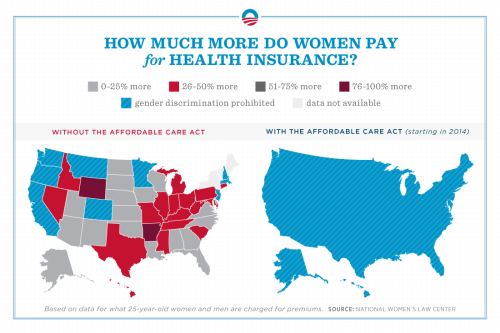
Gender Surcharge: Health Insurance edition

From Barack Obama on tumblr, no less. 


Ireland in on FATCA? No.

This story is making the rounds, but I found it at "lowtax.net": Ireland is in talks with the US over that multilateral FATCA deal, but not really.
"It is thought that Ireland wants any agreed approach to FATCA to be based on domestic tax reporting legislation and an automatic exchange of information under existing bilateral tax treaties. 
As the IFIA has pointed out, Ireland is negotiating the possible adoption of a model global agreement, which would not alter or amend the obligation to identify or report certain information under FATCA, but would outline an alternative pathway for reporting FATCA information. 
..."The fact inter-governmental arrangements are likely to be based on a model agreement means that any framework under which bilateral exchange of information agreements operate should be done on a consistent basis, rather than under individual agreements which might be operated on a disjointed basis.”
I am beginning to believe Steve Dean when he tells me that getting in on the FATCA deal is not at all about about exchanging more information.

Let's just be clear.  FATCA is weird and annoying (and even offensive to some) because it is government-to-taxpayer regulation, in which the US is exerting the jurisdiction to regulate the practices of foreign banks.  Tax treaty info exchange is government-to-government agreement in which the governments agree to collect information on their own, and then share some of it with each other under pre-arranged deals.  Automatic info exchange is a deal in which they turn over info regularly; info by request only if you ask nicely and with sufficient detail.  Rand Paul apparently thinks that is also offensive, enough to deny the executive branch the Senate's advice and consent, but I think and hope he's an outlier.

When you see the story start out talking about FATCA and end up talking about tax treaties, you are witnessing the struggle over who gets to regulate who in our global economy.

Rand Paul blocks US-Swiss Tax treaty update

Why?  Paul is worried about due process and unreasonable search & seizure that could happen if the US starts asking Switzerland for bank info on U.S. citizens and residents.  From Bloomberg:

"Paul, a Kentucky Republican, said the protocol is too “sweeping” and would threaten protections under the Fourth Amendment to the U.S. Constitution, which guards against unreasonable search and seizure. Paul said he is exercising his privilege to delay a Senate vote. 
“We’re concerned about the due process of whether or not people have any kind of process before their records are looked at, the privacy of your banking records,” Paul said in an interview last week. “There needs to be some constitutional protections to your banking records.”
That's a lot of worry, but Mr. Rand should be assured that unlike in some other countries, information requested from another government by the IRS would be inadmissible as evidence against a U.S. citizen if it was seized by the foreign government in contravention of U.S. law.  He could start by reading U.S. v. Wolf, 601 F. Supp 435 (ND Ill. 1984) and U.S. v. Phillips 479 F. Supp. 423 (1979).

Rand isn't sure if “they’re willing to rewrite the treaty for me."  Indeed.  Phil West responds to this silliness with:
 “It’s wrongheaded, it’s inappropriate,” said West, a partner at Steptoe & Johnson LLP in Washington. “Whether this is the senator’s motive or not, it smacks of protecting financial secrecy for those who may have committed criminal tax fraud in the U.S.”
That's absolutely true and Rand's move is outrageous.


UNCTAD update

UNCTAD gets fresh mandate, "after a huge battle between developing and developed countries": the G77 hung together and resisted attempts to silence it or narrow its mandate.  the Guardian's Poverty Matters Blog has this: Unctad is astute and progressive – so why don't developed countries like it?  For several of the reasons Vijay Prashad explained, such as:
"Some explanations for the apparently surprising attitude of developed countries can be found from the informal statements made by certain negotiators. One such representative of an important developed country told his counterpart from a major emerging market economy that they "did not want Unctad to engage in intellectual competition with the IMF"!"
The author follows that with "Intriguing, isn't it? Such people are usually all for competition in everything (certainly in labour markets) – except, apparently, ideas."


Happy tax day, Canadians

Yes, it's finally here.
"The Canada Revenue Agency (CRA) encourages you to file your income tax and benefit return and pay on time and online using the CRA's quick, easy, and secure electronic services. You have until midnight on April 30, 2012, to file your 2011 income tax and benefit return and to pay any balance owing."


Sunday, April 29, 2012

Council of Europe: Stop Tax Havens with Corp Tax Transparency

From Europe, we see movement on corporate tax transparency in the form of a council resolution:

Strasbourg, 27.04.2012 – The Parliamentary Assembly of the Council of Europe (PACE) has demanded a series of steps to end what it calls “massive tax avoidance, evasion and fraud” caused by secrecy jurisdictions, tax havens and offshore financial centres. 
Adopting a resolution ... the parliamentarians said tackling global distortions due to harmful or predatory tax practices – including bank secrecy, lack of transparency and effective public oversight, regulatory dumping, predatory tax arrangements and abusive accounting techniques within multinational companies – was “a moral duty” because they drain public finances and cause serious harm to the public interest. 
The resolution calls for the following corporate tax disclosure items:
  • country-by-country reporting by multinationals wherever they operate, across all business sectors
  • a ban on anonymous accounts, off-balance-sheet bookkeeping and bearer shares
  • disclosure of the ultimate beneficial ownership of all business entities, notably trusts and funds
  • moving towards the automatic exchange of all tax information
With this kind of disclosure, that NYT story on Apple would not be so maddeningly imprecise.


h/t Richard Murphy, for whom this is "another campaign win"--quite so.  


Apple

It's not news that big multinationals face low, low effective tax rates, but I was very glad to see that this NYT report acknowledges that we are working in the dark really, in confirming just exactly how low those rates are.    This is because countries simply do not collect the data, and if they do, they don't require enough disclosure for any kind of accurate analysis.  From the article:
"Neither the government nor corporations make tax returns public, and a company’s taxable income often differs from the profits disclosed in annual reports. Companies report their cash outlays for income taxes in their annual Form 10-K, but it is impossible from those numbers to determine precisely how much, in total, corporations pay to governments. In Apple’s last annual disclosure, the company listed its worldwide taxes — which includes cash taxes paid as well as deferred taxes and other charges — at $8.3 billion, an effective tax rate of almost a quarter of profits. 
However, tax analysts and scholars said that figure most likely overstated how much the company would hand to governments because it included sums that might never be paid. “The information on 10-Ks is fiction for most companies,” said Kimberly Clausing, an economist at Reed College who specializes in multinational taxation. “But for tech companies it goes from fiction to farcical.”

Yes, it's pretty much speculation.  But it makes for good theater: NYT has put together an accusing graphic to provoke a sense of outrage:


Feel outraged?

More to come on the subject.

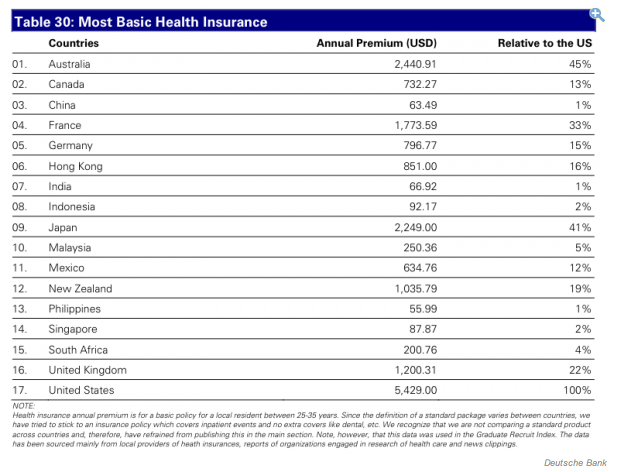
The High, High Cost of U.S. Health Insurance

"This chart says it all," says Yves.


Of course, I like my charts with more visual data, so i redid it and ordered by size instead of alphabetically:


Now I think it really does say it all.


Saturday, April 28, 2012

Measuring the Size of Government

Looking at the federal budget only tells part of the story; the rest is hidden in "spending through the tax code," aka, tax expenditures.   This paper by Donald Marron & Eric Toder [pdf] lays it out:
"The federal government is larger than conventional budget measures suggest. Many tax preferences are effectively spending programs. Adding these preferences to federal outlays and receipts makes the government appear about 4 percent of GDP larger. The 1986 tax reform cut these benefits, but they have since rebounded to a larger share of GDP than before. Using this broader measure of government size, many base-broadening reforms viewed as tax increases would be reclassified as spending cuts. Raising marginal tax rates would be recorded as a tax increase and a spending increase because it would boost the value of many tax preferences."
Ezra Klein has a couple of posts on it, here and here.  I explain tax expenditures to my students only after doing a lengthy bit of work on the nature of income.   I'm not at all sure how a non-tax audience understands tax expenditures.  

Prison Labor & Capitalism & Attractive Complexity

This post started out as a simple link to a lengthy and interesting report on the market for inmate labor--it's cheap, compliant, and has few protections.  It's also state aid/corporate welfare, as the authors note:
In both the North and the South, the contracting out of convict labor was one way in which that state-assisted mechanism of capital accumulation arose.  Contracts with the government assured employers that their labor force would be replenished anytime a worker got sick, was disabled, died, or simply became too worn out to continue.
...Penal institutions all over the country became auxiliary arms of capitalist industry and commerce.  Two-thirds of all prisoners worked for private enterprise.
Today, strikingly enough, government is again providing subsidies and tax incentives as well as facilities, utilities, and free space for corporations making use of this same category of abjectly dependent labor.
But this post has turned into a lengthy discussion of the "subsidies and tax incentives" referred to in the article, and why the subsidy described is a case in point of "attractive complexity," to borrow a phrase.

Now, I do not disagree with the authors of the article that using prison laborers is inherently state aid and corporate welfare: it seems to me the legalized underpayment of the laborers is by itself sufficiently a subsidy to warrant the concern.  But I want to take a closer look at what the authors mean by "tax incentives" for corporations using prison labor.  I am not aware of such incentives, so I looked to be illuminated by clicking on the link the authors have provided under the word "subsidies".

The link takes us to UNICOR where you can read about the work opportunity tax credit (WOTC), which may be available to "[l]ow income ex-offenders (Economically disadvantaged individuals who have been convicted of a felony or released from a prison in the 12 months prior to hire)."--that doesn't look like a subsidy or a tax incentive for prison labor, but let's take a closer look.

The WOTC was enacted a part of the "Vow to Hire Heroes Act", P.L. 112-56, signed into law in November 2011.  Never heard of it?  That's because there was virtually no press coverage of it and anyway who would vote against a law that vowed to hire heroes?  Oh, it turns out quite a few people would vote against it when you find out that the vow to hire heroes involves in fact a vow "[t]o amend the Internal Revenue Code ... to repeal the imposition of 3 percent withholding on certain payments made to vendors by government entities."

This is a lot less interesting than hiring heroes, and does it ever bring you down the rabbit hole of what legislation is called vs what legislation actually does.  This heroic legislation appears instead to be a tax cut of some kind for vendors under government contractors.  Here is the relevant legislative text:

TITLE I--THREE PERCENT WITHHOLDING REPEAL AND JOB CREATION ACT
SEC. 101. SHORT TITLE.
This title may be cited as the `3% Withholding Repeal and Job Creation Act'.
SEC. 102. REPEAL OF IMPOSITION OF 3 PERCENT WITHHOLDING ON CERTAIN PAYMENTS MADE TO VENDORS BY GOVERNMENT ENTITIES.
(a) In General- Section 3402 of the Internal Revenue Code of 1986 is amended by striking subsection (t).
(b) Effective Date- The amendment made by this section shall apply to payments made after December 31, 2011.
What, you don't know what the repealed s. 3402(t) said?  Me neither.  So let's look at that.  It seems 3402(t) imposed a 3% withholding tax on all payments made under government services contracts.

Is this really the subsidy for hiring prison labor that bothers the authors of the article?  The work opportunity tax credit itself doesn't seem to help vendors--it might help the workers (though I don't even think they are a "targeted group") but not the employers.  The rest of the vow to hire heroes act is about using VA funds for retraining.  But if this repeal of the 3% tax is the problem, it doesn't seem to warrant the subsidy label.

This is because as we know, a withholding tax is not a surtax but simply a mechanism for withholding taxes, and you get credit for the withholding when you fill out your income taxes, so it seems like 3402(t) is just an administrative provision, what is the big deal?  In other words, where is the subsidy if you repeal the withholding?

But there is another complication here: it seems 3402(t) withheld amounts were creditable only against "income" taxes, and not "employment" taxes, i.e., not the employer-portion of social security/FICA/FUTA type taxes.

This means, it seems, that under 3402(t), the government would withhold 3% from payments made under government contracts, and the vendors in those contracts would be paying, in effect, a flat 3% excise tax that would not be deductible against the employer's share of social security taxes owed in respect of its employees, but only against the vendor's income taxes.  If the vendor was a small business with low income itself, the 3% acts like a flat 3% income tax floor that disappears once the vendor's actual income tax is sufficient to soak up the withheld tax.  Yes, an AMT for vendors with government contracts.  But both the withholding tax and the repeal seem like really small potatoes--the AMT only kicks in if your income is tiny and then only imposes a tiny alternative tax.

So first, why in the world would Congress write a tiny AMT for government vendors, and then why would they repeal it?  The answer to the former may be revenue raising--3402 was enacted under the Tax Increase Prevention Act of 2005 (TIPRA), in which it was, of course, not a tax increase prevention but in fact a tax increase for some, but so obscure, who would notice?  (there are other revenue raisers in TIPRA, such as in the context of the s. 911 foreign earned income tax exemption, so this is not shocking despite the contrary title).   And the answer to the latter might be, enacting job creating legislation is trendy, and it's better if the legislation is viscerally appealing but doesn't cost too much.

So now we get to how it is that an act vowing to hire heroes turns up looking like a "subsidy" for vendors using prison laborers: previously, all vendors had a tiny AMT imposed on their government contracts, and now they don't; some government vendors use prison labor; ergo vendors using prison labor just got a tiny tax cut in the form of tiny AMT repeal.

As a subsidy it looks pretty obscure.  Perhaps I am missing something fundamentally obvious to someone in the industry, or in the business of tax accounting for government contracts.  But looking at the Congressional record on the subject, it seems like a dog and pony show.

The GOP's statement on the repeal begins with this:
The effect of the repeal of the withholding requirement would be to avoid a decrease in cash flow to these contractors, which would allow them to retain these funds and use them to create jobs and pay suppliers. This would complement the Administration's other efforts to help small businesses.
And from its sponsor, Tim Johnson (R) of Illinois:
Mr. Speaker, H.R. 674 is an extremely crucial piece of legislation that will permanently repeal the 3 percent withholding requirement on all government contracts. ... H.R. 674 will remove any uncertainty from contractors that this tax would eventually be placed upon them. 
During these difficult economic times, this extra tax would limit access to capital, increase operating expenses, and take money out of local economies fortunate enough to have contracts to build infrastructure. That means, not only would businesses be burdened, but whole communities as well, because these local contractors would not be able to hire more local workers. As a result, infrastructure projects would slow, further burdening businesses, communities, and citizens that rely on infrastructure for transportation to work, running water for their families, and interstates to move goods and services. 
That's a lot of faith in the incentivizing effects of a tiny tax cut that probably isn't even a tax cut at all for the majority of vendors.  Crucial?  It's hardly even noticeable.

Coming back up from the rabbit hole, maybe these are subsidies and tax incentives for hiring prison labor, and if so, we can see why they might be provocative when labelled as such.  But equally, we can catch a glimpse of just how fragile our hopes might be for the tax-cut-fueled job creation effort, and we can confirm what Steve Dean has shown: that a lot of the complexity of the code is really deliberately manufactured out of politics.  Attractive complexity: it attracts politicians and it attracts controversy.