Will the US really increase scrutiny for the tax practices of multinationals? Passed in Dodd-Frank, but regulations are a year late and hotly contested.
Canada to sign a free trade deal with Europe, which will serve it better if the US doesn't follow suit.
Canada's fossil subsidies should end, says a former Conservative MP.
A fascinating interview with a U.S. economist you might not know about, who does field work in India and Africa.
U.S. Congress hasn't passed a budget in almost three years.... Is that really surprising?
On FATCA and hedge funds [gated]
Wednesday, March 21, 2012


Tuesday, March 20, 2012
Health care spending: US vs the rest of the world
A series of visual depictions compiled by the Atlantic, the first one showing the U.S. as an outlier in terms of cost:outcome ratio:

That's quite a tale of U.S. exceptionalism. Also, this, which tells a slightly more conservative story of administrative costs (13%) than Zakaria's 20-30%:

A few more charts at the link breakdown health care spending by sector, and the article ends with this chart of U.S. federal spending:

Defense spending: US vs the rest of the world
The picture is quite stark:
The United States, too, has begun to reduce defence spending after a period of substantial expansion. A reassessment of policy and strategy is under way. The goal is that the long stability operations of the past decade will not be undertaken in future. ... American troop numbers in Europe will fall by 10,000 to around 70,000, while Marines are to deploy to Australia and Littoral Combat Ships to Singapore.
The Pentagon is being forced by Congress to make hard choices. In manpower terms, the army and Marines will see the largest cuts, but all services will have programmes curtailed, cancelled or delayed. Still, the extent of these cuts should not be exaggerated: the US will remain by far the world’s major military power and the only NATO member capable of sustaining large air–sea operations or of projecting substantial ground forces on a global scale for a sustained period.
No mention of Canada but by extrapolating from the circle charts at bottom, it looks like a share of about 1.3% of the global total. Canada has at least one attack plane.
Monday, March 19, 2012
Using taxes to correct trade imbalances
John Whalley, who has done a lot of work on tax, trade, and development, has a new paper with Chunding Li entitled Indirect Tax Initiatives and Global Rebalancing, in which the authors suggest that value added taxes can be used strategically to correct the global trade, current account, savings, debt and deficit imbalances that led to the 2008 financial crisis. Exchange rate policies have been the main tool for rebalancing, but Whally and Li suggest that with cooperation, the US, Germany, and China could use VATs to achieve it. From the abstract:
There are plenty of formulas, charts, and jargon-filled paragraphs in the paper, but it also includes a straightforward explanation of how VAT works. I'm not a proponent of VAT in general, but am interested in how these taxes might impact trade. I think the political appetite for new taxes in the U.S. is too low to produce a federal VAT even if it could promise to reverse the trade imbalance, but the authors argue that "any individual country’s VAT changes will significantly reduce world total and individual country’s imbalances, improve individual country’s welfare and increase revenues."
We suggest that if China and Germany (as major surplus countries) switch their present VAT systems from a destination principle to an origin principle, and the US (as the major deficit country) adopts a VAT on a destination principle, jointly these actions can significantly reduce the three countries’ joint imbalances and so contribute to global rebalancing. ... VAT structures are not only good for global rebalancing but also the changes we consider are beneficial for welfare and revenue collection.And from the paper:
both China and Germany (and the EU more broadly) operate destination based value added taxes under which imports are taxed but exports leave the country tax free. Both have large trade surpluses of about 5% of GDP. Switching to an origin basis which taxes exports and allows imports tax free entry will, given these significant imbalances, raise taxes and effectively also tax imbalances potentially lowering their size. The long claimed neutrality of origin/destination basis switches for the VAT ... only holds for balanced trade, and not for today’s world. In the US there is no VAT, but revenue pressures given the debt and deficit situation could in the next few years potentially result in its adoption. Were this to happen, given the large US trade deficit a VAT in the US introduced on a destination basis could similarly serve to reduce the US imbalance. We also suggest that an internationally coordinated indirect tax change involving China and Germany switching to an origin based VAT, and the US introducing a destination based VAT could potentially lead to a significant change in global external sector rebalancing.
There are plenty of formulas, charts, and jargon-filled paragraphs in the paper, but it also includes a straightforward explanation of how VAT works. I'm not a proponent of VAT in general, but am interested in how these taxes might impact trade. I think the political appetite for new taxes in the U.S. is too low to produce a federal VAT even if it could promise to reverse the trade imbalance, but the authors argue that "any individual country’s VAT changes will significantly reduce world total and individual country’s imbalances, improve individual country’s welfare and increase revenues."
Sunday, March 18, 2012
Health care as a public good
Fareed Zakaria says private health insurance is inefficient and health care should be seen as a public good: in the U.S., "an estimated 137,000 people died over seven years because they were uninsured," while in Britain (for now), "irrespective of what you afford, irrespective of your illness, you will be able to access health care." Zakaria discusses the "health care behemoth" in the UK:
The NHS is Europe's largest employer, with well over 1 million people on the payroll. So you'd think it would be inefficient.
T.R. Reid, a former overseas bureau chief with The Washington Post toured the world's health care systems for his recent book, The Healing of America. Reid says:
"That seems sensible, right? The private sector can do things more efficiently? It doesn't work in health care. The least efficient payers in the world are the American private insurance companies. They have administrative costs of 20 to 30%. That's a 30% tax on every dollar you spend on health care. Britain is totally socialized medicine [and its] administrative costs [are] 5%. Canada is private doctors and public payers - 6% administrative costs. So it turns out, for some reason in health care, governments are doing this more efficiently than our private sector."What is the reason? Is it that the government need not strive to maximize returns to shareholders? Zakaria has a program this evening on CNN, perhaps he will discuss it.
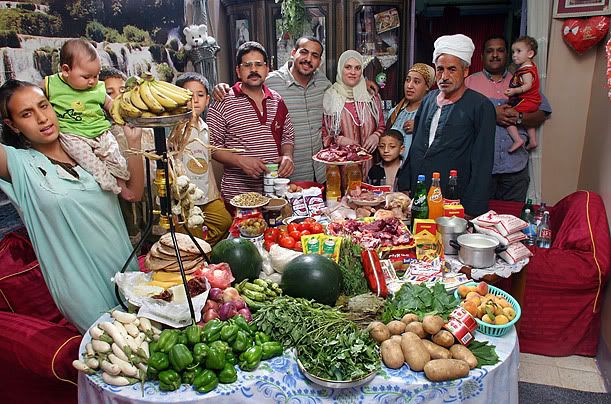
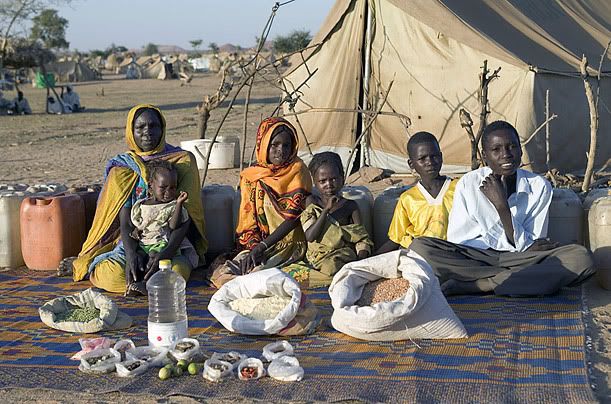
Global Food Disparity in Pictures
Daily Kos links to a fascinating series of photos in which families pose by what they eat in a typical week, from a book by Peter Mentzel called "Hungry Planet: What the World Eats." A few of the more startling contrasted:
In Egypt...
In Chad...
in China...

In America...
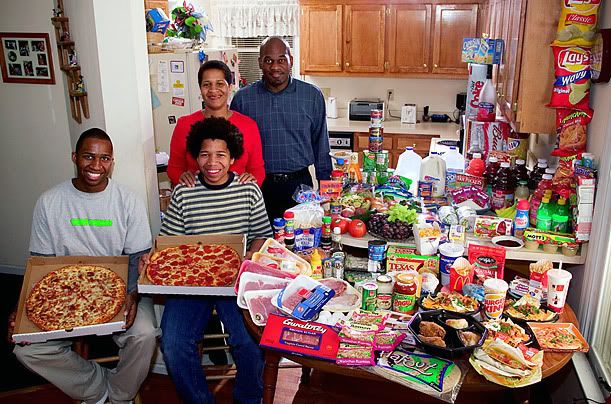
More at the link, all fascinating. The surroundings and family compositions are equally as interesting as the food choices. The pictures immediately reminded me of a series of photos I saw in an airport once that showed families from all over the world posing with their entire household possessions, displayed out in their front yards. I thought that must be the same author/photographer, and indeed, here it is, entitled Material World: A Global Family Portrait.
In Egypt...
In Chad...
in China...
In America...
More at the link, all fascinating. The surroundings and family compositions are equally as interesting as the food choices. The pictures immediately reminded me of a series of photos I saw in an airport once that showed families from all over the world posing with their entire household possessions, displayed out in their front yards. I thought that must be the same author/photographer, and indeed, here it is, entitled Material World: A Global Family Portrait.
Springtime for Tax Deregulation
Like spring blossoms, stories about the failures of the U.S.
income tax begin to sprout at this time of year. President
Obama’s blueprint represents only the latest attempt to address those problems
using a playbook that is 25 years out of date.
Although the problem remains the same as in Reagan’s day (big corporations,
high profits and tiny
taxes) today the solution must be different.
President Obama’s approach must be different because tax deregulation has given corporations
extraordinary abilities, talents that some have exploited to reduce—and in some
cases eliminate—their tax bills. The
same deregulatory impulse that provided bankers with the freedom to nearly destroy the
global financial system now makes a mockery
of the U.S. income tax. How? In some ways, it’s surprisingly simple. For example, deregulation allows anyone to
make a corporation disappear in the blink of an eye, leaving only what is known
as a “tax nothing” behind. As a result,
corporations wield the sort of power one might expect from supervillains.
Neutralizing the impact of tax deregulation is not as simple
as limiting the influence of lobbyists.
Nor will closing loopholes or changing tax rates bring taxpayers’ newfound
powers under control. To understand why,
consider the case of Wal-Mart. After years of playing the corporate bad
guy, Wal-Mart recently found itself playing a (tax) victim. Tax deregulation is to blame because it
disproportionately benefits Wal-Mart’s more cosmopolitan peers. A corporation like Wal-Mart that earns its
income selling t-shirts and hardware to U.S. consumers gets left out.
The tax rules governing multinationals used to be feared. Those once-formidable laws served as potent guardians
of the American tax system, ensuring that corporate taxpayers could not avoid
U.S. tax by shifting income offshore. Now,
multinationals can avoid the reach of the U.S. income tax simply by making
boxes disappear on a corporate chart. Wal-Mart
can only stand on the sidelines as others use the freedom deregulation has
given them to artificially shift profits to more welcoming locales.
Addressing this problem raises the fundamental question of whether
any rule can withstand an assault by corporations able to achieve the
tax-planning equivalent of leaping a tall building in a single bound. Although all taxpayers would love to ignore
inconvenient requirements, it isn’t clear that Congress should be in the
business of granting superpowers to particular taxpayers (or that ordinary
Americans should be forced to foot the bill when it does).
In the 1980s, Reagan joined a bipartisan Congress by eliminating
tax breaks and lowering corporate tax rates. They achieved an extraordinary—but
short-lived—victory. For a time, corporations
paid taxes consistent with their profitability and, no less important, non-corporate
taxpayers. Obama wants to do the same
today, but old-fashioned loopholes are no longer the key problem. In 1986, Obama might have been right to say
that “a parade of lobbyists”
had “rigged the tax code to benefit particular companies and industries” so
that “those with accountants or lawyers to work the system” could “end up
paying no taxes at all.” Today—unless
Wal-Mart has been abandoned by its lobbyists, accountants and lawyers—he is
missing the point.
Saturday, March 17, 2012
Pricing Obamacare & the trouble with projections
It's often difficult to understand what a social program costs each year or over the years, and it seems that the science of projecting these costs stumps even those who apparently ought to know better...or, from an alternate view, the difficulty creates political opportunities for those who would sway us one way or another regardless of what the projections suggest. I discussed the anti-Obamacare litigation earlier; it seems that fuel is being added to the fire as commentators take apparently opposite views of the CBO's recent modification to the projected cost estimates.
An article in the Hill tells us "CBO says Obama's latest budget would add $3.5 trillion in deficits through 2022" and then confuses us mightily.
Krugman pulls the article apart and suggests that this is not just poor reporting but an attempt to spread misinformation, since "What the CBO report actually says is that it expects deficits to be a bit smaller than Obama projects."
He adds that "people who can’t read numbers making dumb claims about Obamacare," with a link to Johnathan Cohn, who says "No, Obamacare’s Cost Didn’t Just Double. Sigh". (Cohn, it appears, is also tired of trying to reason with you people.) Cohn says:
An article in the Hill tells us "CBO says Obama's latest budget would add $3.5 trillion in deficits through 2022" and then confuses us mightily.
Krugman pulls the article apart and suggests that this is not just poor reporting but an attempt to spread misinformation, since "What the CBO report actually says is that it expects deficits to be a bit smaller than Obama projects."
He adds that "people who can’t read numbers making dumb claims about Obamacare," with a link to Johnathan Cohn, who says "No, Obamacare’s Cost Didn’t Just Double. Sigh". (Cohn, it appears, is also tired of trying to reason with you people.) Cohn says:
Sorting through the deceptive attacks on health care reform gets old, even for me. But on Wednesday the Republicans and their allies made a claim so obviously misleading that they, and the media outlets parroting them, must have known they spreading false information.
...If CBO had truly determined that health care reform’s cost will be twice the original estimates, it would be huge news. But CBO said nothing of the sort.
...The real news of the CBO estimate is that, according to its models, health care reform is going to save even more taxpayer dollars than previously thought.
I want to be clear about something. The Affordable Care Act has flaws: Among other things, it reaches fewer people and provides less financial protection than I would prefer. The revised CBO report actually suggests this problem will get mildly worse, since it also expects slightly fewer people to end up with insurance. That’s one reason why the law will cost less; it’s helping fewer people. Another reason is that more employers pay penalties for not offering insurance and more people pay penalties pay penalties for not obtaining it. That’s obviously not great, either.
Cohn explains more about how to understand budget projections, worth reading.
Friday, March 16, 2012
International tax gangsters?
If you ever wondered how tax evasion works, it seems to look a lot like this.
Swiss “Tax Evasion Advisers” Hid Assets, Used Kids:
Swiss “Tax Evasion Advisers” Hid Assets, Used Kids:
Two Swiss men who acted as “full service tax evasion advisers” helped U.S. clients hide hundreds of millions of dollars from tax authorities, while delivering cash in hotels and through a child courier, prosecutors said.
... Both Thomann, 61, and Beck, 46, met clients in Manhattan hotels to hand them cash they couldn’t withdraw without visiting Switzerland and pick up money to deposit in their undeclared accounts, according to the indictments.
...A person identified as “Client 2” faxed Beck a letter to withdraw $150,000 in 2009 from Wegelin, according to the indictment. An “unknown person” told him to go to an address in Brooklyn, New York, at a particular time, the indictment said.
...Upon Client 2’s arrival, “a small child of approximately five years of age exited from the home located at the specified address, walked up to Client 2’s car, and handed Client 2 a brown paper bag containing approximately $150,000 in cash,” according to the indictment.
Netherlands to share more tax info with the US
From TJN:
U.S. hunts for black money in Europe Financial Times Netherlands
A few days ago, the Netherlands announced that it joins the FATCA implementation agreement between the US and Germany, France, the UK, Italy and Spain. Under this agreement, foreign banks and other financial institutions do not need to report information directly to the IRS, but they will be obliged by national legislation to report it to the government of their home country, which then exchanges it on reciprocal terms with the US. This reduces the reporting burden for the banks and other institutions and for that reason, the agreement is supported - somewhat grudgingly - by the Dutch Banking Association. See the government press release Netherlands prepared to join U.S. and G5 on FATCA.The links take you to articles in Dutch. Google tries hard to translate but I think we'll have to take the TJN's word for it. This implies that automatic information exchange is in the works between the U.S. and a country it called a tax haven (but quickly took back); here is the implementation agreement. Of course all we're doing right now is agreeing to agree:
"the United States, France, Germany, Italy, Spain and the United Kingdom have agreed to explore a common approach to FATCA implementation through domestic reporting and reciprocal automatic exchange and based on existing bilateral tax treaties."
Thursday, March 15, 2012
The real cost of the U.S. health care system
In American if you are not an employee, you will not have health insurance but must seek it out in the private market if you want it. If you don't have insurance, you will be billed directly for the costs of any health care you end up using. Without the (much maligned) Affordable Care Act (aka Obamacare), getting health insurance is optional, so people who are not covered under an employer plan can choose to go without. But when things go badly, those who choose to forego insurance and bear the costs of whatever health care they actually use, do not in fact always bear these costs. Instead, they can externalize these costs by filing for bankruptcy, throwing the unpaid cost onto health care providers, who in turn pass it on to insurance companies, and from there onto people who do pay for health care coverage. Allowing people to both under-insure themselves and then discharge health care costs in bankruptcy thus creates a tremendous potential for free riding and externalizing costs onto others in society.
It seems the face of anti-ACA litigation has done just exactly that:
In America, when employment contracts, so does health care coverage: "From 2007 to 2010, the share of children and working-age adults with employer-sponsored coverage fell to 53.5 percent from 63.6 percent".
It seems the face of anti-ACA litigation has done just exactly that:
"As someone who chose not to purchase health insurance —and felt strongly that the federal government had no business telling her that she had to buy it whether she liked it or not—Mary had become an active and outspoken critic of the law. As a result, she was the perfect candidate to be a human face on the challenge to Obamacare.
Last fall, Mary Brown and her husband filed a petition of bankruptcy seeking relief for some $55,000 in debts the couple had run up . . . [including] $4500 worth of medical bills...
Almost half of the medical debt run up by the Browns is owed to Bay Medical Center in Panama City, Florida. A spokesperson for the hospital had this say about their experience with the Browns and the many others who cannot pay their medical bills because they have chosen to remain uninsured. “This is a very common problem. We cover $30 million in charity and uncompensated care every year,” “If it’s a bad debt, we have to absorb it.”And related to that is this:
In America, when employment contracts, so does health care coverage: "From 2007 to 2010, the share of children and working-age adults with employer-sponsored coverage fell to 53.5 percent from 63.6 percent".
Wednesday, March 14, 2012


More on higher ed & taxes
Reich associates disengagement with public universities with the decline of the middle class. The problem:
And here is a discussion of the growing problem of student debt, with this scary looking chart:

The US is already making it harder for young people of modest means to attend college. Public higher education is being starved and the middle class will shrink even more as a result.
...The children of middle- and lower-income families are hardest hit. Remember: The median wage has been dropping since 2000, adjusted for inflation.
... public higher education isn't just a private investment. It's a public good. Our young people - their capacities to think, understand, investigate and innovate - are the US' future.
...Public higher education has been the gateway to the middle class, but that gate is shutting - just when income and wealth are more concentrated at the top than they've been since the 1920s, and when the US needs the brainpower of its young people more than ever.A solution:
A big part of the answer has to be more government support for public education at all levels. This requires more tax revenues - especially from Americans who are best able to pay.
Most Americans still believe in the ideal of equal opportunity. And most harbour the patriotic notion that we have responsibilities to one another as members of the same society.
And here is a discussion of the growing problem of student debt, with this scary looking chart:
Tuesday, March 13, 2012
Why do nations fail?
From Planet Money's Adam Davidson,
He doesn't mention what continues to be one of my favorite books on the subject, Guns Germs & Steel. But the column is on the more recent work (linked to last week), which I have ordered but haven't read yet, by Darren Acemoglu and James Robinson. Davidson says this book arguesOver the centuries, proposed answers have varied greatly. Smith declared that the difference between wealth and poverty resulted from the relative freedom of the markets; Thomas Malthus said poverty comes from overpopulation; and John Maynard Keynes claimed it was a byproduct of a lack of technocrats. (Of course, everyone knows that politicians love listening to wonky bureaucrats!) Jeffrey Sachs, one of the world’s most famous economists, asserts that poor soil, lack of navigable rivers and tropical diseases are, in part, to blame. Others point to culture, geography, climate, colonization and military might. The list goes on.
"that the wealth of a country is most closely correlated with the degree to which the average person shares in the overall growth of its economy...when a nation's institutions prevent the poor from profiting from their work, no amount of disease eradication, good economic advice or foreign aid seems to help."This seems in tune with the Spirit Level.
Subscribe to:
Posts (Atom)