Monday, February 4, 2013

A 2-paragraph summary of the FATCA regs?

From Tax Analysts today [gated], a reader writes in with a 2-paragraph "summary" of the FATCA regs. Excerpt:
In our attempt to ferret out U.S. tax dodgers with foreign accounts, we are using the only leverage we have ... 30 percent withholding on all U.S.-source payments to foreign companies unless they fess up and disclose all of their U.S. beneficiaries. Further, we are going to coerce foreign countries [into] ... facilitating this disclosure by threatening to impose our Byzantine regulations on their local financial institutions if they don't.  
We realize that the net result will be that tax dodgers with foreign accounts will simply move their accounts to banks in countries that don't enter into Disclosure Treaties and that don't have U.S.-source income, so the net result will be to impose our massively complex regulations only on legitimate U.S. and foreign taxpayers. We recognize that this result will drastically reduce foreign investment in the United States in a time when it is desperately needed and will add untold complexity to a world of increasing globalization, but we had to do something in response to news articles on some unreported foreign accounts. 
Really, more in the way of observation than interpretation, but in any event it's a finger on a certain pulse.

Thursday, January 31, 2013

Starbucks' £20m pledge is not a tax, but likely is a tax benefit

I've mentioned here and there that Starbucks' decision to pledge £20m to the UK as penance to the public for its extremely effective tax planning over the past fifteen years is not a tax but might be and probably is a tax benefit, and I've been asked to explain why that is, and why it matters.

First, lets define what a tax is. A tax is a compulsory extraction of resources undertaken by a government, for which failure to comply results in threat of penalty.  A government can do this because it monopolizes the use of force. A tax can be fair or unfair, regressive, progressive, good, bad, or ugly. Not every forceful extraction of resources is a tax per se, but every tax is certainly a forceful extraction of resources. Governments can be (and are) lax, selective, even grossly unjust, in enforcing stated penalties, but so long as the threat exists, an extraction is a tax. No threat of penalty for nonpayment, no tax.

Now let's look at three reasons why Starbucks' £20m pledge cannot possibly be a tax.

  1. It is not being imposed by a government.  Despite the BBC calling this an "agreement," Starbucks itself has characterized the 20m as the product of its own internal decision-making processes. Sure, it's responding to public pressure, but that's not government extraction.
  2. It is not compulsory. After David Cameron piled on at Davos, Starbucks hinted that it might change its mind about its pledge, maybe not be quite so generous if the government won't even bother to be decently grateful about its magnanimity. Who's to stop that? Not HMRC.
  3. There is no penalty if Starbucks doesn't actually hand over the money. At least, not by government; the court of public opinion might be a different story, depends on the news cycle I suppose. But having failed to levy taxes, HMRC can hardly argue if the 20m doesn't show up at some point.

One happy result is that at least Starbucks will not be able to immediately claim the 20m as a credit against taxes it owes at home in the USA (not a tax, let alone one on income, so no foreign tax credit). But what can we say then of the 20m? If it is not a tax, what is it?

The answer is, it is a charitable contribution to the UK government. Why, you may say, that would imply that it's deductible! Yes, depending on the UK's rules for deductibility of contributions to the government. I suspect it would be deductible (UK readers, correct me if I am wrong). Certainly in the US a similar pledge would be deductible under s170:
[T]he term "charitable contribution" means a contribution or gift to or for the use of— 
(1) A State, a possession of the United States, or any political subdivision of any of the foregoing, or the United States or the District of Columbia, but only if the contribution or gift is made for exclusively public purposes. 
Notice: no need for it to be out of generosity, just need a contribution for exclusively public purposes. Not, say, lobbying, outings for lawmakers, bribery, kickbacks, collusion, etc. But I digress.

Keep in mind that the whole point here is that Starbucks has no income in the UK against which to take any deduction, should it be available...at least, right now. But if the UK rules for NOLs are anything like those in the US, they can hold that £20m on the books for years, maybe even a couple of decades and deduct it later, if and when they ever do have positive income being booked in the UK (maybe subject to some limitations, as in the US).

 So, it's not a tax, but if Starbucks in fact turns it over it will be a tax benefit, tucked away somewhere in some regulatory filing in extreme fine print, to be used at some future date to--wait for it---reduce the company's tax bill.

Neat trick!

Corporate tax: why disclosure is the key to reform

Two columns of interest emerged today on the issue of corporate tax disclosure, plus another interesting public hearing in the UK, this time with the big four in the hot seat.  Put all of this together and we can see very clearly the intense connection between tax reform and public understanding of the status quo.  With the latter as to corporate tax being woefully inadequate and relevant information intentionally hidden from public view, the former can be neither informed nor meaningful.  The answer is corporate tax transparency, particularly for multinationals, i.e., on the order of country-by-country reporting for listed companies.  First, on the columns, both from the FT.

In this one, John Gapper says "Companies are complying with laws that governments could change if they wished," and then explains:
Starbucks’ supposed immoral act is not to pay UK corporation tax that it does not owe, and would not owe even if it did not license its brand from the Netherlands. It obeys both the letter and the spirit of global tax law, which governments could reform if they wished.
That's 100% correct. And if you think there is some "spirit" in the transfer pricing law that isn't being acknowledged, then you are forgetting that the transfer pricing rules were effectively written by the industry they are meant to police. So I think the spirit is pretty much being well given its due. Gapper also nicely illustrates what I call the mercenary tendency of the tax state in an economically integrated world: agree with whatever seems politically expedient in principle, defect in practice:
I look forward to Mr Cameron naming and shaming companies such as Google (also a target of British politicians) if they are drawn from Ireland to the UK by his tax arbitrage. 
...Governments must decide which regime is fair, and companies and individuals must comply. 
... most companies that place operations or intellectual property in low-tax countries – or even in tax havens such as Bermuda – are not breaching the spirit of global tax law. They comply with a structure established under the League of Nations in the 1920s. 
This allows – indeed, encourages – multinationals to split their operations among countries, paying taxes as if they were separate entities, in order to avoid double taxation. They have to make transactions at “arm’s length” – as they would deal with others. 
It worked for a long time but is under strain because of the growing value of brands, intellectual property and intangibles to global corporations. “Ideas are their biggest asset, and what generate profits, and it is far easier to shift intangibles than factories,” says Jeffrey Owens, of the Institute for Austrian and International Tax Law.
Well, this is mostly right, at least close enough for its purposes. However, I am just not sure what principles we should expect to emerge when reporters turn, as they too often do, to Mr. Owens, former director of the OECD's tax arm and the man who presided over the demise of the corporate tax on a global scale under the nurturing constancy of the OECD's business-driven tax policy making machine, a person moreover who has publicly called for governments to "avoid like hell" any taxes on corporations. He would seem to be the last person you would ask about how to make a corporate tax system function, again, unless we are talking about that movie.  Gapper concludes:
Politicians thus have the choice of indulging in easy rhetoric against companies that obey the laws they have passed or struggling to reform the tax regime for little reward, with lots of disruption. In their position, I might posture too.
If that's not an argument for greater public accountability of how transfer pricing works out in practice, I am not sure what is.

That brings me to the second column of the day from the FT which illustrates why the public ought to know more about how these regimes work in practice, this one by Bruce Bartlett in which he asks, can publicity curb corporate tax avoidance? He lays out the case nicely for the runaway corporate tax base and he concludes:
[L]ittle in the way of real economic activity, such as jobs or tangible investment, has shifted anywhere. All that has shifted is the tax base. 
...This makes the international tax regime a ripe target for reformers.
... With reports of low domestic taxes paid by large profitable corporations such as Starbucks in the UK, the time may also be ripe for an international agreement to curb tax shifting. The US has recently implemented a law called the Extractive Industries Transparency Initiative that requires companies to disclose their payments to governments from oil, gas and mining assets. Allison Christians of McGill University argues that the expansion of such information reporting to the transfer pricing of all multinationals is the first step towards capturing the revenue now lost to the shifting of business costs to high-tax jurisdictions and revenues to low-tax jurisdictions. 
There is growing evidence that corporations are sensitive to the public outcry when they are caught avoiding taxation excessively. Starbucks, for example, recently agreed to pay more taxes in the UK than legally required to quell the controversy over its virtually nonexistent tax bill. The same shaming technique may have broader application to multinationals generally. 
As Justice Louis Brandeis of the US Supreme Court once put it, “publicity is justly recommended as the remedy for social and industrial diseases”.
First, thank you for the shout out, Mr. Bartlett! Second, this column demonstrates clearly the strong connection between tax reform and public understanding of the status quo, as I suggested above.  Tax reform is not going to come from the only party that has all the info it needs right now, namely, the IRS. Tax reform comes from public expression.  Right now, observers of tax policy need more information in order to offer meaningful reform proposals, and that information is being hidden because governments do not require it to be disclosed, plain and simple.  That is a matter of regulatory choice, and these columns show the choice is bad for policy analysis.

That then brings us to the UK's hearings today in which the public accounts committee taking on the big four accounting firms, trying to suss out what the letter and the spirit of the law is with respect to corporate tax on multinationals.  What emerges is the "perfectly legal" nature of all of this tax avoidance, again confirming the editorials by Gapper and Bartlett.  Here is the BBC's take on the hearings, worth reading in full.  Richard Murphy declares it a win for the PAC but the question is whether that translates to a win for those who do in fact pay taxes in the UK and elsewhere.

That question will be answered affirmatively if instead of killing EITI, which is currently apparently a high priority for many, we expand it to cover all listed companies.

OECD public briefing on TRACE and FATCA: Feb 12

The OECD will hold a public meeting on TRACE and FATCA in Paris on February 12, with three IRS officials on hand to discuss FATCA and a senior tax guy at HSBC to update on the OECD's TRACE project.  Really? A senior tax guy at HSBC is going to tell us about how the OECD is going to prevent tax crimes and money laundering?  Wait, is this like that movie where they hired an accomplished thief to test the security system and explain everything that's wrong with it?  In any event, info:
The OECD and the Business and Industry Advisory Committee (BIAC) to the OECD will host a public briefing session on TRACE and FATCA at the OECD Conference Centre in Paris on 12 February. 
...Officials from the US Treasury and FATCA partner countries will give an update on the progress made on the intergovernmental agreements. 
You must send your questions in advance:
Participants will be given an opportunity to ask questions by completing the question form and sending it to the OECD Secretariat (icaevents@oecd.org) by Friday 8 February...
 But you can also attend in person for 100EUR if you are a financial institution, a practioner, or a journalist, according to the information.  Though it is not stated, I will simply assume that non-interested observers, such as academics, NGO reps, etc., are also warmly invited.  I am very sorry I won't be able to attend myself, but if anyone who reads this does plan to attend, I would dearly appreciate hearing from you.

Wednesday, January 30, 2013

French Budget Minister under investigation for tax evasion thru offshore bank acounts

Bob Goulder at Tax Analysts reports that "French Budget Minister, Jerome Cahuzac, was placed under investigation for allegedly using a secret offshore bank account to evade taxes." We don't have to reach too far to guess where that hidden bank account was:
The bank account in question was with the UBS branch in Geneva, Switzerland. It had been in place since the 1990s, at which time Cahuzac was a practicing plastic surgeon who specialized in hair transplants.
I don't know how they found that account, but it's closed now:
Cahuzac allegedly closed the account in 2010, fearing detection by authorities, and transferred the funds to a separate offshore account in Singapore.
Query whether France's tax authorities can get any information out of Singapore to confirm the existence of a hidden account there.  Since this story apparently involves some kind of whistleblower with concrete information as to which confirmation could be obtained, there is a small chance of cooperation because France and Singapore have a tax treaty with the following exchange of info agreement:

1. The competent authorities of the Contracting States shall exchange such information as is foreseeably relevant for carrying out the provisions of this Convention or to the
administration or enforcement of the domestic laws ....
3. In no case shall the provisions of paragraphs 1 and 2 be construed so as to impose on a
Contracting State the obligation:
a) to carry out administrative measures at variance with the laws and administrative practice of that or of the other Contracting State;
b) to supply information which is not obtainable under the laws or in the normal course of the administration of that or of the other Contracting State...
4. If information is requested by a Contracting State in accordance with this Article, the other Contracting State shall use its information gathering measures to obtain the requested
information, even though that other State may not need such information for its own tax
purposes. The obligation contained in the preceding sentence is subject to the limitations of
paragraph 3 but in no case shall such limitations be construed to permit a Contacting State
to decline to supply information solely because it has no domestic interest in such
information.
5. In no case shall the provisions of paragraph 3 be construed to permit a Contracting State
to decline to supply information solely because the information is held by a bank, other
financial institution, nominee or person acting in an agency or a fiduciary capacity or
because it relates to ownership interests in a person.”  
This suffers from the usual limitations on request-activated (as opposed to automatic) info exchange: the first gov has to know what it doesn't know in order to get confirmation from the other gov.  In other words, no fishing expeditions, and certainly nothing like what a FATCA would theoretically produce.  But it does seem to preclude Singapore invoking bank secrecy protection.  Will be interesting to see if this goes further.

Monday, January 28, 2013

A handy guide to Davos-speak

From Ryan McCarthy at Reuters:
...What Davos folks mean when they constantly call for a “growth plan” or “restoring growth” is that no one can see any particular industry that’s going to increase the pace at which they get rich. And, as a result, the rest of us will have fewer jobs.
...[Bridgewater hedge fund CEO Ray] Dalio expanded a bit: the big conversation in politics and economics, he said, will be about how to get more out of workers – growth won’t come  from the next Internet, the next real estate boom or any new asset, in other words. This means, he said, hard choices about questions like “How long is a vacation?” or “What is a good life?” 
...what Dalio is saying is particularly dire for the rest of us. When the world’s most successful investors tells you economic growth is going to depend on whether or not you take a vacation, it’s time to worry. 
Emphasis mine. Make no mistake: whenever CEOs call for policies to increase growth, they mean in their own pockets.


Starbucks to UK: Kneel before Zod!

When it comes to tax, we know by now that Starbucks only giveth when it wants. That means of course that Starbucks can taketh away.  After David Cameron made some remarks about companies smelling the coffee, Starbucks feels bullied and makes noises about maybe not being quite so generous.

Aw, poor Starbucks! Oh, but don't worry, because when you're Starbucks, you just demand a meeting to set things straight:
Kris Engskov, the multinational’s UK managing director, demanded talks at Downing Street after the Prime Minister said tax-avoiding companies had to “wake up and smell the coffee”.
...“The PM is singling the business out for cheap shots, a company that, it should not be forgotten, has pledged to pay tax now and into the future,” said a source close to the firm.
Can we possibly descend into anything more absurd than this ridiculous status quo?  Well sure, of course we can!
The warning on investment comes amid concern among businesses that Government rhetoric on tax avoidance is hurting their image while their creation of jobs and wealth is not highlighted. 
You see, it is the government's job to produce the proper kind of propaganda on these things.  In sum, what we are now being told by multinationals is:

  1. We will pay tribute when and where and in the amount we wish to, according to the will of our PR department and no one else.
  2. Those upon whom we graciously bestow tribute must grovel in thankfulness and describe us favorably, or we will soon regret our generosity.


How a tax haven is born

Can $1.1 billion buy you a country?  Some investors want to try it, by buying Belle Island, currently a Detroit park, and turning it into a tax haven.  Here's the plan:

Looks like Manhattan. The idea:
The 982-acre island would then be developed into a U.S. commonwealth or city-state of 35,000 people with its own laws, customs and currency.
Come on now. There is a whole city there, it's called Detroit, it's full of buildings and infrastructure that are underused, just waiting for investment.  You don't want to invest in that, though, because that would entail accountability to others and-gasp--paying taxes (well, maybe--after incentives and subsidies, maybe not). It's so much easier to make profits if you don't have to pay taxes or observe other regulatory standards such as those protecting worker's rights, the environment, etc. What you want is a regulatory haven that is conveniently located to your clients, that isn't tainted with the tax haven moniker, and that won't be caught up in any global anti-tax evasion net.  Offshore, but in your own backyard, and not treated like the rest of offshore (otherwise what is the point).  A US commonwealth or city-state just about does the trick...ingenious!

Have any doubts that this is about building a tax haven?  Just read to the end of the article:
Here's the scenario for the Commonwealth of Belle Isle that Lockwood and others want to see: Private investors buy the island from a near-bankrupt Detroit for $1 billion. It then would secede from Michigan to become a semi-independent commonwealth like Puerto Rico and the Northern Mariana Islands. 
Under the plan, it would become an economic and social laboratory where government is limited in scope and taxation is far different than the current U.S. system. 
There is no personal or corporate income tax. Much of the tax base would be provided by a different property tax — one based on the value of the land and not the value of the property. 
It would take $300,000 to become a "Belle Islander," though 20 percent of citizenships would be open for striving immigrants, starving artists and up-and-coming entrepreneurs who don't meet the financial requirement. 
I called the Honduras charter city little more than a glorified gated community; this is clearly the same. An economic and social laboratory?  Hardly--add it to a long list of contenders.  The story says "City officials are likely to reject the plan." Too bad, because it would be fun to watch the US open its own tax haven even as it tries to shut down all the others.

Finance minister annoyed about transparency, on his way to Davos

Canada's Finance Minister Jim Flaherty is annoyed with having a Parliamentary budget watchdog that asked too many questions and sought too much budget transparency, going beyond the job description:
What the government wanted was “a sounding board, a testing board,” said Mr. Flaherty, before heading to Davos, Switzerland, on the weekend for the World Economic Forum.
That's rich!  Too much transparency is bad for politicians. Easier to do your thing in elite networks behind closed doors.  All that disclosure is going to ruin everything.

Human rights and tax secrets

Think those two don't go together? Prince Charles begs to differ:

Prince Charles has used the Human Rights Act and the Official Secrets Act to block revelations about his tax affairs – even though Her Majesty’s Revenue and Customs has said the disclosure would be in the public interest. 
The move follows a bid to uncover the secret arrangements which allow the Prince of Wales to avoid paying tax on the Duchy of Cornwall, his vast estates which generated £18 million profit last year. 
The test case centres on a request by an academic who has asked to see correspondence between the Duchy of Cornwall and HMRC. 
But the Government and the Duchy of Cornwall have refused to agree to the release of the documents because the disclosure would breach Charles’s right to privacy. They also say the information is protected by the Official Secrets Act. 
John Kirkhope, an expert on trusts law from Weston-super-Mare, Somerset, is trying to use the Freedom of Information Act to uncover how HMRC came to grant the Duchy a tax exemption which is estimated to have been worth millions of pounds over the past century.
The issue here is the right of the public to know what the treasury already knows.  A spokesman for Prince Charles said "The Duchy is not a company and is not therefore liable to pay corporation tax." That is completely irrelevant. What is being asked here is not whether tax has been levied and if not why not, but whether the public has a right to know whether tax is being levied, and if not, why not.  That is a transparency question, the kind that animates EITI& CBCR. Of course, neither of these regimes would extend to the Duchy, since its not a public corporation.

Relatedly, notice that the Prince's right to privacy is the invoked protection against the government's disclosure of his tax information to a third party, i.e., a party other than the government itself. That right is, of course, what any UK taxpayer that also has US status will have to forego in order to fulfill the UK's FATCA obligations. No official secrets act protection in that case--just the data privacy act, which the UK has said only requires UK financial institutions to inform (not obtain consent from) their customers whose information they will disclose to the US.

Friday, January 25, 2013

WTO Trade disputes "from the inside"

This will be an interesting talk:
Appellate Body Member Tom Graham will be giving a talk at Hofstra on Feb. 6 entitled "It Sure Looks Different From the Inside: Deciding International Trade Disputes at the WTO". The title sounds promising, and from what I understand he will talk a bit about the use of the Vienna Convention by the AB in its decision-making.  He is not likely to be as forthcoming as, say, Justice Scalia, but he may say some interesting things nonetheless.
I don't see anything about live feed, too bad. I would have like to hear what he had to say--WTO decision-making is of interest to those of us keeping an eye on arbitration in tax treaties.  

Up Goer Your Law Review Article

The Faculty Lounge throws down a challenge to legal academics: can we tell people what we are talking about in words that are easy to understand?
Cedar Riener (follow him @criener), an enterprising psychology professor, has begun a Tumblr, Up Goer Your PhD, collecting doctoral dissertation abstracts written in layman's terms, as described above. His project is a riff on this brilliant layman's diagram of Saturn 5, otherwise known — when one is limited to the most common 1,000 words — as "Up Goer 5." People using Up Goer to explain a variety of other complicated concepts can be found on Twitter at #UpGoerFive. Many Up Goer projects turn out to be hilarious, and they're fun to create, too.
But there's a serious point here as well. Jargon (including technobabble, neurobabble, and other babbles) can be efficient shorthand when conversing among other experts. But let's be frank: it can also conceal some serious B.S., not only from our readers, but also from ourselves.
That's right, and I spend a lot of time trying to stop my own tendency toward jargon in thinking, in teaching, and in writing. This is not easy when your world is dominated by code sections, acronyms, and hyperlexis. I suspect I fall short most of the time, in fact, I just did, five times in that last sentence alone. Sigh.  In my defense, "tax" is not even on the list of the "ten hundred most used words."


Global rulemaking on banking

Related to my comments on Davos yesterday, here is another angle on the role of experts working in networks to produce global governance norms: David Zaring writes about the Basel Committee's stated goal "to strengthen banks' risk data aggregation capabilities and internal risk reporting practices," and he asks: Who helped them come up with the principles?  His answer:
You might begin to answer that question by looking at the comment process.  Who wrote in once the committee completed a draft of the principles and sent it around?  It turns out that Basel kept a list:
British Bankers Association   39kb  
Canadian Bankers Association   368kb  
French Banking Federation   204kb  
Independent Data Professionals Group   788kb  
International Banking Federation   250kb  
Jacques Préfontaine 21kb  
Japanese Bankers Association   74kb  
JWG 257kb  
Polish Financial Sepervision Authority   443kb  
Prefontaine is a Canadian professor, and JWG a beltway bandit/think tank.  So, in other words, other than the Poles, this is a comment process dominated by banking industry groups.  Basel has not in the past radically changed its rules during the comment process (though it changes them some), and I'm glad the committee is no longer operating entirely in secret.  But it does show that the new openness in international financial regulation isn't being exploited by everyone.
Interesting observations about transparency and accountability in governance when governance occurs offshore in networks of experts and interested parties.


What's FBAR got to do, got to do with it

Everything, I am guessing. Tina will give up her US citizenship now that she has attained Swiss citizenship.  Reason given: to "clarify her situation." John Nolte says "She's 73 years-old, her longtime partner lives overseas, and as far as I know she's not in any way making a political statement." He seems a bit puzzled about her decision to give up her status, and he welcomes her back anytime.

Well said. So why is she giving up her citizenship?  Short of making a political statement, I can think of only one good reason: America's newfound vigor for enforcing citizenship-based taxation, and all of the surveillance and form-filling that entails.  Just consider that giving up citizenship is not a simple matter of mailing in your passport. It can be a complex and time- and resource-consuming process which involves enhanced scrutiny and fees for those with high net worth, who are viewed as attempting to flee the tax jurisdiction.

The US has always had citizenship based taxation on the books, but it wasn't truly enforced until FBAR came under IRS authority and FATCA emerged as its enforcement mechanism in 2010.  Now those who have not been compliant will be "rooted out" (former IRS Commissioner Shulman's description of FATCA) with ongoing monitoring, and hefty fines for failure to file. Those who have been compliant will go on to face a regime that is increasingly byzantine, with new forms and requirement seemingly being piled on all the time, in a situation that is becoming very lucrative for tax return preparers and the compliance industry in general--just google FATCA compliance officer job posting and you will get the idea.  Of course, the regime is meant to catch Americans hiding their cash offshore: a laudable goal especially in light of so many high profile cases, many prominently featuring Switzerland.

So the question is whether Tina Turner is an "American" and if she, with her Swiss bank accounts, is "hiding offshore." This raises a series of unanswered questions about the relationship between the individual and the state, none of which, I think, are easily answered. These include, to which country does Tina belong, if she has dual citizenship?  Is this a first come, first served world, so she belongs to the US in perpetuity, based on her birth in Tennessee, no matter where she lives out her life?  Can she choose to belong to another country, or only if she is willing to pay the cost of her continued US status in the form of ongoing compliance with US tax law?  Is Tina going to be allowed to leave the US jurisdiction only on the condition that she renounces any right to come back?  What financial restrictions should a state place on people--especially wealthy ones--who want to move to other jurisdictions?

As long as Tina holds on to her citizenship, even if she is a dual citizen living in another country, the answer to the first question is that she is now and will ever be American. And as long as she has any accounts anywhere in the world outside of the US, the answer to the second is "guilty unless proven innocent on an annual basis." None of the other questions are answerable in law: all are a matter of opinion and, more than anything else, geo-political power.

I am sure that Tina's expatriation will be viewed by many as a response to the high US tax rate, or a betrayal of her US roots, or both. But it is likely neither.  As a Swiss citizen resident in Switzerland, Tina's worldwide income is subject to income tax (federal, cantonal, and municipal), wealth taxes, VAT, etc., and we can only speculate about how much tax she may be asked to pay in the US after credits, exemptions etc. as a US citizen living abroad.  It could very well be zero or close to zero.  So it is seems more likely this is about the hassle of filing a thicket of tax forms, year after year, despite owing little or no tax to the US, and stiff penalties for even "non-willful" infractions, including mistakes.  And it could be about having to do all of that because Americans living abroad are viewed as likely criminals because they have offshore bank accounts.  

If Tina has been tax compliant all these years, she may just be exhausted with the effort; if not, she may see many reasons to cut ties by going the drastic step of irrevocable renouncement.

I would very much like to know if there is some other reason to give up her US citizenship. "Clarifying" one's situation seems just abstract enough to cover the hassle of dealing with US tax compliance.

Thursday, January 24, 2013

Billionaires of the world ranked and charted

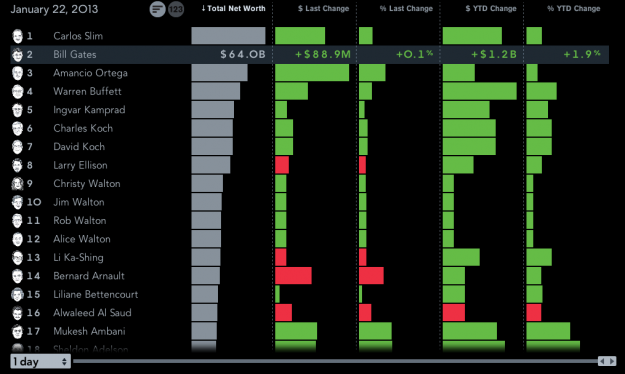
From Flowing data, links and commentary on an interactive chart called "Bloomberg's Billionaires", where you can see who the world's billionaires are and how they compare to each other:
Billionaires ranked

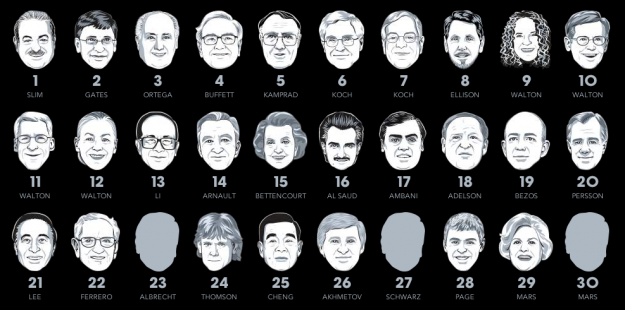
There are four main views. The one above shows rankings, their estimated net worth, and the change from the previous estimate. Below is a simple ranking of the world's billionaires. Each floating head is clickable so that you can more information about the individuals, such as a short bio and where there money is from.
Billionaire floating heads
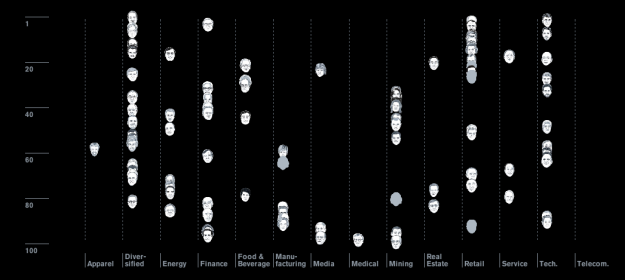
It gets more interesting when you click around and explore. For example, there's a plotting view, and the floating heads transition to their sectors, still sorted by ranking:
Richest people in the world
...[You can] Filter by gender, industry, citizenship, age, and whether or not a billionaire's money was mostly inherited. The slider on the bottom allows you to go back in time to see rankings and net worth change. That part did seem buggy though, as heads seem to disappear or get stuck if you shift too much.
Fascinating, if voyeuristic, and in the typical vein of media obsession with the rich. If Bloomberg produced "Bloomburg's Penniless," and told us all about some of the world's poorest people and just exactly how they got there, would we pay attention?


Davos: cocktail party, soft law generator

Davos is about as lucrative as it gets in terms of international networking, hence FT's headline: Davos is no conspiracy – it is infotainment. The assessment:
The fact that the World Economic Forum has been going since 1971 and can pull 2,600 professionals away from their desks without knowing precisely why they come is quite an achievement. Any event that can charge SFr22,000 ($23,600) per seat – and up to SFr500,000 for membership – has things to teach rivals.
 But here is the part of interest for those listening for signs of soft law in global governance:
...“It allows bankers or people in business to meet and make deals they couldn’t legally do in their offices,” says Richard Saul Wurman, founder of the Ted conferences.
Not stated: this includes with politicians, policymakers, people who might be closely scrutinized if they meet you in their offices at home, but whose ear you can command at a cocktail party without public scrutiny.  I talked about this phenomenon in this paper, and noted the problems for democracy and accountability in governance when epistemic communities take their deliberations off-line, that is, out of the observable paths of governance and into international networks. In these networks, what these private and public elites are doing doesn't look like lawmaking--they are having cocktails, they are listening to speeches--yet ultimately translates into just that. That is the power and the puzzle of soft law, and we can see hints of it in the FT article:
...Davos is serious – its participants discuss weighty topics and review the state of the world. They hear from policy makers and economists what is going on, and what they think will happen (rightly or wrongly). “Davos is a factory where the conventional wisdom is manufactured,” says David Rothkopf, the author of Power Inc. 
...Third, it is a club. Entrance is tightly restricted and it plays to people’s vanity to be invited, or even permitted to join. ... people pay to be with other people they want to become peers with, or whom they admire. The currency of a club is its members. 
...Corporate membership, star guests, personal contact, intellectual stimulation and parties make a potent combination. The network effect is hard to break, even with reverses such as the anti-globalisation protests of the 1990s. Once a quorum of the elite signed up, Davos grew until everyone complained it was too big.
So, a network of elite normmakers and the elites who want to influence them. If you care about the rule of law and how legal principles and institutions develop through power and influence, you will pay close attention to Davos. However you must concentrate not on what you see but what you don't see.

Monday, January 21, 2013

Paper: Putting the Reign Back in Sovereign

I've just posted a draft of my paper, "Putting the Reign Back in Sovereign: Advice for the Second Obama Administration," which I presented at Pepperdine last week. Abstract:

In its first term, the Obama administration enacted two pieces of legislation, each designed to protect an increasingly vulnerable income tax base, and each of which had the potential to set a new and unprecedented course for no less than the regulation of the global economy by the nation-state. The first, the Foreign Account Tax Compliance Act (FATCA), sought to end global tax evasion through tax havens.  The second, a little-noticed two-page addendum to the Dodd-Frank Wall Street Reform and Consumer Protection Act (Dodd-Frank), sought to end the contribution of American multinationals to corruption in governance by codifying the transparency principles of the global Extractive Industries Transparency Initiative (EITI).  Both of these reforms reasserted a role for the nation state in regulating people and resources. But neither has yet to fulfil its potential. First, each has raised difficult questions about what the state can and cannot do to enforce disclosure and compliance on a global basis; failing to answer these questions is impeding implementation and aggravating an already-flagging taxpayer morale. Second, neither is broad enough: FATCA should be truly reciprocal and EITI should expand beyond the extractive industries. By acknowledging and responding in a principled way to the obstacles that limit their effectiveness, a second Obama administration could take significant steps to bring each piece of legislation to its potential, while ensuring that its scope focuses on its intended target in each case. This article outlines how these proposals could be accomplished and makes the case that they should be attempted.
I would be happy to have comments.  And in case it is of interest, here is a link to my powerpoint from the presentation as well (I don't know how to embed that here); you can actually watch the entire conference video here (my presentation was second to last).


Note on Enforcing the Long Arm of the Tax Law

I came across this paper when I was doing some treaty research. It may be of interest: “But the Americans Made Me Do It!”: How United States v. UBS Makes The Case For Executive Exhaustion. No abstract, but here are some excerpts:
In 2008, the U.S. government launched an investigation into UBS AG (“UBS”) following the indictment and conviction of one of UBS’s senior bankers on charges of assisting a wealthy American with tax evasion. ...The United States filed a summons in federal court seeking information from UBS concerning the identities of ... unknown taxpayers. Swiss bank secrecy laws, however, explicitly forbade such disclosure. 
UBS was caught in a classic conflict-of-laws dilemma. On the one hand, UBS and its employees would face potential criminal sanctions if they violated Swiss bank secrecy laws to comply with a U.S. court order. On the other hand, UBS could decline to comply with a potential U.S. court order and face contempt of court....
...U.S. courts thus have a dilemma when the United States, through its executive agencies, wants parties to disclose foreign accounts for tax or other investigatory purposes but bank secrecy laws stand in the way of these investigations. While many courts have used balancing tests to solve this problem, they have found that U.S. law-enforcement interests trump the interests of foreign nations. This places a defendant financial institution in the position of either providing client data in violation of its home state’s laws to meet the demands of the United States or disregarding U.S. discovery orders to meet its home state’s legal requirements.  
... One of the factors for a court to weigh in the balancing formula is “the availability of alternative means of securing the [requested] information.” 
This Comment uses the recent tax investigation into UBS and its account holders as a case study to argue that the alternative means factor from the Third Restatement should be a mandatory step for Executive Branch agencies to exhaust before they can petition a court to compel disclosure of foreign discovery that would require the defending party to violate foreign law. 
This mandatory step, which this Comment terms executive exhaustion, is derived from the concept of administrative exhaustion, in which courts decline to hear cases until the moving party has exhausted all available administrative remedies. The application of executive exhaustion will prevent courts from having to engage in the Third Restatement’s balancing test. By avoiding the Third Restatement’s balancing test, a court can avoid placing parties in a catch- 22—following one state’s laws at the expense of violating those of another state.
And from the conclusion:
[F]ederal courts are aware of the various international interests at stake in certain high-profile litigation. .... Even after the United States, the Swiss government, and UBS came to an agreement regarding the transfer of data, the independent Swiss judiciary held that the UBS client data could not be transferred pursuant to the Treaty Request Agreement because the agreement was not actually a treaty—and thus not officially Swiss law.  If the Swiss government was unable to transfer data pursuant to an agreement it drafted and signed, how did the IRS and the DOJ realistically believe that UBS would be able to comply with a possible order compelling disclosure? An order compelling disclosure would have resulted in a full-blown diplomatic disaster, with the Swiss seizing UBS client data and the IRS and DOJ moving to have contempt-of-court sanctions imposed against UBS.   
In light of the powerful international interests at stake when it comes to an order compelling disclosure of information in violation of foreign law, it is imperative that Executive Branch agencies seek all alternative means before petitioning a court for disclosure. Federal courts should be the last resort for compelling disclosure when an Executive Branch agency seeks information from abroad that would require the violation of foreign law.
 You can read the full paper at the link.

Sunday, January 20, 2013

Motomura on Birthright Citizenship & Legalization

Here is an interesting paper on citizenship as legal status, by Hiroshi Motomura: Making Legal: The Dream Act, Birthright Citizenship, and Broad-Scale Legalization.  Abstract:
    Some of the most controversial topics in immigration and citizenship law involve granting lawful immigration status—or citizenship itself—to persons who might otherwise be in the United States unlawfully. In this Article, I examine arguments for and against three ways to confer lawful status: (1) the DREAM Act, which would grant status to many unauthorized migrants who were brought to the United States as children; (2) the Fourteenth Amendment to the Constitution, under which almost all children born on U.S. soil are U.S. citizens; and (3) broad-scale proposals to grant lawful immigration status to a substantial percentage of the current unauthorized population. I first explain how arguments both for and against the DREAM Act reflect some mix of fairness and pragmatism. Though birthright citizenship seems different from the DREAM Act, the arguments are similar. I next show that although children figure much more prominently in the DREAM Act and birthright citizenship, similar patterns of argument apply to broad–scale legalization, and the arguments in favor are just as strong. Finally, I explain that the "rule of law" is a highly malleable concept that provides no persuasive case against any of these ways to confer lawful immigration or citizenship status. Rule of law arguments in favor of conferring status are stronger than rule of law arguments against doing so.

Treaty Termination and the Separation of Powers

Here is a new paper that is not directly on a tax topic, but does touch on the treaty power, which occasionally comes up in tax policy discussion and therefore may be of interest.  Kristen Eichensehr, Treaty Termination and the Separation of Powers:

The President, Congress, and the courts have long disagreed about who has the power to terminate treaties. Presidents have claimed the power to terminate treaties unilaterally, while Congress and particularly the Senate have argued that because the political branches share the power to make treaties, they should also share the power to terminate them. Unilateral presidential treaty terminations have prompted lawsuits by congressmen and private parties, Senate hearings and reports, and a divided academic literature. Meanwhile, the courts have deemed treaty termination to be a nonjusticiable political question.
This article reframes the debate over treaty termination by looking to treaty formation and analogizing to the Supreme Court's precedents on the Appointments Clause and removal power. The Appointments Clause uses the same "by and with the advice and consent of the Senate" language as the Treaty Clause and is found in the same sentence of the Constitution. Proponents of presidential power have relied on the Supreme Court's Appointments Clause jurisprudence to argue that Congress cannot limit the President's termination power. This article agrees that the oft-proposed requirement of Senate consent prior to treaty termination would be unconstitutional by analogy to the Appointments Clause. However, the Appointments Clause analogy points toward a new solution to the termination debate — namely, that the Senate could impose a "for-cause" restriction on the President's termination power. In particular, this article proposes a "for-cause" limitation implemented via a reservation, understanding, or declaration at the time of a treaty's ratification.
Recognizing the constitutionality of a "for-cause" termination reservation alters the terms of the ongoing debate about the interchangeability of congressional-executive agreements and Article II treaties. Both proponents and opponents of interchangeability have noted that the President's ability to terminate Article II treaties unilaterally makes treaties unreliable as compared to congressional-executive agreements, which cannot be terminated absent action by both Congress and the President. A "for-cause" termination reservation would increase the reliability of Article II treaties and so would shift the comparative utility of congressional-executive agreements and Article II treaties.