Friday, August 24, 2012

Sheppard on transfer pricing: clumsy, sorry, and doomed

Lee Sheppard asks Is Transfer Pricing Worth Salvaging, and answers no: it is "the leading edge of what is wrong with international taxation."  She calls transfer pricing a "clumsy tool[] that affluent developed countries have used among themselves, to their collective detriment" and "a sorry vestige of a system that will be gone in 10 years."  She points to a series of factors that will kill transfer pricing as a going concern: resistance from the BRICs, Europe's move to combined reporting with formulary apportionment, social justice activists' increased scrutiny of and scorn for high profile tax dodging, and various prior failures of tax policy that have already allowed multinationals to exit from the tax system on a global basis.  She concludes:

Booking income from an intangible in a tax haven is not a fit subject for tax competition. Tax competition for foreign direct investment is honest competition. Tax competition for booking income is not. Poor little Ireland is still poor, despite the billions of dollars of multinationals’ income booked there. It was only booked there. It sloshed through Ireland on the way to somewhere else, and did not pave the dirt roads on its way out.

HT: TJN, which is hosting a copy of the column on their website.

Fleming on U.S. Tax Treaty Shopping

J. Clifton Fleming Jr. has posted a new article on treaty shopping that is of interest, entitled Searching for the Uncertain Rationale Underlying the US Treasury's Anti-Treaty Shopping Policy.  In it, he explores the questionable policy behind anti treaty-shopping measures and shows that the exceptions to the limitation on benefits provisions found in US tax treaties basically eviscerate the ability of these provisions to prevent treaty shopping.  It's a quick and straightforward read in Professor Fleming's usual approachable style.

Corporate Tax Transparency: U.S. Update

A step forward in the global tax transparency effort: the U.S. SEC has finally approved rules for implementing the extractive industries transparency provisions of Dodd Frank s. 1504.  The rules were due, by statute, more than a year ago.  Industry lobbying against their issuance was fierce but, perhaps spurred by Oxfam's lawsuit compelling the SEC to stop its foot-dragging, the agency has finally produced.  Here is the announcement from the SEC.  A number of stories call this a big day for transparency and a big step by the US, from the New York TimesGlobal Witness, the Financial Integrity Task Force, the Brookings Institute.

Of course, as Brookings notes, the devil will be in the details, a.k.a., the implementation.  From their report:

Tomorrow those details will be in the hands of the SEC and will determine whether ‘effective transparency’ is attained or continues to remain elusive. Namely the SEC will determine whether the information that needs to be disclosed by companies is sufficiently detailed, relevant and accessible, enabling effective monitoring and analysis by civil society, investors and government reformists.
Given the content of the 2-year-old Dodd-Frank legislation, the SEC has no choice but to mandate disclosure. However, effective disclosure is by no means guaranteed as the SEC could issue weak rules, rendering disclosure ineffective. Thanks to Dodd-Frank legislation mandating transparency, the main danger is no longer wholesale ‘transparency evasion’ by many companies, but the more nuanced risk of enabling ‘transparency elusion’ (or ‘transparency avoidance’) by companies that wish to skirt detailed disclosure, thereby masking possible misdeeds.
Similarly, from the NYT:
Oil experts said it was difficult to know how onerous the payment disclosure rule would be since it was not yet known how the S.E.C. would define some of the requirements. Kevin Book, an analyst at ClearView Energy Partners, said in a research note that the ruling could “impose very real competitive challenges for U.S. companies,” particularly if “compliance leads to disclosure of previously secret terms of concessions, leases and production-sharing agreements.”
More on this to come.


Monday, August 20, 2012

Does Intimacy Matter in the Tax Law?

The home mortgage interest deduction has been in the news a fair amount lately, for a number of reasons.  But one that has received less attention in the media has been: what constitutes a "home" for purposes of the home mortgage interest deduction? The IRS and the Tax Court recently confronted this issue with some startling conclusions.

Slightly simplified, two unmarried taxpayers each owned their own house with a mortgage of $1 million, for which they each properly deducted the entire interest (under the law, each taxpayer is permitted to deduct interest on $1 million principal amount of mortgage, but that is capped at $500,000 per spouse for married couples filing separately).  The couple sold their separate houses and jointly bought a new house with a mortgage of $2 million, each as 50% co-owners and co-obligors.  Each taxpayer deducted half the mortgage interest.  The IRS disallowed half the interest deductions on the theory that the $1 million cap applied to the single home, not to each taxpayer separately.

The taxpayers countered with one simple fact - they were not married.  The Code clearly says that the $500,000 cap applies for a married couple filing separate returns but the cap is $1 million for everyone else. Yet that is not the end of the story - the taxpayers, although not married for tax purposes, were an intimate, same-sex couple.  The Tax Court agreed with the IRS that the taxpayers shared a single "residence" and interpreted the statute to read that the $1 million cap applied to that single residence and not to each taxpayer's share of the mortgage.

The decision raises a number of troubling issues, although there are technical and statutory arguments both in favor and against this result.  At a minimum, it is extremely difficult to determine how to draw any reasonable line under this approach.  What if the taxpayers lived in adjoining rowhouses that shared a common wall?  What if they also shared an emergency exit door?  Or they lived in neighboring apartments with shared common spaces?  What if the couple bought neighboring houses and tore down the fences so they shared a yard?

Perhaps the most troubling aspect of this case is the certainty demonstrated by the IRS and the court that the taxpayers were in fact part of a single residence.  After all, a home with a $2 million mortgage must be pretty large, presumably it would be quite easy for co-owners to pursue independent lives in a house of that size.  Maybe the IRS and the court mistakenly fell victim to the idea that this was a case about same-sex marriage?  But the logical conclusion of the case need not be limited to same-sex couples - it could apply to adult siblings sharing a house, roommates buying an apartment together to share expenses, or long-term, intimate, opposite sex couples who choose not to marry.  How are these different?  This seems like an absurd question, but implicit in it is an inquiry into the intimate nature of the relationship.

Nothing about the legal status of marriage requires spouses to pool resources, share expenses, or even like one another, but once the tax law leaves the relative safety of the bright line of marriage, the intimacy of relationships becomes relevant.  Any rule that distinguishes based on intimacy would not only permit, but would seem to require, the IRS and the courts to judge the intimacy of taxpayer relationships, or even construct what "intimate" means for these purposes.  What is intimate enough to justify tax benefits?  Would taxpayers have to kiss each other in court to prove their intimacy?  Would hiding intimate feelings become the new tax shelter?  Regardless of one's opinion about the holding in this particular case, such an approach would seem to open a door I am not sure most people would want open.  Perhaps the ultimate lesson is that we already have.


Thursday, August 9, 2012

The Cayman Islands: A Modern Morton's Fork?

The Cayman Islands has come to stand as the epitome of the offshore tax haven.  Yet, until just the other day, the Cayman Islands had proposed a first of its kind income tax (dubbed a "community enhancement fee") of 10% on the income of expats.  Unsurprisingly, expats were less than pleased about this, even going so far as to claim that the mere discussion of the possibility of an income tax could kill the Cayman Islands as the preferred tax haven destination in the Caribbean.  Also unsurprisingly, the Caymans reversed course, introducing a new proposed tourist tax to replace the expat tax.

So what is going on?  The Cayman Islands has one of the highest GDP per-capita in the world, and thus presumably should have no problem raising the relatively small amounts of money at issue.  The problem is that the tax base of the Caymans is fleeting.  Expats (and capital for that matter) came to the Caymans precisely for their zero income tax rate, and presumably will leave just as quickly without it (in the words of one Cayman expat - "no tax or we leave").

Attracting financial business and the people who support it through tax competition is what made the Caymans wealthy from a GDP per-capita standpoint.  That it also is what makes it trapped from a revenue standpoint: raise taxes and lose this tax base (and business) or don't raise taxes and never fund any new public goods.  In a recent article I identify and analyze this phenomenon in depth (subsequent work by economists has also begun to do so).  In the article, I refer to this as a modern Morton's Fork, providing small tax haven type countries with a choice, of sorts, between two equally unappealing options.  In the article, this was a matter of theory.  But, lo and behold, it appears to have become real life.

From a US tax policy standpoint, this should be particularly troubling.  The United States needs tax havens such as the Cayman Islands to stop engaging in tax competition to collect the billions, or even trillions, of lost tax revenue.  The Cayman Islands, at least as evidenced by recent events, can't.  So the world appears stuck.

Perhaps it is time to start thinking differently about tax competition.  Instead of ignoring the Morton's Fork plaguing the Cayman Islands and continue insisting it just stop being a tax haven, the United States could adopt policies to make it easier for the Cayman Islands to do so.  For example, if US tax law made it easier for capital to invest in the Cayman Islands, there would be less pressure on the Caymans to rely on tax competition.  In turn, it would become easier for the Cayman Islands to impose some income taxes, share information, or otherwise cooperate with the United States on tax matters, the benefits of which should vastly outweigh any costs.  I discuss some specific proposals in detail in the article, but the basic premise remains.  While this may seem counter-intuitive at first, recent events only further support the idea that counter-intuitive may be precisely what the international tax system needs at this time.  Absent some fundamental change, my guess is we will only continue to see skirmishes such as the one over the failed Cayman "community enhancement fee" increase over time.

Tax Transparency, California style

California is considering a new bill that would have the FTB "publish a list of the 1,500 largest corporate taxpayers per taxable year, including each taxpayer's tax liability and income apportionment information..."  The 1,500 are "as measured by gross receipts, less returns and allowances, that filed a Form 10-K with the federal Securities and Exchange Commission for that taxable year."  Industry reps consider this a privacy violation for corporate taxpayers.  Maybe, but maybe not.  This involves public companies that have disclosure requirements because they are publicly traded, and it involves information they already disclose to the SEC, only with extraneous (non-California) information removed.  It's not at all clear to me why public companies need privacy rights when it comes to taxes paid.  Why are taxes paid and basic measures of how they are calculated so different than all the other financial information these companies already have to disclose in the interest of illuminating their public shareholders about their financial health?

There is no real difference, but tax disclosure presents a very real social/cultural problem for public companies that are paying very low rates of tax--which apparently includes most or all public companies.  The real worry therefore is not a loss of privacy at all but the legitimate worry that sunshine will lead to bad press as data emerges regarding how public companies arrange their tax affairs.

The latest action on the bill, AB 2439, was a second read plus a third reading ordered in the state Senate.  From the Aug. 8 Senate Floor analysis, we get this:
Existing state and federal laws generally prohibit unlawful disclosure or inspection of any income tax return information. ... the FTB may publish statistical data related to taxpayer information so long as nothing specific to a single taxpayer is disclosed.  Notwithstanding these provisions, the Legislature directed FTB to publish a list of the top 500 tax delinquencies over $100,000... 
ARGUMENTS IN SUPPORT: According to the author's office, this bill will ask for the FTB to post one specific data point on its website which corporations already have: corporation taxes paid to California. It simply disaggregates the amount already reported in their SEC 10-K form to be California-specific.  This simple data is urgently needed for several reasons.  First, California recently made significant changes in its corporation tax system, adopting "elective single sales factor apportionment." This new system means that corporations have a choice of how to apportion multi-state income to California. The FTB has estimated that this choice will cost the state nearly $1 billion annually, beginning in tax year 2011. With this bill, we will be able to accurately determine the distribution of benefits and costs from this drastic change.  
ARGUMENTS IN OPPOSITION: The opposition expresses concerns that this bill will result in misleading information that provides no context for a taxpayer's disposition and will provide no objective evaluation of the single sales factor. For many multi-state corporations, their finality tax liability may not be resolved for years after their return is actually filed so the information in this bill may not be accurate. Furthermore, the opposition states that breeching [sic] taxpayer confidentiality is punitive to the individual taxpayer but will not provide further information to the state to determine whether specific tax policies made sense. 
Regarding the "arguments for," I don't know that the legislature's ability to "accurately determine" things requires the data to be publicly disclosed.  The legislature could as easily simply require public companies doing business in California to include the information on their confidential tax returns, which are typically available to state legislatures to review in the aggregate for policy purposes.  Someone needs to make an argument about why public disclosure is necessary.  There are plenty of available arguments, one need only review the CBCR and PWYP campaigns (or you can read my chapter which examines these arguments).

Regarding the "arguments in opposition," I am not sure why the information is misleading unless companies are reporting false or misleading data to the SEC; if that is the case, we have bigger problems.  No, it is not that the data is misleading.  On the contrary, it is more likely that the data is likely going to be painfully and inconveniently accurate.   True, returns are subject to contestation by the FTB.  I would submit that in the name of the rule of law, the process and outcome of agency contestation ought also to be public information  (it is not, unless the matter ends up in court).  But that is no reason why the original claim is somehow misleading, unless intentionally so by the author.  It is the company's stated position at the time it is made.

Interesting typo alert: it is "breaching" not "breeching" that belongs in that last sentence, but the visual of corporate confidentiality as a baby trying to emerge wrong-way around is quite fascinating.  Still, they've made the right point--the case has not (yet) been made for public disclosure.


Hello, and Thanks for the Invite

I want to thank Allison for inviting me to contribute some thoughts to this blog.  I definitely agree with her on one thing - we do not always agree on matters tax and society, but I too always enjoy reading her perspective on things and almost always learn something new.

I look forward to the opportunity to post on some issues I am working on and thinking about, and hope you find them interesting, if not thought provoking.

Welcome to Adam Rosenzweig

I'd like to welcome Adam Rosenzweig, Wash. U. Professor of Law, as a new contributor to the Tax, Society & Culture blog.  We don't always agree on everything tax, society, or culture, but I always enjoy his perspective and look forward to his participation here.

Friday, August 3, 2012

Signs you are the 1%: credible fear of thronging marauders.

I am going to apologize in advance for bringing zombies into this discussion.  But first, this:
“The rich are always afraid. I saw robbers in a bad year once rush into the gate of the great house and the slaves and the concubines and even the Old Mistress herself ran hither and thither and each had a treasure that she thrust into some secret place already planned."
That is from Pearl Buck's The Good Earth (1931).  Now comes this story from NY Magazine:
..."It's incredible, right?" shouts Jeff Greene over the roar of the two-seater dune buggy's motor. "It's 55 acres!" Still in his whites from this morning's tennis match, he's giving a personal tour of his Sag Harbor estate, barreling at 30 miles per hour through the vast forest of scrubby pines and soft moss of its gated grounds. ... Greene made his fortune in real estate, and he’s never been shy about showing it off. “Having money is great,” he says. “It’s fun. The more the better.” ...  “I wish we could spend more time here,” he says. “Honestly, we have so many great homes.
He cuts the engine, and for a moment the only sound is the waves lapping peacefully against the shore. Greene gazes across the bay at the multi-million-dollar houses peeking from behind the trees. I assume he’s quietly contemplating acquiring even more of the shoreline, but then he says something surprising. “If somebody wanted to go after a rich person,” he observes, “they have got their pick of the litter out here.” 
 It’s not a stretch to say many residents of Park Avenue harbor vivid fears of a populist revolt like the one seen in The Dark Knight Rises, in which they cower miserably under their sideboards while ragged hordes plunder the silver.
“This is my fear, and it’s a real, legitimate fear,” Greene says, revving up the engine. “You have this huge, huge class of people who are impoverished. If we keep doing what we’re doing, we will build a class of poor people that will take over this country, and the country will not look like what it does today. It will be a different economy, rights, all that stuff will be different.” 
...He and Mei-Sze plan on rebuilding as soon as they are done with their renovation in Palm Beach. He's not sure what he wants it to look like, but one thing is likely: The new property will have gates. "You're in Palm Beach, you're in the Hamptons, you think you're so secure," Greene says. "Do you really think if you had 50,000 angry people coming across the river, you think you're safe?"
This speaks volumes about what it means to be free.  Fear, even if irrational, is driving the superrich to wall themselves off from society, fearful of a day of reckoning that must eventually destroy their careful efforts to hoard.  Can anyone really be free in a society which allows the haves to amass such wealth that the resulting disparity creates a credible safety threat from the have-nots?

Now for the zombies.

In the final scenes of the second season of the Walking Dead, the camera pans out to show the survivors huddled around a fire, thinking about what they are going to do to protect themselves from the coming zombie onslaught.  A dim but unmistakable picture emerges that the group is not too far from what looks to be an enormous and well protected prison complex.  One leaves the season with the question of whether barricading the group behind a big enough wall will ensure their survival.  Can they survive behind the wall, and for how long?  How will they feed themselves?  What kind of life can they hope to rebuild there?  The alternative is finding a way to live out in the open without being detected as prey by the vast and apparently growing population of zombies (an alternative suggested by the extremely disturbing and creepy entourage that rescues another of the survivors that had been separated from the group).

We may look back and wonder what on earth sustained the zombie craze that has currently infected all levels of social discourse today, even among academics (besides the sheer silliness of the whole venture).  Perhaps the growing sense of unease about what happens in a world defined by absolute social stratification drives some of the allure. 


Wednesday, August 1, 2012

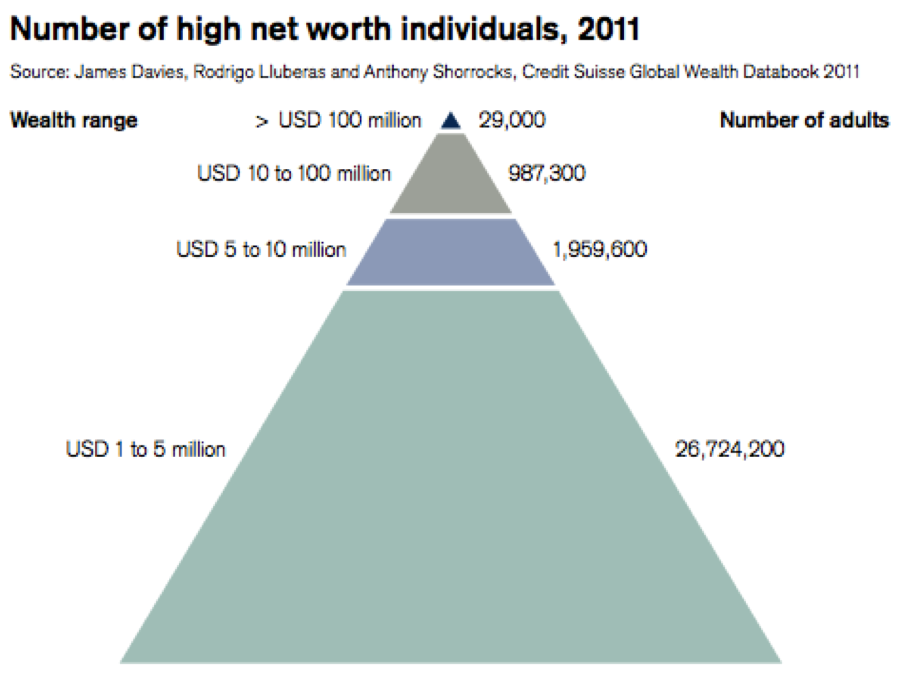
Wealth disparity pyramid

I wish this diagram would draw the rest of the picture, i.e., the enormous block holding up the rest of the pyramid, but this is a powerful visual in any event:


From TJN via Richard Murphy.


Tuesday, July 31, 2012

About that $21-32 Trillion Hidden Offshore

TJN published a report [pdf] earlier this month showing that $21 to $32 trillion is likely hidden offshore.  The OECD scoffed at the number, suggesting that is somehow means that there are thousands of hidden billionaires running around that no one knows anything about:
[Pascal] Saint-Amans [head of the OECD's tax division] suggested the TJN estimates might be overstated. "I was wondering where the equivalent of 450 Bill Gates are hiding from everyone. It looks like the equivalent 20,000 unknown billionaires in the world or 200,000 people with net worth of 100 million," he said. 
Richard Murphy responded by breaking down the likely composition further:
1. [Tier One:] “Oligarch/ politburo/ dictator/ oil sheiks class: Top 100 in the world: 40% of their $4.2 trillion of total financial wealth offshore: average total financial wealth is $42 billion.
2. Tier two: “ordinary billionaires: ”  2900 in the world: 33% of their $4.33 trillion of  total financial wealth is offshore, with an average of $1.5 billion each.
3. Tier three: “ultra high net worth:”  117000 that keep 25% of their $6.8 trillion of total wealth offshore, with an average of $58.1 million each.
4. Tier Four: 9.86 mm  people that keep 20% of their $61.8 trillion of financial wealth offshore, with an average net financial wealth of $6.3 mm
[5.] Tier Five: 59.8 mm people that keep an average of 6% of their $63.4 trillion of financial wealth offshore, with an average net worth of $1.06 mm

Murphy adds " that this much wealth is offshore is not just plausible – it only requires us to make modest assumptions about the proportions of various known types of portfolio that actually exist to think that such level of offshore holding is likely."  He acknowledges in the comments that of course any attempted measure of that which is completely hidden can be nothing more than an estimate.  Of course, governments and banks around the world certainly have the info, and confirmation could be obtained if disclosure was compelled.  But the OECD has not taken the high road on this.  Instead it has supported the veneer of transparency over the systemic support of an international architecture of obscurity.  

Africa's US/UK offshore problem

Complicity with global tax evasion by the US and UK continues to be a big problem for Africa:
When we say offshore centers, when we say secrecy jurisdictions, when we talk about banking secrecy, people may think that these are alien lands, in no-man lands, but actually you will be surprised to know, if you didn’t know—I’m sure you know, but for those who didn’t know, they will be surprised to hear that the biggest offshore centers are in countries like the U.K., in London, the U.S., in New York, Paris in France. These are the biggest offshore centers where you find banks colluding with corrupt leaders, corrupt private investors, in hiding and not disclosing their investments and their bank accounts, because some of it was acquired illegally, was transferred illegally, is held illegally in the sense that it’s not reported to the government.
From RNN via NC.

Monday, July 30, 2012

Keeping it all to himself: Romney versus recent presidents

Check out Romney's income and tax rate versus the last five US presidents:

From flowing data.  Something really is wrong with this picture.  No wonder then that Romney prefers to keep all of his tax info to himself.  Look at Reagan, all the way over to the right by himself.


Olympics tax breaks

McDonald's and Coke won't take corporate tax breaks offered by the UK in connection with the Olympics, after an NGO campaign entitled "Stop the Olympic Tax Dodging."  It's not strictly speaking "tax dodging" to take advantage of an exemption expressly granted by law, but this particular exemption has generated a lot of protest as a wholly unnecessary giveaway on the part of the UK.  Indeed, it is an unnecessary and wasteful giveaway, as sponsorship in the Olympics (aka the World's Longest Commercial Break) is such a hot commodity.

Unbelizable: How to go offshore and disappear

Here is yet another story on how easy it is to set up offshore (especially if you are trying to do so in the USA), accompanied by an infographic:
This is from Planet Money and Adam Davidson has a related column.  Notice that "It's all legal," so this is not about evasion. Really!  It's about protecting your assets from a greedy spouse or undeserving creditors (or is it the other way around).  Of course it's not about evasion.  It's about the ability to say of your investments, "I don't manage them. I don't even know where they are.

From the story:
Right now, the team here at Planet Money are the proud owners of two companies. Unbelizable Inc., in Belize City, and Delawho?, right here in the United States. We have a packet of incorporation documents and a lot of questions about what exactly people do with these kind of companies. Our plan is to find out.
Adam Davidson tries to pin the blame for offshore on overly complex regulations:
One often-overlooked lesson of the financial crisis is that shenanigans don’t happen in the absence of regulation; they happen when regulations are exceedingly complex and involve confusing, overlapping regulatory authorities. 
That is completely disingenuous.  Cheating is not about not overly complex regulations.  It is purely and simply about a desire and willingness to cheat plus an ability to get away with it.  Once again, I have to quote Charlie Kingson: When a large corporation says it wants simplicity, it wants money."  The Great American Jobs Act Caper, 58 Tax Law Rev. 327 (2005).

Tim W-thanks for the link.


Greek islands tax evasion rates: 60-100%

This story reports that in resorts on a number of the Greek islands including Crete, the rate of tax evasion is 100% or nearly so.  I'm not sure it's properly called evasion if there is apparently zero enforcement.  That's not a bug, that's the system?

Sunday, July 15, 2012

Americans don't holiday, update

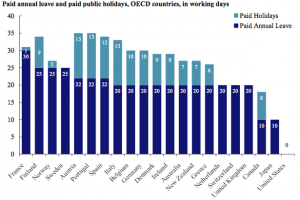
Remember that Americans don't take vacations because they are collaborating in their own self-destruction; here is some new data from the OECD to confirm:

Link from Opinio Juris.  That pitiful blank spot on the far right is the US.  You can see the original chart and much more in a paper entitled "NoVacation Nation" by Rebecca Ray and John Schmitt [pdf].  Some highlights:

[W]orkers in the United States are less likely to receive paid annual leave and paid public holidays, and those U.S. workers that do receive paid time off generally receive far less than their counterparts in comparable economies.
... The United States is the only advanced economy in the world that does not guarantee its workers paid leave. 
...In all countries many employers offer, usually as a result of collective agreements, public holiday entitlements over and above statutory minima.  ... in the United States, almost one in four workers there has no paid leave and no paid public holidays at all.
...lower wage workers are less likely to have any paid leave (69%) than higher-wage workers (88%); part-timers (36%) far less likely to have paid leave than full-timers (90%); and workers in small establishments (70%) are less likely to have paid leave than those in medium and large establishments (86%).
For low wage, part time, and small business workers in America, life is a relentless grind.  NC had a post recently by Alternet's Lynn Parramore on "Pain and Bondage in the US Workplace," which uses the recent fascination with Fifty Shades of Grey to describe how Americans, so exercised about freedom, willingly submit to increasing repression when it comes to contracting out their labor:
Americans are supposed to be people who love freedom above everything else. But where is the citizen less free than in the typical workplace? Workers are denied bathroom breaks. They cannot leave to care for a sick child. Downtime and vacations are a joke. Some – just ask who picked your tomatoes – have been reduced to slave-like conditions. In the current climate of more than three years of unemployment over 8 percent, the longest stretch since the Great Depression, the worker has little choice but to submit. And pretend to like it.
Parramore recalls the 60s, when unions and progressive national policies tempered repression in the workplace, but as we know most of that came to a screeching halt with the Reagan election.  Three decades later plenty of Americans who have suffered the stagnant wages and stripped benefits that characterize life in the contemporary American workforce continue to support the policies and politicians that ensure and increase their submission, while reviling both unions and federal regulatory policy as assaults on freedom.  That is perplexing.


Saturday, July 14, 2012

US continues campaign against EU airline tax

The US will host a meeting in order to "pil[e] further pressure on the EU to back down and the international community to find a global solution..." to greenhouse gas emissions.  From Reuters.  "Finding a global solution" is of course a euphemism for "doing nothing."  That's because of course the EU tax is a step toward a global solution, and it would be effectively global if the US adopted it.  Instead, the plan here is to gather officials from similarly opposing countries including India and China--a "coalition of the unwilling"--to agree to retaliatory measures against the EU.  Behind every diplomatic effort is a lobbyist:
Airlines will not have to pay for the permits until next year, and are pressing their governments to agree on a global deal before then.   
Russ Bailey, a senior attorney for the Air Line Pilots Association, a U.S. lobby group, said time is running out for EU ETS opponents to come up with a viable alternative. 
"There is a sense of urgency because airlines have to start paying next April. We hope there will be a resolution that becomes clear enough before then," he told Reuters Point Carbon."  
I doubt that Bailey has in mind a resolution that every country will adopt the EU system, even though that would be crystal clear as far as resolutions go.  The global deal sought here is reversion to the status quo, of that there can be little doubt.  

Wednesday, July 11, 2012

Taming FATCA

For US persons living abroad, living their lives means having foreign bank accounts.  Regimes like FATCA and FBAR are particularly harsh for these persons, many or perhaps most of whom are either dual citizens themselves or are in families with dual and multiple citizenships.  While it seems clear to me that the US can impose its sovereign jurisdiction with regimes like FATCA and FBAR, it's less clear to me that it should do so, especially with a one-size-fits-all approach that appears to treat everyone with a foreign bank account as a potential tax criminal.  The question is whether and how these regimes can be tamed so that they fulfill the core mission--catching tax cheats--without becoming a Team America: World Tax Police, bypassing bilateral and multilateral cooperation among governments in order to impose draconian US rules on individuals and financial institutions across the globe 


In my latest Tax Notes International column, "Could a Same-Country Exception Help Focus FATCA and FBAR?" [pdf], I discuss some of the political and practical issues of relaxing the reporting rules for Americans living abroad with respect to accounts they hold in their country of residence.  This is not a comprehensive technical proposal but rather a broad look at the pragmatic and political reasons why the US really ought to back off on exercising its tax sovereignty when it comes to its citizens living abroad. I argue that FATCA and FBAR are either a rather nasty piece of arm-twisting, a bit of bad faith in
the U.S. diplomatic relations department, or, worse, they are signaling a loss of faith in the pursuit of cooperation through diplomacy.  I suggest that carving out an exception for US persons who are using bank accounts to live their lives as residents and often dual citizens abroad could provide a means of backing away from either of these destructive positions.